VISIT CONTINENTS
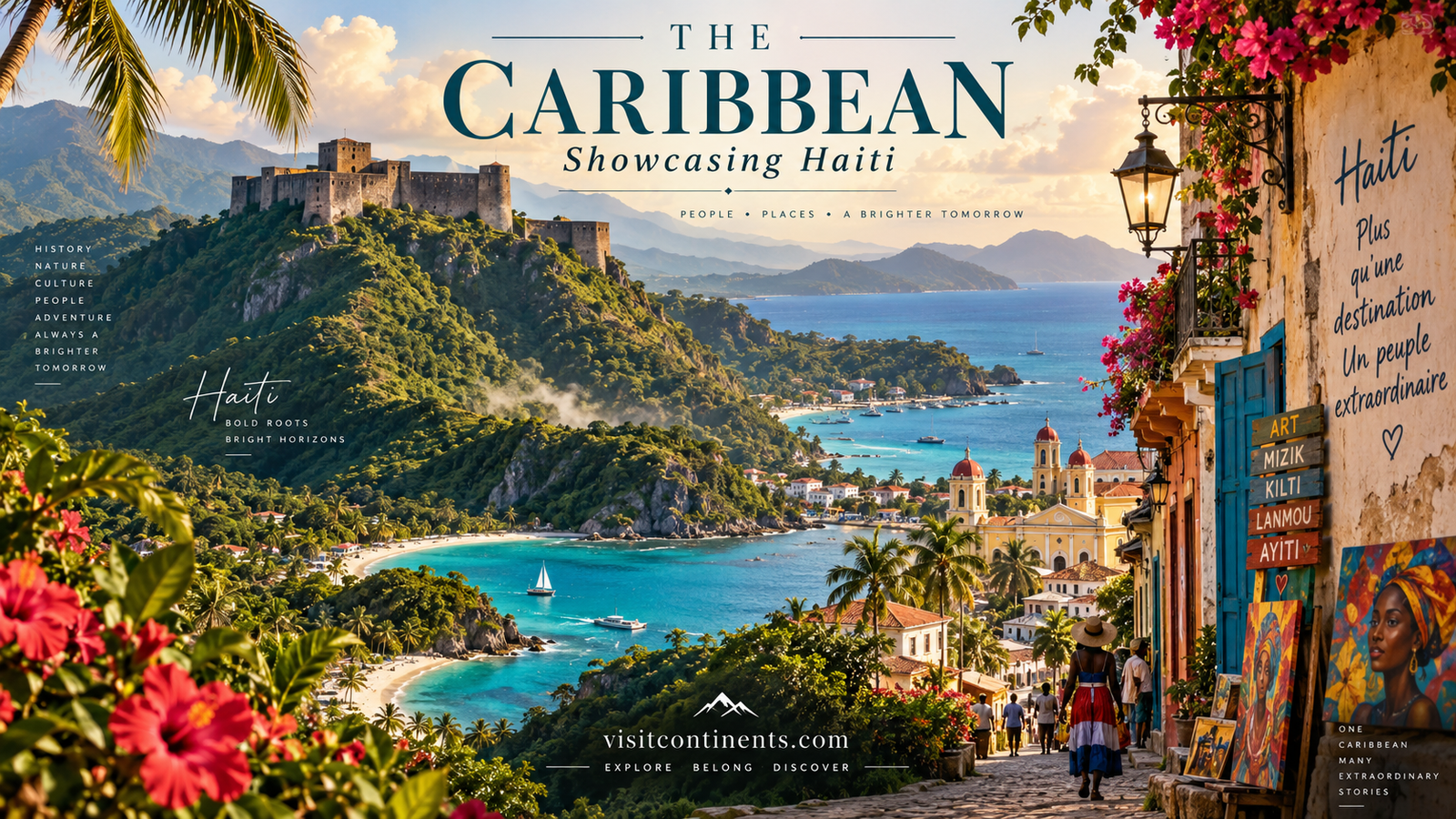

CARIBBEAN TRAVEL GUIDE | COUNTRIES • ISLANDS • BEACHES • CULTURES • ADVENTURE
The Caribbean is one of the world’s most extraordinary travel regions, celebrated for its turquoise waters, white-sand beaches, tropical islands, vibrant cultures, historic cities, and remarkable natural landscapes.
From the mountain ranges and waterfalls of Jamaica to the historic streets of Havana, the magnificent beaches of the Dominican Republic, the colorful architecture of Curaçao, and the lush tropical landscapes of Saint Lucia, the Caribbean offers an incredible variety of destinations to explore.
The region is more than a collection of beautiful beaches. It is home to diverse communities, Indigenous heritage, African cultural influences, European colonial histories, distinct languages, traditional music, remarkable cuisines, and centuries of maritime trade and cultural exchange.
Travelers can explore ancient fortresses, hike through tropical rainforests, snorkel above coral reefs, discover volcanic mountains, experience lively cultural festivals, and enjoy traditional Caribbean hospitality.
Although the Caribbean is frequently associated with island vacations, its geography and political organization are more complex. The region includes 13 sovereign island countries, numerous territories, and, under broader geographical definitions, mainland coastal areas connected to the Caribbean Sea.
In this comprehensive Visit Continents guide, discover the Caribbean’s 13 independent countries, their capital cities, the region’s territories, famous islands, remarkable natural attractions, cultural traditions, popular travel destinations, and essential information for planning your next Caribbean adventure.
1. Discover the Caribbean: A Region of Islands, Oceans, and Cultures


4
The Caribbean is a geographical and cultural region located primarily between North America and South America.
It is centered on the Caribbean Sea and includes island groups that form an arc from the southeastern Gulf of Mexico toward the northern coast of South America.
The islands are traditionally divided into the Greater Antilles, the Lesser Antilles, and the Lucayan Archipelago.
The region encompasses volcanic islands, limestone formations, coral reefs, coastal plains, tropical forests, wetlands, and mountain ranges.
Its climate is generally tropical, although temperatures, rainfall, elevation, and seasonal conditions vary significantly from one destination to another.
The Caribbean at a glance
| Geographical region | Caribbean |
| Continent | North America |
| Independent island countries | 13 |
| Other jurisdictions | Numerous overseas territories and other non-sovereign areas |
| Principal sea | Caribbean Sea |
| Surrounding ocean | Atlantic Ocean |
| Climate | Predominantly tropical |
| Widely used languages | English, Spanish, French, Dutch, Haitian Creole, and other Creole and indigenous languages |
| Common travel experiences | Beach holidays, historical tours, cultural festivals, hiking, snorkeling, diving, and sailing |
Is the Caribbean a continent?
No. The Caribbean is a geographical and cultural region within North America in the commonly used seven-continent model.
It is not considered an eighth continent.
However, its distinctive geography, history, languages, and cultural identity make it an important travel region in its own right.
Is the Caribbean the same as the West Indies?
The terms Caribbean and West Indies are often used interchangeably when referring to the islands of the region.
However, their geographical and historical meanings can differ depending on context.
The West Indies traditionally encompasses the Greater Antilles, Lesser Antilles, and Lucayan Archipelago, while broader definitions of the Caribbean may also include mainland countries and coastal territories with strong geographical, historical, and cultural connections to the Caribbean Sea.
2. How Many Countries Are in the Caribbean?

The Caribbean contains 13 sovereign island countries under the commonly used geographical classification.
These countries differ significantly in size, population, language, political systems, cultural traditions, and natural landscapes.
The Dominican Republic and Haiti share the island of Hispaniola, while Cuba is the Caribbean’s largest island by land area.
Several smaller independent states are located in the eastern Caribbean, including Saint Lucia, Dominica, Grenada, Antigua and Barbuda, and Saint Vincent and the Grenadines.
The Bahamas lies in the Atlantic Ocean rather than the Caribbean Sea itself but is geographically and culturally included within the Caribbean region.
The complete list of the 13 independent Caribbean countries
| No. | Country | Capital city |
| 1 | Antigua and Barbuda | St. John’s |
| 2 | Bahamas | Nassau |
| 3 | Barbados | Bridgetown |
| 4 | Cuba | Havana |
| 5 | Dominica | Roseau |
| 6 | Dominican Republic | Santo Domingo |
| 7 | Grenada | St. George’s |
| 8 | Haiti | Port-au-Prince |
| 9 | Jamaica | Kingston |
| 10 | Saint Kitts and Nevis | Basseterre |
| 11 | Saint Lucia | Castries |
| 12 | Saint Vincent and the Grenadines | Kingstown |
| 13 | Trinidad and Tobago | Port of Spain |
The 13-country count refers specifically to sovereign island countries. Broader political, cultural, and economic definitions of the Caribbean also include mainland countries such as Belize, Guyana, and Suriname, as well as other coastal nations and territories.
3. Explore the 13 Independent Countries of the Caribbean
Every Caribbean country has its own identity, history, traditions, landscapes, and attractions. Some are known for spectacular beaches and offshore reefs, while others are recognized for tropical mountains, historic architecture, music, cultural festivals, and dramatic volcanic scenery.
The following guide introduces all 13 independent Caribbean countries and highlights experiences that make each destination distinctive.
1. Antigua and Barbuda


5
Eastern Caribbean
Capital: St. John’s
Official language: English
Currency: Eastern Caribbean dollar (XCD)
Antigua and Barbuda is a twin-island nation in the eastern Caribbean, recognized for its beautiful beaches, sheltered harbours, coral reefs, and maritime heritage.
Antigua is the more populous island and contains the national capital, St. John’s. Barbuda is known for its relatively undeveloped coastal landscapes, sandy beaches, and important bird habitats.
One of Antigua’s most famous attractions is Nelson’s Dockyard, a restored historic naval dockyard located within English Harbour.
Visitors can explore colonial-era buildings, museums, marinas, and scenic viewpoints overlooking the harbour.
Antigua also offers sailing excursions, snorkeling, beach activities, and opportunities to experience local cuisine and cultural festivals.
Barbuda’s extensive beaches and natural landscapes appeal to travelers interested in quieter coastal experiences, although accommodation and transportation options are more limited than on Antigua.
Suggested stay: 4–7 days.
Travel highlights: Nelson’s Dockyard, English Harbour, Dickenson Bay, Shirley Heights, Barbuda’s beaches, sailing, and marine excursions.
2. The Bahamas


6
Lucayan Archipelago
Capital: Nassau
Official language: English
Currency: Bahamian dollar (BSD)
The Bahamas is an archipelagic country located in the Atlantic Ocean, southeast of Florida and north of Cuba.
Although its islands lie outside the Caribbean Sea, The Bahamas is geographically and culturally included within the wider Caribbean region.
The country consists of approximately 700 islands and more than 2,000 cays and rocks, with a relatively small number of islands supporting most of its population.
The Bahamas is internationally recognized for its clear turquoise waters, white- and pink-sand beaches, coral reefs, and extensive marine environments.
Nassau, located on New Providence Island, is the national capital and a major center of tourism, commerce, and cultural activity.
Visitors can explore historic architecture, local markets, museums, and coastal attractions.
The Exuma islands are renowned for their spectacular waters and marine excursions, while Harbour Island is famous for its pink-sand beach.
Grand Bahama and several of the Out Islands offer additional opportunities for snorkeling, diving, fishing, nature exploration, and more relaxed island experiences.
Bahamian culture includes the vibrant Junkanoo festival, traditional music, distinctive crafts, and regional cuisine.
Suggested stay: 5–7 days for one or two islands.
Travel highlights: Nassau, Exuma, Harbour Island, Grand Bahama, marine wildlife, snorkeling, diving, and Junkanoo cultural experiences.
3. Barbados


6
Eastern Caribbean
Capital: Bridgetown
Official language: English
Currency: Barbadian dollar (BBD)
Barbados is an island nation located east of the main arc of the Lesser Antilles, where the Caribbean region meets the Atlantic Ocean.
The country is famous for its beaches, historic architecture, cultural festivals, music, and vibrant culinary traditions.
Bridgetown, the national capital, contains important historic buildings, markets, museums, and a waterfront associated with the island’s maritime history.
The Historic Bridgetown and its Garrison area are recognized for their significance to the island’s colonial history and architectural heritage.
Along the western and southern coasts, travelers can discover sandy beaches and marine environments suitable for various recreational activities.
The eastern coast features more dramatic Atlantic scenery, including the striking rock formations and powerful surf at Bathsheba.
Barbados is also famous for Crop Over, a major cultural festival celebrating the island’s heritage through music, dance, art, and public events.
Visitors can explore Harrison’s Cave, discover historic plantation landscapes, enjoy local cuisine, and learn about the island’s cultural history.
Suggested stay: 5–7 days.
Travel highlights: Bridgetown, Bathsheba, Harrison’s Cave, coastal beaches, Crop Over, cultural heritage, and local cuisine.
4. Cuba


4
Greater Antilles
Capital: Havana
Official language: Spanish
Currency: Cuban peso (CUP)
Cuba is the largest island in the Caribbean and one of the region’s most historically and culturally distinctive countries.
Located south of Florida and east of Mexico’s Yucatán Peninsula, Cuba features historic cities, mountain ranges, tropical forests, agricultural valleys, coral reefs, and extensive coastlines.
Havana is famous for its colorful architecture, historic squares, vintage automobiles, waterfront promenade, and rich musical heritage.
Old Havana contains important examples of colonial-era architecture and historic urban design.
Travelers interested in Cuban history and culture can explore museums, art galleries, traditional music venues, and historic neighbourhoods.
Trinidad, in central Cuba, is recognized for its well-preserved historic center and colorful streets.
The Viñales Valley offers dramatic limestone formations, agricultural landscapes, and opportunities to learn about traditional farming practices.
Cuba is also internationally associated with musical traditions such as son cubano, rumba, and salsa, alongside a rich literary and artistic heritage.
Travelers should research current entry regulations, payment arrangements, transportation availability, and any restrictions associated with their nationality before planning a visit.
Suggested stay: 7–14 days.
Travel highlights: Havana, Trinidad, Viñales Valley, Varadero, colonial architecture, traditional music, and cultural exploration.
5. Dominica


7
Lesser Antilles
Capital: Roseau
Official language: English
Currency: Eastern Caribbean dollar (XCD)
Dominica, officially the Commonwealth of Dominica, is a mountainous island nation in the eastern Caribbean.
It should not be confused with the Dominican Republic, which is a separate and much larger country located on the island of Hispaniola.
Dominica is often known as the Nature Island of the Caribbean because of its dense tropical forests, waterfalls, volcanic landscapes, rivers, and mountainous interior.
Morne Trois Pitons National Park is an important protected area containing geothermal features, forest ecosystems, lakes, and dramatic natural scenery.
One of the island’s most remarkable attractions is Boiling Lake, a geothermal lake accessible through a challenging hiking route.
Visitors can also explore Trafalgar Falls, Emerald Pool, coastal communities, and designated marine environments.
Dominica is home to the Kalinago Territory, where members of the Indigenous Kalinago community maintain cultural traditions and share aspects of their heritage through locally organized experiences.
The island offers a different kind of Caribbean holiday, particularly for travelers interested in hiking, natural environments, and cultural exploration rather than large-scale resort tourism.
Suggested stay: 5–8 days.
Travel highlights: Morne Trois Pitons National Park, Boiling Lake, Trafalgar Falls, Emerald Pool, Kalinago cultural heritage, hiking, and marine excursions.
6. Dominican Republic


6
Greater Antilles
Capital: Santo Domingo
Official language: Spanish
Currency: Dominican peso (DOP)
The Dominican Republic occupies the eastern portion of Hispaniola, sharing the island with Haiti.
It is one of the Caribbean’s most popular international tourism destinations, recognized for its extensive beaches, tropical mountain ranges, historic cities, and distinctive cultural traditions.
Santo Domingo, the capital, is among the oldest continuously inhabited European-founded cities in the Americas.
Its Colonial City contains historic churches, public squares, fortifications, and important architectural landmarks associated with the early colonial period.
Punta Cana is internationally recognized for its beaches, coastal resorts, and recreational activities.
The Samaná Peninsula offers tropical landscapes, beaches, waterfalls, and seasonal opportunities for whale watching.
In the country’s interior, the Cordillera Central mountain range contains Pico Duarte, the highest mountain in the Caribbean.
The Dominican Republic is also famous for merengue and bachata, musical traditions that have gained international audiences.
Visitors can enjoy regional cuisine, explore historical landmarks, hike through mountain landscapes, and experience coastal and urban cultural life.
Suggested stay: 7–10 days.
Travel highlights: Santo Domingo, Punta Cana, Samaná, Pico Duarte, Puerto Plata, merengue, bachata, and historic colonial architecture.
7. Grenada


7
Lesser Antilles
Capital: St. George’s
Official language: English
Currency: Eastern Caribbean dollar (XCD)
Grenada is an island nation in the southeastern Caribbean, known for its tropical landscapes, beautiful beaches, aromatic spices, and historic coastal settlements.
The country consists of the main island of Grenada and smaller islands, including Carriacou and Petite Martinique.
Grenada is frequently called the Spice Island because of its historical and contemporary production of nutmeg, mace, cinnamon, cloves, and other spices.
St. George’s, the national capital, is recognized for its picturesque harbour, colorful hillside buildings, and historic fortifications.
Grand Anse Beach is among the island’s most popular coastal destinations, offering a long stretch of white sand and clear water.
Visitors can also explore tropical forests, waterfalls, spice-producing estates, and protected marine environments.
The Underwater Sculpture Park near Moliniere provides a distinctive opportunity to observe submerged artwork and marine life through appropriate snorkeling or diving excursions.
Suggested stay: 4–7 days.
Travel highlights: St. George’s, Grand Anse Beach, spice estates, waterfalls, underwater sculpture sites, and island excursions.
8. Haiti


5
Greater Antilles
Capital: Port-au-Prince
Official languages: Haitian Creole and French
Currency: Haitian gourde (HTG)
Haiti occupies the western portion of Hispaniola and shares the island with the Dominican Republic.
The country has a remarkable history, rich cultural traditions, striking mountain landscapes, tropical beaches, and an artistic heritage that has influenced the wider Caribbean and the African diaspora.
Haiti became independent on January 1, 1804, following the Haitian Revolution. It became the first independent Black republic and the first nation established through a successful revolt by enslaved people.
This history remains central to Haiti’s national identity and its contribution to the history of freedom and independence in the Americas.
Explore Haiti’s historical landmarks

The Citadelle Laferrière, located in northern Haiti, is one of the Caribbean’s most extraordinary historical monuments.
Built in the early nineteenth century, the fortress stands on a mountaintop overlooking the surrounding landscape.
Together with the Sans-Souci Palace and the buildings at Ramiers, it forms part of a UNESCO World Heritage property associated with Haiti’s independence.
The historic city of Cap-Haïtien and surrounding northern region also contain important architectural and cultural landmarks.
Discover Haiti’s natural beauty and culture
Haiti features mountain ranges, forested environments, waterfalls, caves, and coastal scenery.
Jacmel is recognized for its artistic heritage, historic architecture, and traditions associated with carnival and papier-mâché craftsmanship.
Haitian culture is also internationally known for its music, including konpa and rara, as well as distinctive cuisine, painting, literature, and religious traditions.
Popular Haitian dishes include griot, diri kole ak pwa, soup joumou, and various regional preparations of seafood, vegetables, and root crops.
Haiti’s attractions and cultural heritage are substantial, but serious security and humanitarian conditions currently make ordinary tourism difficult and potentially dangerous. Travelers should consult up-to-date official advisories rather than assume that historic or natural attractions are accessible.
Suggested stay: Dependent on future improvements in travel conditions and safe access.
Travel highlights: Citadelle Laferrière, Sans-Souci Palace, Cap-Haïtien, Jacmel, Haitian music, traditional cuisine, and cultural heritage.
9. Jamaica


4
Greater Antilles
Capital: Kingston
Official language: English
Currency: Jamaican dollar (JMD)
Jamaica is one of the Caribbean’s most internationally recognized countries, famous for its reggae music, beautiful beaches, tropical mountains, waterfalls, and cultural heritage.
The island lies south of Cuba and west of Hispaniola.
Kingston, the national capital, is an important cultural and economic center.
The city is closely associated with the development of reggae music and the legacy of Bob Marley.
Visitors can explore museums, art galleries, historic locations, and cultural institutions celebrating Jamaica’s contributions to music, literature, sports, and the arts.
Montego Bay and Negril are well-known coastal destinations offering beaches, accommodation, restaurants, and recreational activities.
Ocho Rios is famous for Dunn’s River Falls, where visitors can experience a spectacular series of cascading waterfalls through authorized activities.
The Blue Mountains provide a different perspective on Jamaica, with forested landscapes, hiking opportunities, and coffee-growing regions.
Jamaican cuisine includes jerk chicken, ackee and saltfish, rice and peas, patties, and numerous regional specialties.
Suggested stay: 5–10 days.
Travel highlights: Kingston, Montego Bay, Negril, Dunn’s River Falls, the Blue Mountains, reggae music, and Jamaican cuisine.
10. Saint Kitts and Nevis


7
Lesser Antilles
Capital: Basseterre
Official language: English
Currency: Eastern Caribbean dollar (XCD)
Saint Kitts and Nevis is a two-island nation in the eastern Caribbean, recognized for its volcanic landscapes, tropical vegetation, historic landmarks, and attractive coastlines.
Saint Kitts is the larger and more populous island, while Nevis is known for its mountainous scenery and relatively quiet atmosphere.
Basseterre, located on Saint Kitts, is the national capital and contains historic buildings, markets, public squares, and waterfront attractions.
One of the country’s most important historical landmarks is Brimstone Hill Fortress National Park.
The fortress is recognized for its military architecture and historical importance during the colonial period.
Nevis features beautiful beaches, historic plantation buildings, and Mount Nevis, a volcanic peak rising above the island.
Visitors can explore the islands through guided tours, hiking, coastal excursions, and cultural activities.
Suggested stay: 4–6 days.
Travel highlights: Basseterre, Brimstone Hill Fortress, Mount Nevis, historic plantations, beaches, and island exploration.
11. Saint Lucia


8
Lesser Antilles
Capital: Castries
Official language: English
Currency: Eastern Caribbean dollar (XCD)
Saint Lucia is one of the Caribbean’s most visually distinctive islands, celebrated for its dramatic volcanic mountains, tropical rainforests, beaches, and picturesque coastal communities.
The island’s most famous natural landmarks are the Pitons, two steep volcanic formations rising above the southwestern coastline.
Gros Piton and Petit Piton create one of the Caribbean’s most recognizable landscapes.
The nearby town of Soufrière serves as a gateway to natural attractions, including Sulphur Springs, waterfalls, botanical gardens, and scenic coastal areas.
Visitors can participate in guided hiking excursions, explore tropical forests, enjoy marine activities, and learn about the island’s cultural traditions.
Castries, the capital, offers markets, historic sites, and urban cultural experiences.
Saint Lucia’s heritage reflects African, French, British, and Indigenous historical influences, expressed through its language, cuisine, music, and festivals.
Suggested stay: 5–7 days.
Travel highlights: Gros Piton, Petit Piton, Soufrière, Sulphur Springs, Pigeon Island, tropical forests, and coastal excursions.
12. Saint Vincent and the Grenadines


4
Lesser Antilles
Capital: Kingstown
Official language: English
Currency: Eastern Caribbean dollar (XCD)
Saint Vincent and the Grenadines is an island nation consisting of the main island of Saint Vincent and a chain of smaller islands extending southward through the eastern Caribbean.
The country is famous for its sailing destinations, tropical landscapes, marine environments, and remarkable island scenery.
Saint Vincent contains mountainous terrain, tropical forests, waterfalls, and La Soufrière, an active volcano.
Kingstown, the national capital, offers markets, historic architecture, botanical gardens, and access to the island’s cultural attractions.
The Grenadines include destinations such as Bequia, Canouan, Mayreau, Union Island, and Mustique.
The Tobago Cays Marine Park is internationally recognized for its beautiful turquoise waters, coral reefs, sandy beaches, and opportunities for marine wildlife observation.
The country offers opportunities for sailing, snorkeling, hiking, cultural exploration, and visits to smaller island communities.
Suggested stay: 7–10 days, particularly when exploring several islands.
Travel highlights: Kingstown, Bequia, Tobago Cays, La Soufrière, island sailing, snorkeling, and marine conservation areas.
13. Trinidad and Tobago


4
Southern Caribbean
Capital: Port of Spain
Official language: English
Currency: Trinidad and Tobago dollar (TTD)
Trinidad and Tobago is a twin-island country located near the northeastern coast of South America.
The two main islands offer different but complementary travel experiences.
Trinidad is the larger and more populous island, recognized for its cultural festivals, music, culinary diversity, wetlands, forests, and urban centers.
Tobago is particularly known for its beaches, coral reefs, rainforest landscapes, and coastal villages.
Port of Spain, the national capital, is famous for Trinidad Carnival, one of the Caribbean’s most celebrated cultural events.
The country is also closely associated with the development of calypso, soca, and steelpan music.
Visitors to Trinidad can explore Maracas Bay, the Northern Range, Caroni Swamp, and local cultural attractions.
Tobago offers destinations such as Pigeon Point, Buccoo Reef, and the Main Ridge Forest Reserve.
The country’s cultural heritage reflects African, Indian, European, Indigenous, Chinese, and Middle Eastern influences, visible in its festivals, food, music, and everyday life.
Suggested stay: 7–10 days to explore both Trinidad and Tobago.
Travel highlights: Trinidad Carnival, Port of Spain, Maracas Bay, Caroni Swamp, Pigeon Point, Buccoo Reef, and Tobago’s rainforests.
4. Caribbean Territories and Other Important Island Destinations


4
In addition to its 13 independent island countries, the Caribbean contains numerous territories and other non-sovereign jurisdictions.
These destinations have their own cultures, languages, governments, and tourism attractions, but they are not independent countries.
Some maintain constitutional relationships with the United States, United Kingdom, France, or the Kingdom of the Netherlands.
Understanding these distinctions is important when planning travel, particularly because passport, visa, currency, and entry requirements can differ between nearby islands.
Major Caribbean territories and jurisdictions
| Destination | Political status or affiliation |
|---|---|
| Puerto Rico | Unincorporated territory of the United States |
| U.S. Virgin Islands | Unincorporated territory of the United States |
| British Virgin Islands | British Overseas Territory |
| Cayman Islands | British Overseas Territory |
| Turks and Caicos Islands | British Overseas Territory |
| Anguilla | British Overseas Territory |
| Montserrat | British Overseas Territory |
| Aruba | Constituent country within the Kingdom of the Netherlands |
| Curaçao | Constituent country within the Kingdom of the Netherlands |
| Sint Maarten | Constituent country within the Kingdom of the Netherlands |
| Bonaire | Special municipality of the Netherlands |
| Sint Eustatius | Special municipality of the Netherlands |
| Saba | Special municipality of the Netherlands |
| Guadeloupe | Overseas department and region of France |
| Martinique | Overseas department and region of France |
| Saint Barthélemy | Overseas collectivity of France |
| Saint Martin | Overseas collectivity of France |
The terms country and territory have different constitutional meanings across these jurisdictions. Aruba, Curaçao, and Sint Maarten, for example, are constituent countries within the Kingdom of the Netherlands, but they are not independent sovereign states.
Puerto Rico: Discover the Beauty of the Spanish Caribbean

Puerto Rico is one of the Caribbean’s major travel destinations, known for its historic cities, tropical rainforests, beautiful beaches, and rich cultural heritage.
San Juan, its capital, contains historic fortifications, colorful colonial architecture, museums, restaurants, and lively public spaces.
El Yunque National Forest is recognized for its tropical rainforest landscapes, waterfalls, and biodiversity.
The islands of Vieques and Culebra offer additional opportunities for beach exploration, snorkeling, and nature-based activities.
Puerto Rican culture includes distinctive musical traditions, cuisine, literature, and celebrations reflecting the island’s Indigenous, African, Spanish, and other historical influences.
Aruba: A Caribbean Island of Beaches and Desert Landscapes

Aruba is located in the southern Caribbean near Venezuela.
It is known for its beaches, relatively dry climate, coastal resorts, and distinctive desert-like landscapes.
Eagle Beach and Palm Beach are among the island’s most recognizable coastal destinations.
Arikok National Park contains rocky hills, caves, natural landscapes, and historic cultural sites.
Oranjestad, Aruba’s capital, features colorful architecture, museums, shopping areas, and waterfront attractions.
Curaçao: Colorful Architecture and Marine Adventures

Curaçao is famous for its colorful waterfront architecture, coral reefs, sheltered beaches, and multicultural heritage.
Willemstad, its capital, is recognized for its distinctive historic buildings and urban landscape.
Visitors can explore museums, historic neighborhoods, coastal coves, and marine environments.
The island is also known for its diving and snorkeling opportunities, with numerous coastal sites offering access to tropical marine ecosystems.
Turks and Caicos Islands: Spectacular Beaches and Turquoise Water

The Turks and Caicos Islands are located southeast of The Bahamas and north of Hispaniola.
The destination is internationally recognized for its beautiful beaches, clear waters, coral reefs, and coastal resorts.
Grace Bay Beach, on Providenciales, is one of its most famous attractions.
Visitors can enjoy snorkeling, diving, marine excursions, kayaking, and coastal sightseeing.
The islands also contain important marine conservation areas and habitats for migratory birds and other wildlife.
5. The Caribbean’s Major Island Groups

The Caribbean islands are commonly divided into three major geographical groups.
These divisions help travelers understand the region’s geography and plan journeys between neighboring destinations.
The Greater Antilles
The Greater Antilles consist of the Caribbean’s four largest islands: Cuba, Hispaniola, Jamaica, and Puerto Rico, along with smaller neighboring islands.
Hispaniola is shared by Haiti and the Dominican Republic.
The Greater Antilles contain extensive mountain ranges, major cities, historic settlements, agricultural regions, and diverse natural environments.
Because these islands are relatively large, traveling within individual countries can require substantial time.
The Lesser Antilles
The Lesser Antilles form an arc of smaller islands extending from the Virgin Islands southward toward the coast of South America.
They include sovereign countries such as Antigua and Barbuda, Dominica, Grenada, Saint Lucia, and Saint Vincent and the Grenadines, along with several territories.
Many of these islands are volcanic and contain mountainous interiors, rainforests, beaches, and coral reefs.
Some of the southeastern Caribbean islands, including Barbados and Trinidad and Tobago, are also included in the wider Lesser Antilles grouping.
The Lucayan Archipelago
The Lucayan Archipelago includes The Bahamas and the Turks and Caicos Islands.
These islands are located in the Atlantic Ocean, north of the Greater Antilles.
They are known for their low-lying limestone landscapes, coral reefs, marine environments, and spectacular turquoise waters.
Although geographically outside the Caribbean Sea, they are commonly included in the Caribbean region.
6. The Most Beautiful Natural Attractions in the Caribbean


4
The Caribbean contains remarkable natural landscapes extending far beyond its famous beaches.
Its islands feature rainforests, mountains, waterfalls, caves, volcanic formations, coral reefs, wetlands, and extensive marine habitats.
The following destinations illustrate the region’s geographical diversity.

The Pitons, Saint Lucia
These dramatic volcanic formations rise above the southwestern coast of Saint Lucia and create one of the region’s most recognizable landscapes.

Dunn’s River Falls, Jamaica
A spectacular series of cascading waterfalls surrounded by tropical vegetation near Ocho Rios.

Boiling Lake, Dominica
An extraordinary geothermal lake within Morne Trois Pitons National Park, accessible through a challenging hiking route.

Exuma Islands, The Bahamas
A beautiful island chain recognized for its clear waters, sandbars, marine environments, and spectacular coastal scenery.

Viñales Valley, Cuba
A distinctive landscape of limestone hills, agricultural fields, caves, and historic rural communities.

Samaná Peninsula, Dominican Republic
A tropical region containing beautiful beaches, waterfalls, coastal mountains, and seasonal whale-watching opportunities.
7. Caribbean Culture, Music, Festivals, and Languages


7
The Caribbean’s cultural identity has developed through centuries of interaction among Indigenous peoples, Africans, Europeans, Asians, and other communities.
The region’s history includes Indigenous civilizations, European colonization, the transatlantic slave trade, emancipation, migration, independence movements, and the development of contemporary Caribbean societies.
These experiences have shaped distinct national cultures expressed through music, dance, cuisine, literature, visual arts, religion, language, and community traditions.
Caribbean languages
The Caribbean is a multilingual region.
Spanish is widely spoken in Cuba, the Dominican Republic, and Puerto Rico.
English is an official language in several independent Caribbean countries, including Jamaica, Barbados, Trinidad and Tobago, and The Bahamas.
French and French-based Creole languages are spoken in various destinations, including Haiti, Martinique, and Guadeloupe.
Haitian Creole is one of Haiti’s two official languages, alongside French, and is spoken by the overwhelming majority of its population.
Dutch, Papiamentu, and other languages are used in parts of the Dutch Caribbean.
Many Caribbean countries also have distinctive English-based or French-based Creole languages that form important parts of their cultural identities.
Caribbean music

The Caribbean has made substantial contributions to international music.
Jamaica is associated with reggae, ska, dancehall, and other musical traditions.
Trinidad and Tobago played a central role in the development of calypso, soca, and steelpan music.
Haiti is internationally recognized for konpa, rara, and other distinctive musical forms.
The Dominican Republic is associated with merengue and bachata, while Cuba has contributed important traditions including son cubano, rumba, mambo, and salsa.
Music is central to many Caribbean festivals, celebrations, and cultural gatherings.
Caribbean Carnival
Carnival is one of the region’s most recognizable cultural traditions, although celebrations differ considerably by destination.
Trinidad Carnival is famous for its elaborate costumes, soca and calypso music, street parades, and traditional cultural performances.
Haiti’s carnival celebrations include distinctive music, artistic traditions, and regional cultural expressions.
Other Caribbean countries celebrate Carnival or related festivals at different times of the year.
Travelers interested in attending a major festival should research the specific destination’s calendar, as events do not all occur on the same dates.
8. Caribbean Food: Discover the Flavors of the Islands


5
Caribbean cuisine reflects the region’s diverse agricultural environments, maritime traditions, Indigenous food knowledge, and historical cultural connections.
Local dishes differ significantly between countries and even among communities within the same island.
The region’s food traditions include fresh seafood, tropical fruits, rice, beans, cassava, plantains, root vegetables, spices, and a wide variety of meat and vegetable preparations.
Jamaican cuisine
Jamaica is famous for jerk cooking, a distinctive style of seasoning and preparation.
Other popular dishes include ackee and saltfish, rice and peas, patties, and various regional stews.
Haitian cuisine
Haitian food includes griot, fried plantains, pikliz, diri kole ak pwa, legim, and soup joumou.
Soup joumou has particular cultural significance because of its association with Haiti’s independence and national identity.
Dominican cuisine
Dominican cuisine includes mangú, sancocho, la bandera Dominicana, and numerous rice, bean, meat, seafood, and plantain dishes.
Trinidadian and Tobagonian cuisine
Popular foods include doubles, roti, pelau, callaloo, and bake and shark.
The country’s food traditions reflect its diverse historical and cultural influences.
Barbadian cuisine
Barbados is known for dishes such as cou-cou and flying fish, along with seafood, rice, vegetables, and regional specialties.
Exploring Caribbean cuisine can provide valuable insights into the history, agricultural traditions, and cultural identities of each country.
9. When Is the Best Time to Visit the Caribbean?

The Caribbean generally experiences warm tropical temperatures throughout the year, making it possible to visit many destinations in different seasons.
However, rainfall, humidity, sea conditions, tropical storms, and tourism demand vary considerably by location and time of year.
For much of the Caribbean, December through April is a popular travel period because conditions are often drier and less humid than during the warmer, wetter months.
The Atlantic hurricane season officially runs from June 1 through November 30. Tropical cyclones can occur outside this period, and the risk varies among islands and from year to year.
National Ocean Service
+1
| Travel period | General conditions |
|---|---|
| December–April | Popular tourism season; generally drier weather in many destinations |
| May–June | Warmer conditions, increasing rainfall in some areas, and the beginning of hurricane season |
| July–August | Hot and humid conditions in many destinations; tropical storm risk varies |
| September–October | Often a period of heightened Atlantic hurricane activity |
| November | Transitional weather in many destinations as the hurricane season approaches its end |
These seasonal patterns are broad guidelines rather than guarantees. The southern Caribbean, including Aruba, Curaçao, and Trinidad and Tobago, has different climatic characteristics from the northern Caribbean islands.
Travelers should review destination-specific conditions and current weather forecasts before finalizing their plans.
10. How to Plan a Caribbean Island-Hopping Adventure

One of the most rewarding ways to discover the Caribbean is to visit several nearby islands during the same journey.
However, geographical proximity does not always mean that transportation is straightforward. Two neighboring islands may have limited direct flights, infrequent ferries, or different immigration requirements.
A well-organized itinerary should group destinations with reliable transportation connections and allow enough time to explore each country.
Suggested itinerary: Seven Caribbean countries in 28 days
The following is an illustrative route for travelers who want to experience a variety of Caribbean destinations. It requires several international or regional flights, and actual transport schedules should be checked before booking.

Days 1–4
Dominican Republic
Explore Santo Domingo’s historic center and enjoy the country’s beaches, cultural attractions, and regional cuisine.

Days 5–8
Jamaica
Discover reggae culture, tropical waterfalls, the Blue Mountains, and the coastal destinations of Montego Bay or Negril.

Days 9–12
Antigua and Barbuda
Experience beautiful beaches, sailing excursions, historic Nelson’s Dockyard, and scenic coastal viewpoints.

Days 13–16
Saint Lucia
Explore the Pitons, tropical forests, volcanic landscapes, beaches, and cultural attractions.

Days 17–20
Barbados
Visit historic Bridgetown, enjoy coastal scenery, discover traditional cuisine, and explore the island’s cultural heritage.

Days 21–24
Grenada
Discover St. George’s, tropical waterfalls, spice estates, beaches, and marine environments.

Days 25–28
Trinidad and Tobago
Experience the country’s cultural heritage, traditional music, local cuisine, and beautiful coastal landscapes.
This itinerary is not a confirmed flight schedule. Travelers should research actual connections, visa requirements, seasonal weather, and the time needed to move between islands.
A shorter itinerary focusing on two or three destinations may offer more time to experience local communities and individual attractions.
11. How Much Does a Caribbean Vacation Cost?

The cost of visiting the Caribbean depends on the destination, accommodation preferences, transportation, activities, and time of year.
Some islands offer extensive resort accommodation, while others provide smaller guesthouses, locally operated hotels, and vacation rentals.
Transportation between islands can represent a significant expense, particularly when direct flight or ferry connections are limited.
Major expenses to consider
| Travel expense | What to include |
|---|---|
| International flights | Flights to and from the Caribbean |
| Inter-island transportation | Regional flights, ferries, and airport transfers |
| Accommodation | Hotels, guesthouses, resorts, and vacation rentals |
| Food | Restaurants, local cuisine, groceries, and refreshments |
| Activities | Guided tours, snorkeling, diving, hiking, and boat excursions |
| Travel documentation | Passports, visas, and applicable entry fees |
| Travel insurance | Medical coverage, cancellations, and weather-related disruptions |
| Emergency reserve | Unexpected transportation, accommodation, or medical expenses |
Travelers seeking to reduce costs can consider visiting fewer islands, comparing accommodation options, and selecting destinations with reliable public transportation.
Traveling outside peak tourism periods may also provide different accommodation and transportation options, although weather risks should be considered.
12. Essential Travel Tips Before Visiting the Caribbean

A successful Caribbean journey requires attention to travel documents, transportation, weather, personal safety, and the distinct regulations of each destination.
Check passport and visa requirements
Each Caribbean country and territory has its own entry requirements.
A visa or travel authorization valid for one destination may not permit entry into another.
Travelers should confirm passport validity requirements, immigration rules, and any required onward-travel documentation before booking.
Prepare for tropical weather
The Caribbean’s warm climate makes it attractive for beach holidays and outdoor exploration, but strong sunlight, high humidity, heavy rainfall, and tropical storms can affect travel.
Monitor official weather forecasts, particularly during hurricane season.
Consider insurance that provides appropriate coverage for weather-related cancellations and interruptions.
Follow beach and marine safety guidance
Ocean currents, strong waves, coral reefs, marine animals, and changing weather conditions can create hazards.
Swim in designated areas when available, follow local safety instructions, and choose reputable operators for snorkeling, diving, and boating activities.
Respect local cultures
The Caribbean is home to communities with distinct languages, cultural traditions, histories, and religious practices.
Travelers should respect local customs, ask permission before photographing people, and approach historical and cultural sites with sensitivity.
Support responsible tourism
Choose businesses that support local communities and follow appropriate environmental practices.
Avoid disturbing wildlife, touching coral reefs, removing natural materials, or leaving waste on beaches and in marine environments.
Responsible tourism helps protect the destinations that make Caribbean travel possible.
13. Frequently Asked Questions About the Caribbean
1. How many independent countries are in the Caribbean?
The Caribbean contains 13 sovereign island countries under the commonly used geographical classification.
2. What are the 13 Caribbean countries?
Antigua and Barbuda, The Bahamas, Barbados, Cuba, Dominica, the Dominican Republic, Grenada, Haiti, Jamaica, Saint Kitts and Nevis, Saint Lucia, Saint Vincent and the Grenadines, and Trinidad and Tobago.
3. Is the Caribbean a continent?
No. The Caribbean is a geographical and cultural region within North America in the widely used seven-continent model.
4. What is the largest Caribbean island?
Cuba is the largest island in the Caribbean by land area.
5. Are Haiti and the Dominican Republic on the same island?
Yes. Haiti occupies the western portion of Hispaniola, while the Dominican Republic occupies the eastern portion.
6. Is Puerto Rico an independent country?
No. Puerto Rico is an unincorporated territory of the United States, with its own local government and distinct cultural identity.
7. Is The Bahamas part of the Caribbean?
Yes. Although The Bahamas lies in the Atlantic Ocean rather than the Caribbean Sea, it is geographically and culturally included within the wider Caribbean region.
8. Is Belize a Caribbean country?
Belize is geographically located in Central America and has a Caribbean coastline. It is also culturally and politically connected to the wider Caribbean and is a member of the Caribbean Community, or CARICOM.
CARICOM
+1
9. What languages are spoken in the Caribbean?
English, Spanish, French, Dutch, Haitian Creole, Papiamentu, and numerous other Creole and Indigenous languages are spoken throughout the region.
10. When is the Caribbean hurricane season?
The official Atlantic hurricane season runs from June 1 through November 30. Individual storm activity and risk vary by destination and year.
National Ocean Service
+1
11. Can you visit all 13 Caribbean countries?
Yes, visiting all 13 countries can be a long-term travel goal. However, transportation connections, entry requirements, financial considerations, and current safety conditions may require travelers to organize separate trips or postpone certain destinations.
12. How long does it take to explore the Caribbean?
A week may be suitable for exploring one island, while a multi-country journey can require several weeks or months. Travelers who want to experience all 13 independent countries in depth may prefer to organize multiple trips over a longer period.
Conclusion: The Caribbean, a Region of Endless Discovery

The Caribbean is one of the world’s most remarkable travel regions, offering an extraordinary combination of natural beauty, rich cultural heritage, fascinating history, beautiful islands, and unforgettable experiences.
Its 13 independent countries each possess distinctive identities, landscapes, traditions, languages, and attractions.
From the historic streets of Havana and the spectacular beaches of The Bahamas to the magnificent Pitons of Saint Lucia, the waterfalls of Jamaica, the cultural heritage of Haiti, and the vibrant festivals of Trinidad and Tobago, the Caribbean offers countless opportunities for exploration and discovery.
Beyond its independent countries, the region also includes remarkable territories and island destinations such as Puerto Rico, Aruba, Curaçao, and the Turks and Caicos Islands.
Travelers can experience tropical rainforests, explore historic fortresses, snorkel above coral reefs, enjoy traditional cuisine, discover diverse musical traditions, and learn about the communities that make the Caribbean culturally unique.
However, the region’s geographical diversity, different immigration requirements, transportation systems, and seasonal weather conditions make thoughtful travel planning important.
Whether you dream of relaxing on a tropical beach, discovering Caribbean history, experiencing a cultural festival, or visiting every independent country in the region, a carefully organized journey can provide a deeper appreciation of the Caribbean’s remarkable diversity.
For travelers exploring all seven continents, the Caribbean offers an opportunity to discover a distinctive part of North America while experiencing the cultural and natural heritage of its many island nations.
VISIT CONTINENTS
Explore the Caribbean. Discover Every Island.
Experience breathtaking beaches, vibrant cultures, historic cities, tropical landscapes, and unforgettable adventures across the Caribbean’s 13 independent countries and remarkable island destinations.
Explore the World. Discover Every Continent.
visitcontinents.com