VISIT CONTINENTS
VISIT CONTINENTS
Explore the World. Discover Every Continent.
visitcontinents.com
The World’s Five Oceans: The Ultimate Guide to Their Wonders, Marine Life, Islands, and Beautiful Destinations

OCEANS TRAVEL GUIDE | GEOGRAPHY • MARINE LIFE • ISLANDS • CORAL REEFS • ADVENTURE
The world’s oceans are among the most extraordinary natural environments on Earth. From the immense blue waters of the Pacific and the historic maritime routes of the Atlantic to the tropical islands of the Indian Ocean, the icy wilderness of the Southern Ocean, and the frozen landscapes of the Arctic Ocean, each offers its own remarkable geography, ecosystems, and opportunities for exploration.
Oceans cover approximately 71% of Earth’s surface and contain around 97% of the planet’s water. They influence global weather patterns, regulate climate, support countless species of marine life, and connect the world’s continents through trade, transportation, and cultural exchange.
For travelers, the oceans provide opportunities to discover tropical islands, relax on beautiful beaches, snorkel above coral reefs, observe whales and dolphins, sail through spectacular coastal landscapes, and explore remote polar environments.
The ocean is also central to the lives and cultures of millions of people. Coastal and island communities depend on marine environments for food, transportation, employment, recreation, and cultural traditions.
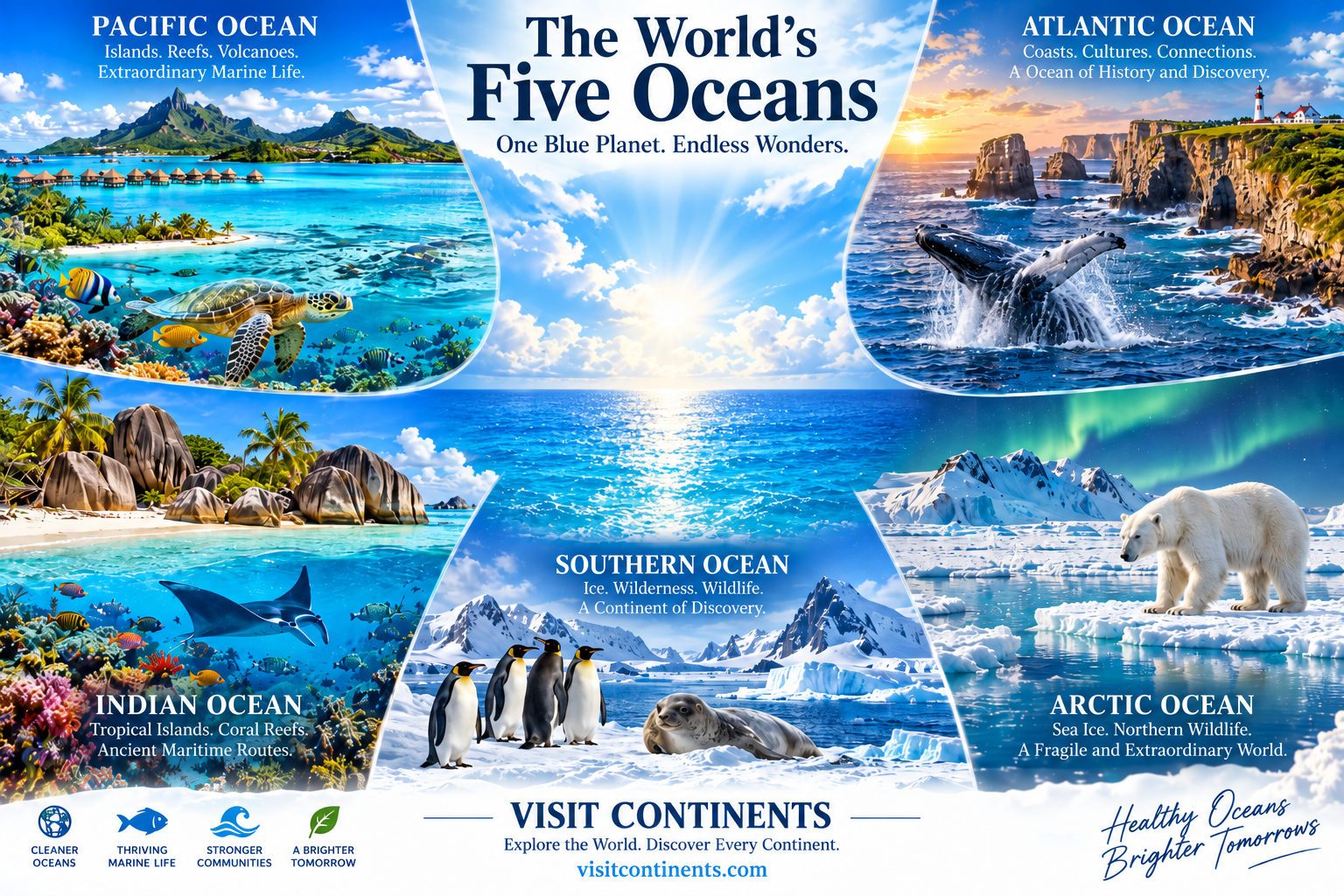
Although Earth’s ocean waters form one interconnected global ocean, geographers commonly divide them into five named oceans: the Pacific, Atlantic, Indian, Southern, and Arctic.
In this comprehensive Visit Continents guide, discover all five oceans, their geographical locations, remarkable natural features, marine wildlife, famous islands, beautiful coastal destinations, and essential information for planning an unforgettable ocean adventure.
1. How Many Oceans Are There in the World?

There are five commonly recognized oceans on Earth.
The Pacific, Atlantic, Indian, Southern, and Arctic Oceans are geographical divisions of one continuous body of salt water that connects the continents.
The five-ocean model is widely used in modern geography education, although the precise boundaries of some oceans, particularly the Southern Ocean, can vary according to the organization or mapping convention.
The five oceans at a glance
| Ocean | Defining feature |
| Pacific Ocean | Largest and deepest ocean |
| Atlantic Ocean | Second-largest ocean |
| Indian Ocean | Third-largest ocean |
| Southern Ocean | Encircles Antarctica |
| Arctic Ocean | Smallest and shallowest ocean overall |
The five oceans differ in size, depth, temperature, currents, biological diversity, and geographical location.
Their waters are continually connected through ocean circulation, creating a global marine system that affects life on every continent.
2. The Pacific Ocean: The Largest and Deepest Ocean on Earth


4
The Pacific Ocean is the largest and deepest ocean on Earth, stretching between Asia and Australia to the west and North and South America to the east.
Its enormous waters extend from the Arctic region in the north toward the Southern Ocean around Antarctica.
The Pacific contains thousands of islands, spectacular coral reefs, deep underwater trenches, active volcanoes, and some of the world’s most remarkable marine ecosystems.
It is also home to many island nations and communities with distinctive languages, cultural traditions, and historical connections to the sea.
Pacific Ocean at a glance
| Ocean | Pacific Ocean |
| Approximate area | 165 million km² |
| Size ranking | 1st — Largest ocean |
| Deepest known location | Challenger Deep, Mariana Trench |
| Major island regions | Melanesia, Micronesia, and Polynesia |
| Notable marine life | Whales, dolphins, sharks, sea turtles, reef fish, and numerous other species |
Approximate ocean areas vary according to the geographical boundaries used.
Discover the Pacific Ocean’s remarkable geography
The Pacific Ocean occupies an immense portion of Earth’s surface and contains some of its most dramatic geological features.
Along much of its margins lies the Pacific Ring of Fire, a broad zone associated with frequent earthquakes and volcanic activity.
The ocean floor contains underwater mountain ranges, volcanic islands, deep trenches, and extensive areas of abyssal plains.
The Mariana Trench, in the western Pacific, contains Challenger Deep, the deepest known location in the world’s oceans.
The Pacific also plays a major role in global climate patterns through ocean circulation and interactions between the atmosphere and the sea.
The most beautiful places to visit in the Pacific Ocean
Bora Bora, French Polynesia

Bora Bora is a spectacular island in French Polynesia, internationally recognized for its turquoise lagoon, volcanic mountain scenery, coral reefs, and tropical beaches.
Mount Otemanu rises dramatically above the island, creating one of the South Pacific’s most recognizable landscapes.
Visitors can enjoy snorkeling, guided lagoon excursions, coastal photography, and opportunities to learn about Polynesian culture.
The island’s surrounding marine environments support tropical fish, rays, and other aquatic species.
The Great Barrier Reef, Australia

The Great Barrier Reef stretches along Australia’s northeastern coastline and forms the world’s largest coral reef system.
Its marine environments support extraordinary biodiversity, including reef fish, sea turtles, rays, sharks, and numerous other organisms.
Travelers can explore selected areas through licensed snorkeling and diving excursions, glass-bottom boat tours, and island visits.
Because coral reefs are sensitive environments, visitors should avoid touching coral, disturbing wildlife, and anchoring boats on reef habitats.
Hawaii, United States

Hawaii is a volcanic island chain in the central Pacific Ocean.
Its islands contain tropical forests, beaches, volcanic mountains, waterfalls, and distinctive marine ecosystems.
Visitors can explore the dramatic Na Pali Coast on Kauai, the volcanic landscapes of Hawaii Island, the beaches of Oahu, and the mountain and coastal environments of Maui.
Hawaiian cultural heritage reflects the history and traditions of Native Hawaiian communities and their longstanding connections to the islands and surrounding ocean.
Fiji

Fiji is an island country in the South Pacific known for its tropical landscapes, beautiful beaches, coral reefs, and cultural traditions.
The Mamanuca and Yasawa island groups offer opportunities for coastal exploration, snorkeling, and island-based holidays.
Visitors can also explore traditional communities, learn about Fijian cultural practices through locally organized experiences, and discover the country’s diverse marine ecosystems.
Pacific Ocean travel highlights
Recommended destinations: Hawaii, Fiji, French Polynesia, the Great Barrier Reef, Palau, and the Galápagos Islands.
Popular experiences: Tropical island holidays, snorkeling, scuba diving, whale watching, surfing, sailing, and cultural exploration.
Travel tip: The Pacific spans an enormous geographical area. Island groups may be separated by thousands of kilometers, so organize your itinerary around realistic flight and ferry connections.
3. The Atlantic Ocean: Connecting the Americas, Europe, and Africa


7
The Atlantic Ocean is the second-largest ocean on Earth.
It lies between North and South America to the west and Europe and Africa to the east, extending from the Arctic region toward the Southern Ocean.
The Atlantic has played an important role in maritime navigation, trade, migration, cultural exchange, and the development of coastal communities.
Its waters contain remarkable marine environments, from the warm tropical reefs of the Caribbean to the cold, nutrient-rich ecosystems of the North Atlantic.
The Atlantic also influences climate through major currents and ocean circulation patterns.
National Ocean Service
+1
Atlantic Ocean at a glance
| Ocean | Atlantic Ocean |
| Approximate area | 106 million km² |
| Size ranking | 2nd-largest ocean |
| Major geographical divisions | North Atlantic and South Atlantic |
| Important current system | Gulf Stream and broader Atlantic circulation |
| Major connected seas | Caribbean Sea, Mediterranean Sea, and North Sea |
The Atlantic Ocean’s extraordinary geography
The Atlantic Ocean contains a wide variety of marine environments, island groups, underwater mountains, continental shelves, and deep ocean basins.
The Mid-Atlantic Ridge extends along much of the ocean floor and marks a major tectonic boundary where sections of Earth’s crust move apart.
Parts of this underwater mountain system rise above sea level, contributing to the volcanic landscapes of islands such as Iceland and the Azores.
The Atlantic also includes important shipping routes connecting the Americas, Europe, Africa, and other parts of the world.
The most beautiful places to visit in the Atlantic Ocean
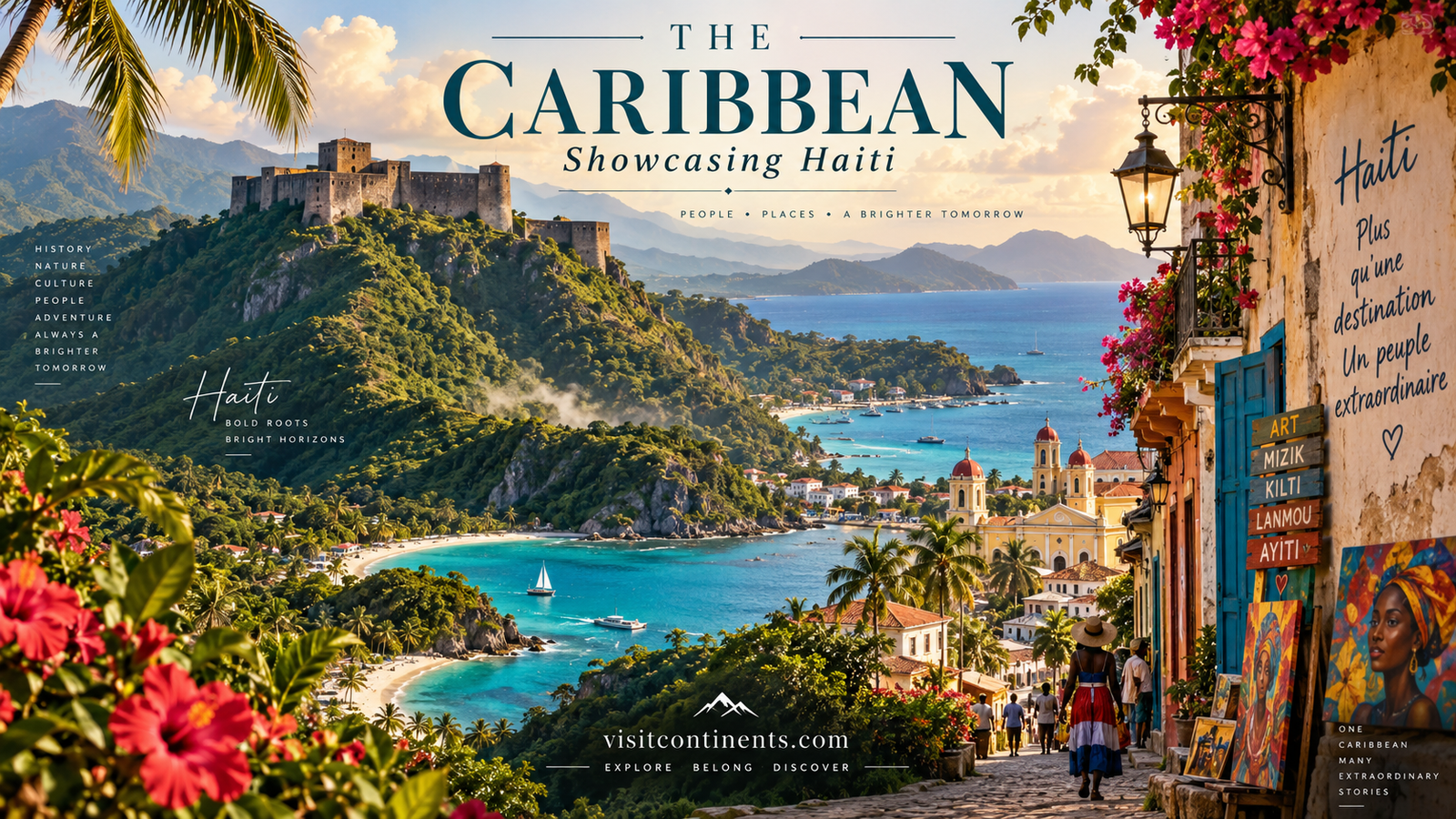
The Caribbean Islands


4
The Caribbean Sea is a marginal sea of the Atlantic Ocean and contains some of the world’s most recognizable tropical island destinations.
The wider Caribbean region includes 13 independent island countries and numerous territories.
Visitors can enjoy beautiful beaches, historic towns, vibrant festivals, tropical forests, coral reefs, and distinctive cultural experiences.
Haiti, Jamaica, the Dominican Republic, Saint Lucia, Barbados, and The Bahamas each offer different combinations of history, natural scenery, and cultural traditions.
In Haiti, the historic Citadelle Laferrière, the artistic heritage of Jacmel, and the country’s mountain landscapes illustrate the region’s rich cultural and geographical diversity.
Travelers should assess current destination-specific security conditions and transportation availability when planning Caribbean journeys.
The Azores, Portugal

The Azores are a Portuguese archipelago located in the North Atlantic Ocean.
The islands are known for their volcanic landscapes, crater lakes, geothermal features, dramatic coastlines, and green mountain scenery.
São Miguel, the largest island, is famous for its lakes, hot springs, and scenic viewpoints.
The Azores also offer opportunities for whale watching, hiking, coastal exploration, and learning about traditional island communities.
The Canary Islands, Spain

The Canary Islands are a Spanish archipelago in the Atlantic Ocean, located off the northwestern coast of Africa.
The islands feature volcanic mountains, beaches, forests, desert-like landscapes, and coastal villages.
Tenerife is home to Mount Teide, a spectacular volcanic peak within Teide National Park.
Lanzarote is known for its dramatic volcanic terrain, while Gran Canaria and Fuerteventura offer distinctive coastal and inland landscapes.
Cabo Verde

Cabo Verde is an independent island country in the Atlantic Ocean off the western coast of Africa.
Its volcanic islands contain sandy beaches, mountain valleys, coastal settlements, and dry landscapes.
Sal and Boa Vista are known for their beaches, while Santo Antão offers spectacular mountain scenery and hiking opportunities.
The island of Fogo contains an active volcano and remarkable volcanic terrain.
Cabo Verde is also recognized for its music, cuisine, and cultural traditions reflecting African and Atlantic historical connections.
Atlantic Ocean travel highlights
Recommended destinations: The Caribbean, Azores, Canary Islands, Cabo Verde, Bermuda, and selected Atlantic coastal regions of Europe, Africa, and the Americas.
Popular experiences: Beach holidays, whale watching, sailing, snorkeling, historic cities, volcanic island exploration, and coastal hiking.
Travel tip: Atlantic weather varies substantially by latitude and season. Research hurricane seasons, ocean conditions, and local travel restrictions before booking.
4. The Indian Ocean: Tropical Islands, Coral Reefs, and Ancient Maritime Routes


8
The Indian Ocean is the world’s third-largest ocean, extending between Africa to the west, Asia to the north, and Australia to the east.
Its northern waters connect important coastal regions of the Arabian Peninsula, India, Southeast Asia, and East Africa.
The ocean is known for its tropical islands, coral reefs, extensive shipping routes, marine biodiversity, and historical connections between civilizations.
For centuries, maritime trade across the Indian Ocean contributed to exchanges of goods, languages, religions, food, technology, and cultural traditions.
Today, it remains an important region for international commerce, fisheries, tourism, and marine conservation.
Indian Ocean at a glance
| Ocean | Indian Ocean |
| Approximate area | 70 million km² |
| Size ranking | 3rd-largest ocean |
| Surrounding continents | Africa, Asia, Australia, and Antarctica across its southern boundary |
| Major connected seas | Arabian Sea, Red Sea, and Andaman Sea |
| Notable island destinations | Maldives, Seychelles, Mauritius, Madagascar, and Sri Lanka |
The Indian Ocean’s geographical diversity
The Indian Ocean contains deep ocean basins, underwater mountain ranges, coral reefs, volcanic islands, and extensive continental shelves.
Its surface conditions are strongly influenced by seasonal monsoon systems, particularly in the northern Indian Ocean.
These wind patterns have historically shaped maritime trade, fishing, and navigation across the region.
The ocean also supports important ecosystems, including mangrove forests, seagrass beds, coral reefs, and open-ocean habitats.
The most beautiful places to visit in the Indian Ocean
Maldives

The Maldives is an island country southwest of India and Sri Lanka, recognized for its low-lying coral islands, spectacular lagoons, white-sand beaches, and marine biodiversity.
Visitors can enjoy snorkeling, diving, guided marine excursions, island holidays, and opportunities to learn about Maldivian culture.
The surrounding waters support reef fish, sea turtles, rays, sharks, and numerous other marine animals.
Because the islands are geographically dispersed, transportation between destinations may require scheduled boats, speedboats, or seaplane transfers.
Seychelles

Seychelles is an island country northeast of Madagascar, famous for its spectacular beaches, granite rock formations, tropical vegetation, and protected marine environments.
Mahé, Praslin, and La Digue are among the country’s principal tourist islands.
Visitors can explore beaches, nature reserves, botanical gardens, and designated hiking routes.
The islands also support distinctive plants and animals, including the coco de mer palm and giant tortoises in suitable habitats.
Mauritius

Mauritius is an island country east of Madagascar, known for its beaches, volcanic mountains, tropical forests, and multicultural heritage.
Le Morne Brabant is one of its most recognizable natural landmarks.
Black River Gorges National Park offers forest landscapes and hiking opportunities, while the coastal regions provide access to lagoons, beaches, and marine activities.
Mauritian cuisine, music, festivals, and religious traditions reflect diverse African, European, Indian, and Chinese historical influences.
Zanzibar, Tanzania

Zanzibar is an archipelago off Tanzania’s eastern coast.
It is known for its beautiful beaches, historic architecture, cultural traditions, and longstanding connections to Indian Ocean trade.
Stone Town contains important examples of Swahili coastal architecture and historic urban heritage.
Travelers can explore traditional markets, enjoy coastal activities, discover regional cuisine, and learn about the archipelago’s cultural history.
Sri Lanka

Sri Lanka is an island country south of India, offering a combination of Indian Ocean beaches, ancient cities, tea-growing highlands, tropical forests, and wildlife habitats.
Visitors can explore historic sites, national parks, coastal villages, and traditional cultural attractions.
The island’s different coastal regions experience distinct monsoon patterns, making seasonal planning important for beach holidays and marine excursions.
Indian Ocean travel highlights
Recommended destinations: Maldives, Seychelles, Mauritius, Zanzibar, Sri Lanka, and Madagascar.
Popular experiences: Tropical island holidays, snorkeling, scuba diving, marine wildlife observation, cultural exploration, and coastal photography.
Travel tip: Monsoon seasons, tropical cyclone risks, and marine conditions vary by destination. Confirm the most suitable travel period for the particular island or coastal region you plan to visit.
5. The Southern Ocean: Explore the Frozen Waters Around Antarctica


7
The Southern Ocean surrounds Antarctica and connects the southern portions of the Atlantic, Pacific, and Indian Oceans.
It is one of the world’s most remote marine environments and is characterized by cold waters, powerful currents, sea ice, enormous icebergs, and remarkable wildlife.
Under the commonly used five-ocean model, the Southern Ocean extends from the Antarctic coastline northward to approximately 60 degrees south latitude. Its precise boundary has not been universally agreed upon by all geographical authorities.
National Ocean Service
Unlike the tropical oceans, the Southern Ocean is primarily associated with polar exploration, scientific research, and specialized expedition tourism.
Southern Ocean at a glance
| Ocean | Southern Ocean |
| Location | Surrounds Antarctica |
| Approximate area | 20 million km² |
| Size ranking | 4th-largest ocean |
| Climate | Polar marine |
| Notable wildlife | Penguins, whales, seals, krill, and seabirds |
| Main tourism season | November–March |
The importance of the Southern Ocean
The Southern Ocean plays an important role in Earth’s climate system through the movement of ocean water, heat, carbon, and nutrients.
The Antarctic Circumpolar Current flows around Antarctica, connecting the major ocean basins and influencing global ocean circulation.
The Southern Ocean is also home to extensive marine food webs that depend heavily on Antarctic krill.
Krill serve as an important food source for penguins, seals, whales, fish, and seabirds.
Scientific research in the region helps improve understanding of marine ecosystems, sea ice, climate change, and global ocean circulation.
The most remarkable places to visit in the Southern Ocean
Antarctic Peninsula

The Antarctic Peninsula is among the most commonly visited regions of Antarctica.
Expedition vessels travel through spectacular coastal waters where passengers can observe glaciers, icebergs, penguins, seals, and whales.
Many journeys begin in Ushuaia, Argentina, before crossing the Drake Passage toward Antarctic waters.
Depending on weather and sea ice, travelers may participate in guided shore landings, small-boat excursions, and educational activities.
South Shetland Islands

The South Shetland Islands lie north of the Antarctic Peninsula.
Their landscapes include glaciers, rocky coastlines, volcanic formations, and important wildlife habitats.
Some Antarctic expedition itineraries include visits to selected islands where passengers may observe penguins and seals or explore designated historical sites.
South Georgia

South Georgia is a remote island in the South Atlantic sector of the Southern Ocean region.
It is internationally recognized for its enormous seabird colonies, dramatic mountain scenery, glaciers, and important historical connections to polar exploration.
Travelers may encounter king penguins, elephant seals, fur seals, and numerous other wildlife species during authorized expedition visits.
Because South Georgia lies north of 60 degrees south, it is outside the Southern Ocean under the strict 60°S boundary convention, but it is frequently included in broader Antarctic and subantarctic expedition itineraries.
Southern Ocean travel highlights
Recommended destinations: Antarctic Peninsula, South Shetland Islands, and selected subantarctic islands on longer expeditions.
Popular experiences: Expedition cruising, iceberg viewing, penguin observation, whale watching, polar photography, and guided educational activities.
Travel tip: Southern Ocean travel requires specialized transportation and careful preparation. Weather, sea ice, and wildlife protection rules determine which activities are possible.
6. The Arctic Ocean: The Smallest Ocean and the World’s Northern Polar Waters


4
The Arctic Ocean is the smallest and shallowest of Earth’s five commonly recognized oceans overall.
It surrounds the geographic North Pole and lies between the northern portions of North America, Europe, and Asia.
Much of the Arctic Ocean is covered by sea ice during winter, while the extent of sea ice decreases during summer.
The region is home to remarkable marine wildlife and is closely connected to the cultural traditions, livelihoods, and environments of northern communities.
Unlike the Southern Ocean, which surrounds a continent, the Arctic Ocean is largely surrounded by continental landmasses and islands.
Arctic Ocean at a glance
| Ocean | Arctic Ocean |
| Approximate area | 14 million km² |
| Size ranking | 5th — Smallest ocean |
| Location | Surrounds the geographic North Pole |
| Climate | Polar marine |
| Notable wildlife | Polar bears, walruses, seals, beluga whales, narwhals, and other marine species |
Discover the Arctic Ocean’s unique environment
The Arctic Ocean contains extensive continental shelves, deep basins, underwater mountain ranges, and seasonal sea ice.
Its surface conditions are influenced by cold temperatures, ocean currents, freshwater entering from major rivers, and the seasonal formation and melting of sea ice.
Sea ice provides important habitat for many animals, including polar bears and seals.
The Arctic Ocean also supports marine ecosystems that are essential to northern coastal communities.
Scientific research helps monitor changes in sea ice, ocean temperatures, marine wildlife, and the wider Arctic environment.
The most beautiful places to visit in the Arctic Ocean
Svalbard, Norway

Svalbard is a Norwegian archipelago in the Arctic Ocean, known for its glaciers, mountain landscapes, fjords, and polar wildlife.
Longyearbyen serves as the principal settlement and main gateway for visitors.
Travelers can explore selected coastal areas through organized expeditions and observe the surrounding polar environment.
Polar bears inhabit the archipelago, making qualified guides and strict wildlife safety procedures essential for wilderness activities.
Greenland

Greenland is the world’s largest island and is located between the Arctic and North Atlantic Oceans.
Its coastal environments contain enormous glaciers, icebergs, mountains, and remarkable marine habitats.
Ilulissat Icefjord is one of Greenland’s most famous natural attractions, while Nuuk offers cultural institutions and opportunities to learn about contemporary Greenlandic life.
Visitors can experience the region through guided boat excursions, designated walking routes, and appropriate wildlife-viewing activities.
Northern Canada

Canada’s Arctic islands and northern coastline provide access to spectacular polar environments.
Nunavut contains extensive coastal landscapes, tundra, mountains, glaciers, and communities with rich Inuit cultural heritage.
Baffin Island is particularly recognized for its fjords, mountain scenery, and remote wilderness areas.
Travelers should plan transportation carefully because many Arctic communities have limited road access and depend on aircraft or seasonal marine transport.
Northern Alaska

Northern Alaska borders the Arctic Ocean and contains tundra, coastal plains, mountain ranges, and important wildlife habitats.
Utqiaġvik is one of the northernmost communities in the United States and an important center of Iñupiat culture.
Visitors can learn about northern community life, regional history, Arctic environmental conditions, and local cultural traditions through suitable organized experiences.
Arctic Ocean travel highlights
Recommended destinations: Svalbard, Greenland, northern Canada, and northern Alaska.
Popular experiences: Arctic cruising, glacier viewing, cultural exploration, wildlife observation, polar photography, and educational expeditions.
Travel tip: The Arctic Ocean is a remote and demanding environment. Select appropriately experienced operators and understand the risks associated with cold weather, sea ice, limited transportation, and wildlife.
7. The Most Beautiful Islands and Coastal Destinations Around the World’s Oceans

The world’s oceans contain countless islands and coastal destinations, each shaped by different geological, environmental, and cultural processes.
Some islands developed through volcanic activity, while others formed through coral growth or the separation of landmasses over millions of years.
Travelers can choose between tropical beach holidays, cultural exploration, mountain adventures, marine wildlife experiences, and remote polar expeditions.
The following destinations illustrate the diversity of ocean travel.

Maldives — Indian Ocean
A tropical island country famous for its low-lying coral islands, turquoise lagoons, white-sand beaches, and marine recreation.
Bora Bora — Pacific Ocean
A volcanic island with an extraordinary lagoon, dramatic mountain scenery, coral reefs, and Polynesian cultural heritage.

Haiti — Caribbean Sea, Atlantic Ocean
A Caribbean country with dramatic mountain landscapes, tropical beaches, distinctive cultural traditions, and important historical landmarks.
Seychelles — Indian Ocean
An island nation known for its remarkable granite formations, protected marine ecosystems, tropical forests, and spectacular beaches.

Galápagos Islands — Pacific Ocean
An Ecuadorian archipelago famous for its distinctive wildlife, volcanic landscapes, marine biodiversity, and conservation importance.

Azores — Atlantic Ocean
A volcanic Portuguese archipelago featuring crater lakes, green mountains, geothermal areas, and marine wildlife.

Greenland — Arctic and North Atlantic Oceans
A vast island recognized for its ice sheet, glaciers, enormous icebergs, mountain scenery, and Inuit cultural heritage.
8. Marine Life: Discover the Extraordinary Animals of the World’s Oceans


5
The world’s oceans support an extraordinary range of life, from microscopic plankton to the largest animals on Earth.
Marine ecosystems include coral reefs, kelp forests, seagrass meadows, estuaries, mangrove habitats, deep-sea environments, and open-ocean waters.
Different species are adapted to particular temperature ranges, depths, food sources, and geographical conditions.
Whales: Giants of the ocean

Whales are among the world’s most remarkable marine animals.
The blue whale is the largest animal known to have lived on Earth.
Humpback whales are famous for their long migrations, complex vocalizations, and spectacular surface behavior.
Orcas, also known as killer whales, are members of the dolphin family and occur in oceans around the world.
Whale-watching opportunities are available in destinations such as Alaska, Iceland, Norway, Canada, the Dominican Republic, South Africa, and Australia.
Sightings depend on the season and local conditions, and visitors should choose operators that follow responsible wildlife-viewing regulations.
Dolphins

Dolphins are intelligent, social marine mammals found in oceans and some river systems.
Different dolphin species inhabit tropical, temperate, and cold waters.
Travelers may encounter dolphins during authorized marine excursions, boat tours, or coastal wildlife-viewing activities.
Responsible observation requires allowing animals to move naturally without chasing, feeding, touching, or surrounding them.
Sea turtles

Sea turtles inhabit tropical and subtropical marine environments in several of the world’s oceans.
Species include green sea turtles, hawksbill turtles, loggerhead turtles, leatherback turtles, and others.
They play important roles in marine ecosystems, including seagrass meadows and coral reef habitats.
Visitors may observe turtles while snorkeling or diving, but they should never touch or disturb the animals or interfere with nesting beaches.
Sharks and rays

Sharks and rays are important components of marine ecosystems.
Different species inhabit coral reefs, coastal waters, open oceans, and deep-sea environments.
Whale sharks, the world’s largest living fish, feed primarily on plankton and small organisms.
Manta rays are recognized for their broad bodies and graceful movement through the water.
When choosing marine excursions, travelers should prioritize operators that follow appropriate wildlife protection and visitor safety practices.
Coral reef wildlife

Coral reefs support an extraordinary variety of marine life.
Their habitats provide shelter, feeding areas, and breeding environments for fish, crustaceans, mollusks, sea turtles, and numerous other organisms.
Although reefs occupy a relatively small portion of the ocean floor, they support a substantial share of marine biodiversity and provide important benefits to coastal communities.
NOAA Coastal Management
Corals are living animals, and their structures can be damaged by touching, careless diving, boat anchors, and other disturbances.
9. Why Are Oceans Important to Life on Earth?

Oceans are essential to Earth’s environmental systems and human societies.
They influence global temperatures, produce and absorb gases, transport heat, support biological diversity, and connect coastal communities through trade and transportation.
Understanding their importance helps travelers appreciate why marine conservation is essential.
Oceans influence Earth’s climate
Ocean waters absorb and redistribute heat, influencing atmospheric circulation and regional weather patterns.
Major ocean currents help transport warm and cold water between different latitudes.
These processes affect rainfall, temperature, marine ecosystems, and broader climate conditions.
Oceans support oxygen production
Marine photosynthetic organisms, including phytoplankton, produce a substantial portion of the oxygen generated through photosynthesis on Earth.
These microscopic organisms also form the foundation of many marine food webs.
Their growth and distribution are influenced by light, temperature, nutrients, and ocean circulation.
Oceans support communities and livelihoods
Millions of people depend on marine environments for fishing, transportation, tourism, trade, and other economic activities.
Coastal communities also maintain cultural traditions, traditional knowledge systems, and historical relationships with the sea.
The ocean’s importance extends far beyond recreation and scenic beauty.
Oceans contain extraordinary biodiversity
From shallow coral reefs and coastal wetlands to the deep ocean floor, marine environments support an immense variety of life.
Many species remain poorly studied, particularly in remote and deep-sea habitats.
Scientific research continues to improve our understanding of marine ecosystems and the environmental conditions that sustain them.
10. Ocean Conservation: Protecting the World’s Marine Environments

The world’s oceans face numerous environmental pressures, including climate change, marine pollution, unsustainable fishing, habitat degradation, and disturbances to wildlife.
These challenges affect marine biodiversity, coastal communities, food security, and the long-term sustainability of ocean-based activities.
Plastic pollution
Plastic waste can enter marine environments through rivers, storm drains, coastal litter, fishing activities, and other sources.
Marine animals may become entangled in discarded fishing equipment or mistake plastic debris for food.
Larger plastic items can also break into smaller particles known as microplastics, which can persist in marine environments.
National Ocean Service
Travelers can help reduce pollution by disposing of waste properly, avoiding unnecessary single-use items, and participating in organized coastal cleanup activities.
Coral reef degradation
Coral reefs face pressures from increasing ocean temperatures, pollution, disease, sedimentation, destructive fishing practices, and physical damage.
Prolonged marine heatwaves can cause coral bleaching, which may lead to coral mortality when stressful conditions persist.
NOAA Coastal Management
+1
Visitors can help protect reefs by maintaining buoyancy while diving, keeping hands and fins away from coral, avoiding wildlife disturbance, and choosing responsible marine operators.
Responsible wildlife tourism
Whale watching, snorkeling, diving, and other marine activities can create opportunities for education and conservation awareness.
However, poorly managed activities can disturb animals and damage sensitive habitats.
Visitors should avoid touching, feeding, pursuing, or surrounding marine wildlife and follow local viewing-distance regulations.
National Ocean Service
Supporting coastal communities
Responsible ocean tourism can support local employment, cultural preservation, and marine conservation initiatives.
Travelers can choose locally operated services, respect cultural traditions, and support businesses that follow environmental regulations.
Protecting the oceans involves both conserving natural ecosystems and recognizing the communities whose lives and livelihoods are connected to the sea.
11. When Is the Best Time to Explore the World’s Oceans?

The most suitable travel period depends on the ocean, destination, climate, and activities planned.
The Pacific and Indian Oceans encompass large tropical regions but also include temperate and colder environments.
The Atlantic extends across both hemispheres, while the Southern and Arctic Oceans have distinctive polar travel seasons.
| Ocean | Destination example | General travel window |
|---|---|---|
| Pacific | Hawaii | Year-round, depending on activities |
| Pacific | Fiji | May–October for generally drier conditions |
| Pacific | French Polynesia | May–October for generally drier conditions |
| Atlantic | Caribbean | December–April for drier weather in many islands |
| Atlantic | Azores | May–September for many outdoor activities |
| Indian | Maldives | December–April for generally drier conditions |
| Indian | Seychelles | Year-round, with seasonal differences in winds and sea conditions |
| Indian | Mauritius | May–November for relatively cooler conditions |
| Southern | Antarctic Peninsula | November–March |
| Arctic | Svalbard | June–September for many summer marine excursions |
These periods are general planning guidelines, not guarantees of favorable weather or wildlife sightings.
Tropical storms, monsoons, ocean currents, and regional climate patterns can affect destinations differently, even within the same ocean.
Travelers should research their specific island, coastal area, or expedition route before booking.
12. How to Plan a Journey Across All Five Oceans

Traveling across all five oceans is an ambitious adventure that can combine tropical island exploration with remote polar expeditions.
Unlike visiting five neighboring countries, exploring five oceans involves destinations separated by immense distances and very different environments.
An efficient itinerary should account for transportation connections, seasonal conditions, accommodation, activity requirements, and the traveler’s overall budget.
Suggested five-ocean travel itinerary

Ocean 1 · Pacific
Hawaii, United States
Discover volcanic landscapes, tropical beaches, cultural attractions, and selected marine environments.
Ocean 2 · Atlantic
Azores, Portugal
Explore volcanic islands, crater lakes, coastal landscapes, and marine wildlife through appropriately organized excursions.
Ocean 3 · Indian
Seychelles
Experience turquoise waters, remarkable beaches, tropical landscapes, and protected marine ecosystems.

Ocean 4 · Southern
Antarctic Peninsula
Join a specialized expedition to observe glaciers, icebergs, penguins, seals, and whales in Antarctic waters.

Ocean 5 · Arctic
Svalbard, Norway
Discover spectacular Arctic landscapes, northern communities, glaciers, and polar marine environments through organized excursions.
This route is an illustrative travel-planning framework rather than a fixed itinerary.
The Southern Ocean’s main Antarctic expedition season and the Arctic’s popular summer expedition season occur during opposite parts of the calendar year.
Travelers seeking to experience both polar regions should consider scheduling their journey over several months or completing separate expeditions.
There is also no requirement to cross the entire breadth of each ocean. Visiting a suitable coastal or island destination in each named ocean region can provide a meaningful introduction to all five.
13. Essential Safety Tips for Ocean Travel

Ocean travel offers extraordinary experiences, but marine environments can present serious hazards.
Strong currents, changing tides, large waves, extreme weather, cold temperatures, marine animals, and limited emergency services can affect even experienced travelers.
Follow beach safety instructions
Swim in designated areas when available and follow local beach warnings.
Research rip currents, tides, wave conditions, and any seasonal hazards before entering the water.
Never assume that a beach is safe for swimming simply because the water appears calm.
Choose qualified marine operators
For diving, snorkeling, kayaking, sailing, and expedition cruising, select operators with appropriate training, equipment, safety procedures, and local knowledge.
Activities should match your swimming ability, physical condition, and experience.
Respect marine wildlife
Never touch, chase, feed, or deliberately disturb marine animals.
Maintain appropriate distances and follow all local wildlife-viewing regulations.
Choose operators that prioritize conservation and allow animals to behave naturally.
Prepare for remote destinations
Some islands and polar regions have limited medical facilities, transportation services, and emergency response capabilities.
Travelers should confirm insurance coverage, evacuation arrangements, communication options, and contingency plans before visiting remote locations.
Monitor weather and marine forecasts
Tropical cyclones, monsoons, polar storms, strong winds, and rough seas can affect transportation and outdoor activities.
Check official weather forecasts and follow guidance from local authorities, vessel operators, and qualified guides.
14. Frequently Asked Questions About the World’s Oceans
1. How many oceans are there in the world?
Earth has one interconnected global ocean, commonly divided into five named oceans: the Pacific, Atlantic, Indian, Southern, and Arctic.
National Ocean Service
2. What is the largest ocean in the world?
The Pacific Ocean is the largest ocean, covering approximately 165 million square kilometers.
3. What is the smallest ocean in the world?
The Arctic Ocean is the smallest of Earth’s five commonly recognized oceans.
4. What is the deepest ocean in the world?
The Pacific Ocean is the deepest ocean. Challenger Deep, within the Mariana Trench, is the deepest known location in the global ocean.
5. Which ocean surrounds Antarctica?
The Southern Ocean surrounds Antarctica and connects the southern portions of the Atlantic, Pacific, and Indian Oceans.
6. Which ocean contains the North Pole?
The geographic North Pole is located within the Arctic Ocean.
7. Which ocean is the Caribbean Sea part of?
The Caribbean Sea is a marginal sea of the Atlantic Ocean.
8. Which ocean contains the Maldives?
The Maldives is an island country in the Indian Ocean, southwest of India and Sri Lanka.
9. Which ocean contains Hawaii?
Hawaii is located in the central Pacific Ocean.
10. Which ocean contains the Great Barrier Reef?
The Great Barrier Reef is located in the Coral Sea, a marginal sea of the Pacific Ocean, off Australia’s northeastern coast.
11. Which ocean separates Africa from the Americas?
The Atlantic Ocean lies between Africa and the Americas.
12. Which ocean lies between Africa and Australia?
The Indian Ocean extends between Africa and Australia.
13. Can you visit all five oceans?
Yes. Travelers can experience all five named ocean regions through coastal visits, island holidays, marine excursions, and specialized polar expeditions. The practical arrangements depend on the destinations selected and the definition of what constitutes a visit.
14. What is the difference between an ocean and a sea?
An ocean is a major division of Earth’s interconnected global saltwater body. A sea is generally a smaller subdivision of an ocean, often partly enclosed by land, although geographical naming conventions have exceptions.
15. Why are oceans important?
Oceans influence Earth’s climate, support marine biodiversity, provide food and livelihoods, connect continents through transportation, and play essential roles in global environmental systems.
Conclusion: Five Oceans, One Extraordinary Blue Planet

The world’s five oceans offer an extraordinary combination of natural beauty, remarkable marine wildlife, geographical diversity, and opportunities for adventure.
From the immense waters of the Pacific and the historic maritime routes of the Atlantic to the tropical islands of the Indian Ocean, the frozen wilderness of the Southern Ocean, and the sea-ice environments of the Arctic Ocean, each ocean contains destinations and ecosystems worth discovering.
Travelers can explore spectacular coral reefs, observe whales in their natural habitats, visit tropical islands, discover historic coastal communities, sail through dramatic fjords, and participate in specialized polar expeditions.
The oceans also connect the world’s seven continents and support the livelihoods, cultural traditions, and well-being of communities around the globe.
Although they are commonly divided into five named regions, their waters form one interconnected global ocean whose health influences life across the planet.
Protecting marine environments is therefore essential to preserving biodiversity, sustaining coastal communities, and ensuring that future generations can continue to experience the extraordinary beauty of the world’s oceans.
Whether your dream is to snorkel above the Great Barrier Reef, explore the turquoise waters of the Caribbean, discover the tropical islands of the Indian Ocean, photograph Antarctic icebergs, or experience the Arctic’s northern wilderness, the oceans offer countless opportunities for exploration and discovery.
For travelers seeking to explore every continent and every ocean, our blue planet offers a lifetime of remarkable experiences.
VISIT CONTINENTS
Explore the World’s Five Oceans. Discover Our Blue Planet.
Experience beautiful islands, spectacular coral reefs, extraordinary marine wildlife, breathtaking coastlines, fascinating cultures, and unforgettable ocean adventures across the globe.
Explore the World. Discover Every Continent.
visitcontinents.com