VISIT CONTINENTS
VISIT CONTINENTS
Explore the World. Discover Every Continent.
visitcontinents.com
South America: The Ultimate Travel Guide to Its 12 Countries, Cities, Cultures, and Beautiful Destinations

SOUTH AMERICA TRAVEL GUIDE | COUNTRIES • CITIES • HISTORY • CULTURE • WILDLIFE • ADVENTURE
South America is one of the world’s most extraordinary continents, celebrated for its breathtaking natural landscapes, ancient civilizations, remarkable wildlife, vibrant cities, and rich cultural heritage.
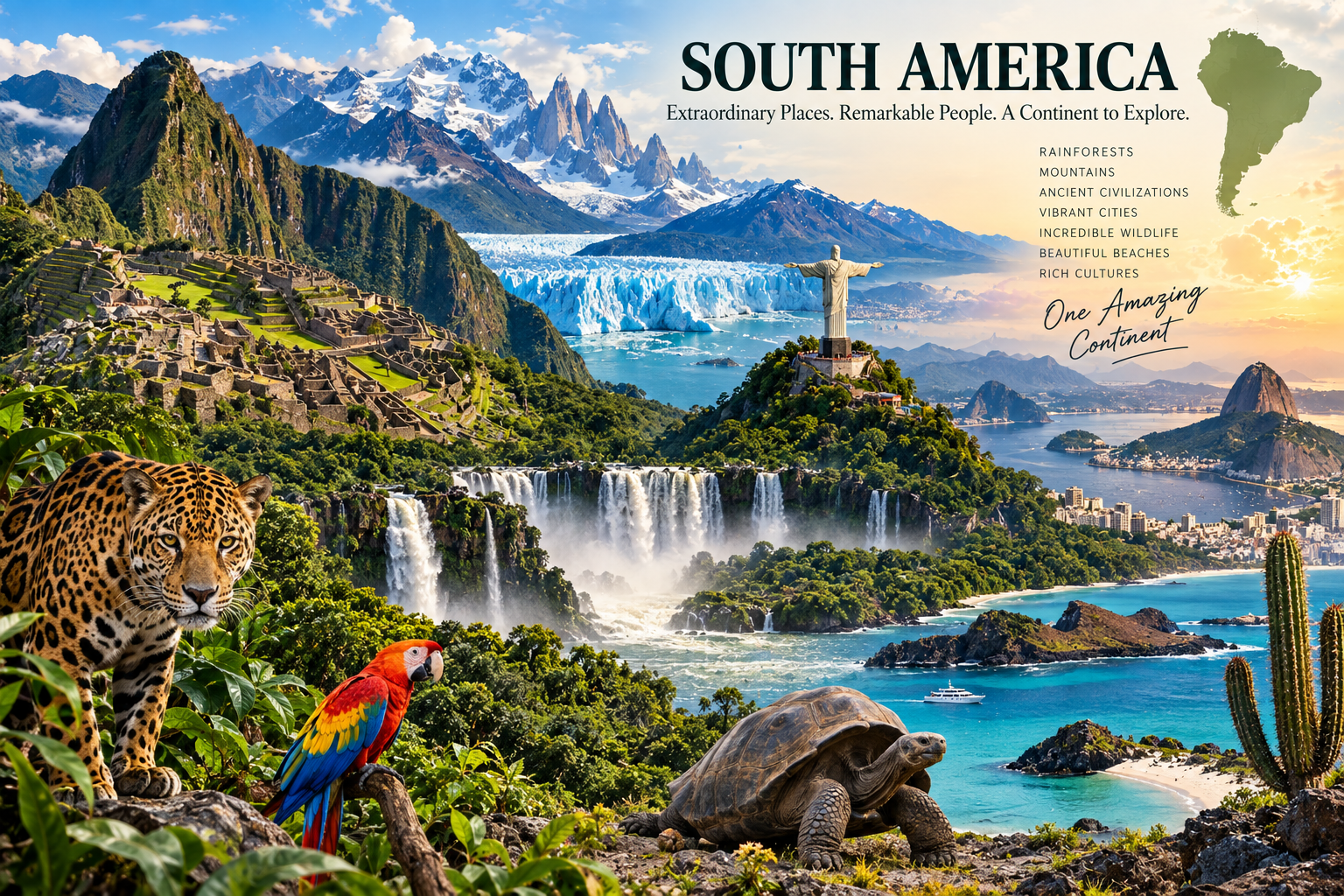
From the magnificent Amazon rainforest and the towering peaks of the Andes Mountains to the ancient Inca citadel of Machu Picchu, the spectacular waterfalls of Iguazú, the glaciers of Patagonia, and the tropical beaches of Brazil, South America offers an incredible variety of destinations to explore.
Travelers can discover the colorful streets of Cartagena, experience the music and culture of Rio de Janeiro, explore the historic neighborhoods of Buenos Aires, hike through dramatic mountain landscapes, and encounter extraordinary wildlife in the Galápagos Islands.
The continent is also home to diverse Indigenous peoples, distinctive languages, traditional music, regional cuisines, historical monuments, and some of Earth’s most biologically rich ecosystems.
Although South America is often associated with tropical rainforests, its geography extends far beyond the Amazon. The continent contains deserts, glaciers, high-altitude plateaus, extensive grasslands, tropical wetlands, volcanic landscapes, and remarkable coastal environments.
South America is home to 12 independent sovereign countries, each with its own identity, history, geography, cultural traditions, and travel attractions.
In this comprehensive Visit Continents guide, discover all 12 South American countries, their capital cities, major attractions, geographical regions, beautiful natural wonders, cultural traditions, wildlife, travel seasons, and essential information for planning an unforgettable journey across the continent.
1. Discover South America: A Continent of Extraordinary Diversity


7
South America is the world’s fourth-largest continent by land area, covering approximately 17.8 million square kilometers.
It lies primarily in the Southern Hemisphere, although its northern regions extend across the equator.
The continent is bordered by the Pacific Ocean to the west and the Atlantic Ocean to the east. Its northern boundary connects with the Caribbean region, while the Isthmus of Panama links South America geographically to North America.
The Andes Mountains stretch along much of South America’s western edge, forming one of the world’s longest continental mountain ranges.
To the east lies the enormous Amazon Basin, which contains the world’s largest tropical rainforest and an extraordinary network of rivers.
Farther south, the continent’s landscapes include the Pampas grasslands, the Atacama Desert, the Patagonian steppe, temperate forests, mountain glaciers, and the windswept environments approaching Tierra del Fuego.
South America at a glance
Is South America the same as Latin America?
No. South America is a geographical continent, while Latin America is a cultural and linguistic region that generally includes countries in the Americas where languages derived from Latin, particularly Spanish and Portuguese, predominate.
Latin America commonly includes Mexico, much of Central America, and parts of the Caribbean in addition to most of South America.
Guyana and Suriname, for example, are geographically South American countries but are not always included in narrower definitions of Latin America.
Is the Caribbean part of South America?
The Caribbean is generally grouped with North America in the seven-continent model.
However, several South American countries, including Colombia and Venezuela, have Caribbean coastlines.
The southern Caribbean islands of Trinidad and Tobago, Aruba, and Curaçao are geographically close to South America but are generally classified within the Caribbean region.
2. How Many Countries Are in South America?

South America contains 12 independent sovereign countries. These nations differ considerably in size, population, language, geography, cultural heritage, and economic activity.
Brazil is the continent’s largest country by both land area and population, while Suriname is its smallest independent country by land area.
Most South American countries use Spanish as an official language, but Brazil is predominantly Portuguese-speaking, Guyana uses English as its official language, and Suriname uses Dutch.
The continent also contains French Guiana, an overseas department and region of France, which is geographically located in South America but is not an independent country.
The complete list of the 12 South American countries and their capitals
ALPHABETICAL COUNTRY LIST
Bolivia has two capital cities with different functions: Sucre is its constitutional capital, while La Paz serves as the seat of government.
These 12 countries offer an extraordinary variety of destinations, from enormous tropical forests and major cities to remote mountain communities, historic settlements, grasslands, and coastal islands.
3. Explore the 12 Countries of South America
Every South American country has a distinctive combination of natural attractions, historical landmarks, cultural traditions, and travel experiences.
Some are known for their archaeological heritage and mountain landscapes, while others offer spectacular beaches, tropical rainforests, major metropolitan centers, wildlife habitats, and traditional rural communities.
1. Argentina: Discover Patagonia, Buenos Aires, and the Andes


4
Capital: Buenos Aires | Region: Southern South America
Argentina is one of South America’s largest countries, stretching from the subtropical north to the windswept landscapes of Patagonia and Tierra del Fuego in the far south.
Its geography includes the Andes Mountains, extensive grasslands, forests, lakes, glaciers, and Atlantic coastal environments.
Buenos Aires, the national capital, is famous for its historic architecture, lively neighborhoods, museums, restaurants, and tango traditions.
Visitors can explore the colorful streets of La Boca, discover the historic buildings of San Telmo, and enjoy the city’s parks, cultural institutions, and culinary experiences.
Argentina is also home to some of the continent’s most remarkable natural attractions.
Iguazú Falls, located along the border with Brazil, is one of the world’s most spectacular waterfall systems.
In Patagonia, Los Glaciares National Park contains the remarkable Perito Moreno Glacier and dramatic mountain landscapes surrounding Mount Fitz Roy.
Farther south, Ushuaia serves as an important gateway for expeditions to Antarctica.
Argentina’s culinary traditions include asado, empanadas, regional stews, and distinctive foods associated with the country’s agricultural heritage.
Argentina travel highlights
Recommended destinations: Buenos Aires, Iguazú Falls, Patagonia, El Calafate, El Chaltén, Mendoza, and Ushuaia.
Suggested duration: 10–21 days for selected regions.
Popular experiences: Glacier excursions, mountain hiking, tango, historic city exploration, regional cuisine, and Antarctic expedition connections.
2. Bolivia: Explore the World’s Largest Salt Flat and Ancient Andean Cultures


6
Constitutional capital: Sucre | Seat of government: La Paz
Bolivia is a landlocked South American country known for its dramatic high-altitude landscapes, salt flats, historic cities, Andean traditions, and extraordinary geographical diversity.
Its western region includes portions of the Andes and the Altiplano, while the eastern lowlands contain tropical forests, wetlands, and savanna environments.
One of Bolivia’s most recognizable natural attractions is Salar de Uyuni, the world’s largest salt flat.
During suitable wet-season conditions, a thin layer of water can transform parts of the salt flat into an enormous reflective surface, creating remarkable opportunities for photography.
La Paz is one of the world’s highest major seats of government and is situated within a dramatic mountain valley.
Sucre, Bolivia’s constitutional capital, is known for its historic architecture, museums, and cultural heritage.
Lake Titicaca, shared with Peru, is another major attraction, offering spectacular Andean scenery and opportunities to learn about lakeside communities.
Bolivia’s cultural diversity includes Quechua, Aymara, Guarani, and numerous other Indigenous peoples whose languages, traditions, and histories remain central to national life.
Bolivia travel highlights
Recommended destinations: Salar de Uyuni, La Paz, Sucre, Lake Titicaca, Tiwanaku, and the Andes.
Suggested duration: 7–14 days.
Popular experiences: Salt-flat photography, mountain landscapes, archaeological sites, traditional markets, Indigenous cultural heritage, and nature exploration.
Travel tip: Many popular destinations are at high elevation. Allow time for acclimatization and plan activities according to your physical condition.
3. Brazil: Experience the Amazon, Rio de Janeiro, and Tropical Beaches


4
Capital: Brasília | Region: Eastern and central South America
Brazil is the largest country in South America by land area and population.
Its enormous territory contains major cities, extensive tropical forests, wetlands, mountains, savannas, rivers, and thousands of kilometers of coastline.
Rio de Janeiro is internationally recognized for its spectacular natural setting, famous beaches, music, and cultural attractions.
The Christ the Redeemer statue rises above the city on Corcovado Mountain, while Sugarloaf Mountain provides remarkable views of Guanabara Bay and the surrounding urban landscape.
Copacabana and Ipanema are among Rio’s most recognizable beaches.
São Paulo is Brazil’s largest metropolitan area and an important center of business, arts, cuisine, and contemporary cultural life.
Salvador, in the state of Bahia, is renowned for its Afro-Brazilian cultural heritage, historic architecture, music, and regional cuisine.
Brazil also contains much of the Amazon rainforest, one of the world’s most important tropical ecosystems.
Other major natural attractions include Iguazú Falls, the Pantanal wetlands, and the coastal landscapes of northeastern Brazil.
Brazilian cultural traditions include samba, forró, capoeira, bossa nova, and numerous other forms of artistic expression.
Brazil travel highlights
Recommended destinations: Rio de Janeiro, São Paulo, Brasília, Salvador, the Amazon, Iguazú Falls, and the Pantanal.
Suggested duration: 10–21 days for selected regions.
Popular experiences: Beaches, wildlife observation, rainforest exploration, music, Carnival, museums, historic cities, and regional cuisine.
4. Chile: Discover the Atacama Desert and Patagonia


7
Capital: Santiago | Region: Western South America
Chile is a long, narrow country extending along South America’s Pacific coast.
Its geography is remarkably varied, encompassing the Atacama Desert in the north, fertile valleys in the central region, and forests, fjords, glaciers, and mountains farther south.
Santiago, the national capital, is located near the Andes and offers museums, historic architecture, cultural institutions, restaurants, and access to nearby mountain destinations.
The Atacama Desert is one of the driest nonpolar deserts on Earth.
Visitors can explore its extraordinary geological formations, salt flats, volcanic landscapes, and high-altitude lagoons through suitable guided excursions.
Southern Chile is famous for Patagonia, particularly Torres del Paine National Park, where dramatic mountain peaks rise above lakes, forests, and glaciers.
Chile also includes Rapa Nui, commonly known as Easter Island, a remote Pacific island internationally recognized for its monumental moai statues and distinctive Polynesian cultural heritage.
Chile travel highlights
Recommended destinations: Santiago, Atacama Desert, Torres del Paine, Valparaíso, Lake District, and Rapa Nui.
Suggested duration: 10–21 days.
Popular experiences: Desert exploration, mountain trekking, glacier viewing, historic city visits, astronomy-related tourism, and Polynesian cultural heritage.
5. Colombia: Colorful Cities, Caribbean Beaches, and Coffee Landscapes


4
Capital: Bogotá | Region: Northern South America
Colombia is a geographically diverse country with coastlines along both the Caribbean Sea and the Pacific Ocean.
Its landscapes include the Andes Mountains, tropical rainforests, extensive plains, rivers, and beautiful coastal environments.
Bogotá, the national capital, sits high in the Andes and offers museums, historic neighborhoods, cultural institutions, restaurants, and urban attractions.
Cartagena is famous for its colorful historic center, colonial-era fortifications, Caribbean coastline, and lively cultural atmosphere.
Medellín is recognized for its mountainous urban setting, cultural attractions, museums, and public transportation infrastructure.
Colombia’s coffee-growing region contains beautiful green valleys, traditional towns, and agricultural landscapes.
The Cocora Valley is particularly known for its towering wax palms, which rise above the surrounding mountain scenery.
Tayrona National Natural Park combines tropical forest environments with beautiful Caribbean beaches.
Colombian cultural traditions include cumbia, vallenato, salsa, regional crafts, and an extensive range of traditional foods.
Colombia travel highlights
Recommended destinations: Bogotá, Cartagena, Medellín, Cocora Valley, the Coffee Cultural Landscape, and Tayrona National Natural Park.
Suggested duration: 10–14 days.
Popular experiences: Historic cities, Caribbean beaches, coffee culture, mountain hiking, museums, music, and regional cuisine.
6. Ecuador: Explore the Galápagos Islands and the Equatorial Andes


7
Capital: Quito | Region: Northwestern South America
Ecuador is a relatively compact South American country with an extraordinary diversity of natural environments.
Its territory includes Pacific coastal regions, Andean mountain ranges, Amazonian rainforest, and the Galápagos Islands.
Quito, the national capital, is situated high in the Andes and is famous for its historic center, churches, public squares, and surrounding mountain scenery.
Cotopaxi National Park contains one of Ecuador’s most recognizable volcanoes and offers opportunities for scenic exploration and mountain activities.
The Amazonian region supports tropical forests, extensive biodiversity, and communities with distinctive cultural traditions.
The Galápagos Islands, located in the Pacific Ocean off Ecuador’s mainland coast, are internationally celebrated for their remarkable wildlife and their significance in the history of evolutionary science.
Visitors may encounter giant tortoises, marine iguanas, blue-footed boobies, sea lions, and numerous other species.
The islands are protected environments, and tourism activities are subject to conservation regulations.
Ecuador travel highlights
Recommended destinations: Quito, Galápagos Islands, Cotopaxi, Cuenca, the Amazon, and Baños.
Suggested duration: 10–14 days, with additional time for a comprehensive Galápagos itinerary.
Popular experiences: Wildlife observation, volcano excursions, historic city exploration, rainforest experiences, and marine activities.
7. Guyana: Discover South America’s English-Speaking Rainforest Country


6
Capital: Georgetown | Region: Northeastern South America
Guyana is located on South America’s northeastern Atlantic coast and is the continent’s only independent country with English as its official language.
Its landscape includes extensive tropical rainforests, major rivers, savannas, mountains, and coastal wetlands.
Georgetown, the national capital, is known for its wooden architecture, historic buildings, botanical gardens, and cultural institutions.
One of Guyana’s most extraordinary natural attractions is Kaieteur Falls, a spectacular waterfall located deep within the country’s rainforest.
Kaieteur is famous for its dramatic single main drop and its surrounding protected forest environment.
The Iwokrama Forest is another important conservation area, offering opportunities to learn about rainforest ecosystems, biodiversity, and sustainable forest management.
Guyana is also home to diverse Indigenous communities, including peoples whose cultural traditions and livelihoods maintain longstanding connections with the country’s forests and rivers.
Its cuisine and cultural traditions reflect Indigenous, African, Indian, European, and other historical influences.
Guyana travel highlights
Recommended destinations: Georgetown, Kaieteur Falls, Iwokrama Forest, Rupununi Savannah, and selected rainforest communities.
Suggested duration: 7–10 days.
Popular experiences: Rainforest exploration, waterfall photography, wildlife observation, Indigenous cultural experiences, and guided nature excursions.
Travel tip: Some natural attractions require specialized transport or small aircraft. Confirm weather conditions, tour availability, and travel arrangements in advance.
8. Paraguay: Discover the Heart of South America


5
Capital: Asunción | Region: Central South America
Paraguay is a landlocked country located in the heart of South America.
It is bordered by Argentina, Bolivia, and Brazil and is geographically shaped by major river systems, forests, grasslands, wetlands, and agricultural landscapes.
Asunción, the national capital, is one of South America’s older European-founded cities and contains historic architecture, museums, public squares, and cultural attractions.
Paraguay’s cultural identity is strongly influenced by its Indigenous Guarani heritage.
Both Spanish and Guarani are official languages, and Guarani is widely spoken throughout the country.
The Jesuit Missions of La Santísima Trinidad de Paraná and Jesús de Tavarangue preserve important archaeological remains associated with colonial-era religious settlements.
Paraguay is also associated with Itaipu, a major hydroelectric complex shared with Brazil.
The country’s cuisine includes sopa paraguaya, chipa, mbejú, and various dishes prepared with corn, cassava, cheese, and regional ingredients.
Paraguay travel highlights
Recommended destinations: Asunción, Encarnación, Jesuit Missions, Itaipu, and selected nature reserves.
Suggested duration: 5–8 days.
Popular experiences: Historical sightseeing, Guarani cultural heritage, traditional cuisine, rural landscapes, and nature exploration.
9. Peru: Machu Picchu, the Sacred Valley, and Ancient Civilizations


4
Capital: Lima | Region: Western South America
Peru is one of South America’s most historically significant travel destinations, recognized for its ancient civilizations, spectacular mountain landscapes, diverse ecosystems, and rich cultural traditions.
Machu Picchu, the famous Inca citadel situated high in the Andes, is among the world’s most recognizable archaeological landmarks.
Its remarkable stone architecture and dramatic mountain setting attract travelers interested in history, archaeology, and cultural heritage.
Cusco, once the capital of the Inca Empire, contains important historical buildings, archaeological sites, traditional markets, and cultural institutions.
The nearby Sacred Valley offers impressive mountain scenery, agricultural terraces, traditional communities, and important Inca heritage sites.
Peru also contains part of Lake Titicaca, shared with Bolivia, as well as extensive areas of the Amazon rainforest.
Lima, the national capital, is known for its historic center, coastal neighborhoods, museums, and internationally recognized culinary traditions.
Peruvian cuisine includes ceviche, lomo saltado, causa, anticuchos, and numerous regional specialties influenced by Indigenous, European, African, and Asian historical connections.
Peru travel highlights
Recommended destinations: Lima, Cusco, Machu Picchu, Sacred Valley, Lake Titicaca, Arequipa, and the Amazon.
Suggested duration: 10–14 days.
Popular experiences: Inca heritage, archaeological exploration, mountain trekking, traditional markets, rainforest excursions, and Peruvian cuisine.
Travel tip: Reserve Machu Picchu admission and any required trekking permits well in advance, and allow time for altitude acclimatization when visiting the Andean highlands.
10. Suriname: Tropical Rainforests and Multicultural Heritage


6
Capital: Paramaribo | Region: Northeastern South America
Suriname is the smallest independent country in South America by land area.
Located on the continent’s northeastern Atlantic coast, the country is recognized for its extensive tropical forests, rivers, cultural diversity, and distinctive historical heritage.
Paramaribo, its capital, contains historic wooden architecture, markets, religious buildings, and cultural institutions.
The city’s historical development reflects Indigenous, African, European, Indian, Javanese, Chinese, and other cultural influences.
Dutch is Suriname’s official language, while Sranan Tongo and numerous other languages are widely spoken.
Much of the country’s interior is covered by tropical rainforest, providing habitats for diverse wildlife and important ecological systems.
The Central Suriname Nature Reserve protects an extensive area of rainforest and is internationally recognized for its biodiversity.
Suriname’s food traditions reflect its multicultural heritage, with dishes and cooking techniques influenced by communities from several continents.
Suriname travel highlights
Recommended destinations: Paramaribo, Central Suriname Nature Reserve, Brownsberg Nature Park, and selected river communities.
Suggested duration: 5–10 days.
Popular experiences: Historic architecture, multicultural cuisine, rainforest exploration, river excursions, and wildlife observation.
11. Uruguay: Beautiful Beaches, Historic Towns, and Rural Traditions


8
Capital: Montevideo | Region: Southeastern South America
Uruguay is a relatively small South American country located between Brazil and Argentina.
It is known for its Atlantic beaches, rolling grasslands, historic towns, agricultural landscapes, and cultural traditions.
Montevideo, the national capital, is situated along the Río de la Plata and features historic neighborhoods, museums, markets, theaters, and an extensive waterfront promenade.
Punta del Este is one of Uruguay’s most recognizable coastal destinations, offering beaches, modern architecture, restaurants, and recreational activities.
Colonia del Sacramento is a historic town recognized for its cobblestone streets, colonial-era buildings, and picturesque location along the Río de la Plata.
Uruguay’s countryside is associated with cattle ranching and gaucho traditions, which remain important parts of the country’s cultural heritage.
The country’s cuisine includes asado, chivito, empanadas, and a strong tradition of drinking mate.
Uruguay travel highlights
Recommended destinations: Montevideo, Punta del Este, Colonia del Sacramento, and the Atlantic coastline.
Suggested duration: 5–8 days.
Popular experiences: Beaches, historic towns, coastal sightseeing, traditional cuisine, rural cultural experiences, and museums.
12. Venezuela: Angel Falls, Caribbean Beaches, and the Andes


4
Capital: Caracas | Region: Northern South America
Venezuela is a South American country with an extraordinary variety of natural environments, including Caribbean coastlines, tropical rainforests, extensive plains, mountain ranges, and dramatic highland plateaus.
Its northern coast faces the Caribbean Sea, while the country’s interior contains parts of the Andes, the Orinoco River system, and the ancient geological formations of the Guiana Highlands.
One of Venezuela’s most remarkable natural attractions is Angel Falls, also known as Salto Ángel or Kerepakupai Merú.
Located within Canaima National Park, it is recognized as the world’s highest uninterrupted waterfall, descending from the dramatic tabletop mountain known as Auyán-tepui.
Mount Roraima is another distinctive landscape, famous for its flat-topped summit and steep cliffs.
The Los Roques archipelago is known for its turquoise waters, coral reefs, sandy islands, and marine environments.
Caracas, the national capital, contains museums, cultural institutions, historic landmarks, and urban neighborhoods surrounded by mountains.
Venezuelan cultural traditions include joropo music, regional dance, traditional crafts, and cuisine such as arepas, pabellón criollo, and hallacas.
However, economic difficulties, political tensions, security concerns, and changes in transportation and essential services can significantly affect travel. Visitors should assess current official advisories and entry requirements rather than assume that remote attractions are accessible.
Venezuela cultural and natural highlights
Notable destinations: Caracas, Angel Falls, Canaima National Park, Mount Roraima, Los Roques, and Mérida.
Potential experiences: Waterfall viewing, mountain landscapes, Caribbean coastal scenery, traditional cuisine, and cultural heritage.
Travel consideration: Remote excursions require specialized transportation and careful assessment of current local safety, infrastructure, and access conditions.
4. French Guiana: An Important South American Territory


7
French Guiana is located on South America’s northeastern Atlantic coast, between Brazil and Suriname.
Although it is geographically part of South America, French Guiana is not an independent country. It is an overseas department and region of France and is therefore part of the European Union.
Cayenne is its capital and principal urban center.
French Guiana’s landscape includes extensive tropical forests, rivers, wetlands, and coastal environments.
One of its most internationally recognized facilities is the Guiana Space Centre near Kourou, an important European spaceport.
The territory is also known for the Salvation Islands, including Devil’s Island, which are associated with the history of the former French penal colony.
French Guiana has a diverse cultural heritage shaped by Indigenous peoples, Creole communities, Maroon communities, and migration from other parts of the world.
French Guiana at a glance
Capital: Cayenne
Political status: Overseas department and region of France
Official language: French
Currency: Euro (EUR)
Travel highlights: Cayenne, Guiana Space Centre, Salvation Islands, rainforest environments, and cultural heritage.
Travelers should verify French and European entry rules specifically for French Guiana, as its immigration arrangements differ from those of the European Schengen Area.
5. South America’s Major Geographical Regions

South America can be divided into several broad geographical and cultural regions.
Unlike its 12-country count, these regional divisions are not universally fixed. Different geographical, historical, cultural, and economic organizations use different groupings.
For travel planning, the following five regions provide a useful introduction to the continent’s diverse environments and destinations.
Northern South America

1. Northern South America
This region includes much of Colombia, Venezuela, Guyana, Suriname, and French Guiana.
It features Caribbean and Atlantic coastlines, tropical rainforests, rivers, wetlands, mountain landscapes, and culturally diverse communities.
Important attractions include Cartagena, Angel Falls, Kaieteur Falls, the Guiana Highlands, and the coastal environments of northern Colombia and Venezuela.
Andean South America

2. The Andean Region
The Andean region includes major portions of Ecuador, Peru, Bolivia, Colombia, Chile, Argentina, and Venezuela.
It is defined by the Andes Mountains and contains high-altitude plateaus, volcanic landscapes, traditional communities, archaeological sites, and spectacular mountain scenery.
Notable destinations include Machu Picchu, Lake Titicaca, Cotopaxi, Salar de Uyuni, and the highland regions of Peru and Bolivia.
Amazon Basin

3. The Amazon Region
The Amazon Basin extends across several South American countries and contains the world’s largest tropical rainforest.
It includes extensive areas of Brazil, Peru, Colombia, Bolivia, Ecuador, Venezuela, Guyana, and Suriname, as well as French Guiana within the broader Amazonian forest region.
The region supports exceptional biodiversity and numerous Indigenous communities with deep historical connections to the forest and its river systems.
Eastern and Southeastern South America

4. The Atlantic and La Plata Regions
Eastern and southeastern South America contain major portions of Brazil, Paraguay, Uruguay, and northeastern Argentina.
Their landscapes include Atlantic beaches, the Brazilian Highlands, the Pantanal wetlands, major river systems, grasslands, and extensive agricultural regions.
Well-known destinations include Rio de Janeiro, Iguazú Falls, the Pantanal, Buenos Aires, and Montevideo.
Southern South America

5. Patagonia and the Southern Cone
Southern South America includes Argentina, Chile, Uruguay, and neighboring areas commonly grouped within the Southern Cone.
The region contains Patagonia’s dramatic mountains and glaciers, the Pampas grasslands, temperate forests, extensive coastlines, and Tierra del Fuego.
Travelers can explore Buenos Aires, Santiago, Montevideo, Torres del Paine, Los Glaciares National Park, and the southern landscapes surrounding Ushuaia.
6. South America’s Most Beautiful Natural Wonders
South America is home to some of Earth’s most remarkable natural environments.
Its landscapes have developed through immense geological processes, river systems, climate variations, volcanic activity, and the evolution of diverse ecosystems.
The following attractions illustrate the continent’s extraordinary natural beauty.
The Amazon Rainforest — Multiple Countries
The Amazon is the world’s largest tropical rainforest. It supports extraordinary biodiversity, major freshwater ecosystems, and numerous Indigenous communities.

Iguazú Falls — Argentina and Brazil
This spectacular waterfall system lies along the international border and is surrounded by subtropical rainforest. Visitors can explore designated viewing areas on both sides, subject to applicable entry requirements.
Machu Picchu — Peru
This historic Inca citadel is situated high in the Andes Mountains. Its remarkable architecture and dramatic setting make it one of the continent’s most recognizable cultural and natural landscapes.

Salar de Uyuni — Bolivia
The world’s largest salt flat is famous for its immense white landscape and extraordinary mirror-like reflections during suitable wet-season conditions.

Torres del Paine — Chile
This Patagonian national park is known for its dramatic granite peaks, turquoise lakes, glaciers, forests, and remarkable trekking routes.

Angel Falls — Venezuela
Angel Falls descends from the immense Auyán-tepui plateau in Canaima National Park and is recognized as the world’s highest uninterrupted waterfall.

Galápagos Islands — Ecuador
The Galápagos archipelago contains remarkable volcanic landscapes and distinctive wildlife, including giant tortoises, marine iguanas, sea lions, and numerous seabird species.

Atacama Desert — Chile
The Atacama is one of the driest nonpolar deserts on Earth, featuring extraordinary geological formations, salt flats, volcanic landscapes, and remarkable night-sky viewing conditions.
7. Wildlife in South America: Discover the Continent’s Extraordinary Animals


8
South America is one of the world’s most biologically diverse continents.
Its tropical forests, high mountains, grasslands, wetlands, coastal ecosystems, and offshore islands support an extraordinary range of animals.
Some wildlife species inhabit extensive areas of the continent, while others are restricted to particular environments or islands.
Jaguars and rainforest predators

The jaguar is the largest wild cat native to the Americas.
It inhabits a variety of environments, including tropical forests, wetlands, and other suitable habitats across parts of South America.
The Pantanal, which extends across Brazil, Bolivia, and Paraguay, is an important wetland ecosystem where guided wildlife excursions may provide opportunities to observe jaguars.
Other rainforest predators include various smaller wild cats, birds of prey, snakes, and specialized aquatic predators.
Visitors should observe wild animals from safe distances and follow all conservation and tour-operator guidelines.
Llamas, alpacas, and Andean wildlife

The Andes Mountains support animals adapted to high-altitude environments.
Llamas and alpacas have long been important to Andean communities for transportation, fiber production, and other traditional uses.
Wild relatives include guanacos and vicuñas.
The Andean condor, one of the world’s largest flying birds by wingspan, inhabits mountain regions and other suitable environments along the Andes.
Travelers visiting highland destinations may encounter these animals through authorized wildlife-viewing or community-led cultural experiences.
Giant tortoises and Galápagos wildlife

The Galápagos Islands are internationally recognized for their remarkable wildlife and the evolutionary processes that shaped their ecosystems.
Giant tortoises are among the archipelago’s most recognizable animals.
The islands are also home to marine iguanas, Galápagos sea lions, Darwin’s finches, and blue-footed boobies.
Many species evolved in relative geographical isolation, producing distinctive adaptations to their environments.
Visitors must follow national park regulations and avoid approaching or disturbing wildlife.
Capybaras and wetland animals

Capybaras are the world’s largest living rodents.
They inhabit wetlands, riverbanks, grasslands, and other environments across much of South America.
These social animals are often seen resting near water or swimming in rivers and lakes.
The Pantanal and other wetland ecosystems also support caimans, giant otters, numerous fish species, and a remarkable variety of birds.
Tropical birds and marine wildlife

South America’s forests and wetlands provide habitats for toucans, macaws, hummingbirds, harpy eagles, and countless other bird species.
The continent’s surrounding oceans support penguins, sea lions, dolphins, whales, sea turtles, and numerous fish species.
Patagonia and the southern Atlantic coast provide opportunities to observe marine mammals and seabirds during suitable seasons.
These ecosystems are important to biodiversity conservation and scientific research.
8. South American Culture, Languages, and Traditions


8
South America’s cultural heritage reflects thousands of years of Indigenous history, the development of ancient civilizations, European colonization, the transatlantic slave trade, migration, independence movements, and ongoing cultural exchange.
The continent’s communities have developed distinctive traditions in music, dance, literature, architecture, visual arts, agriculture, cuisine, and religious practices.
Its cultural diversity is particularly evident in the different languages spoken across its 12 countries.
Languages of South America
Spanish is an official language in most South American countries.
Brazil uses Portuguese as its official language, while Guyana uses English and Suriname uses Dutch.
Numerous Indigenous languages also play important roles in cultural identity and everyday life.
Quechua and Aymara are spoken across parts of the Andean region, while Guarani is widely spoken in Paraguay and neighboring areas.
The Amazon Basin is home to many additional Indigenous languages associated with distinct communities.
French is the official language of French Guiana, while several Creole languages are spoken throughout the Guianas.
Travelers who learn basic expressions in the local language can communicate more easily and show respect for the communities they visit.
Indigenous civilizations and cultural heritage

South America was home to complex civilizations long before European colonization.
The Inca Empire developed an extensive network of roads, agricultural terraces, settlements, and administrative centers across large parts of the Andes.
Machu Picchu and Cusco are among the most internationally recognized examples of Inca architectural and cultural heritage.
Other Indigenous societies developed important cultural traditions across the continent, including in the Amazon Basin, the Andean highlands, the southern grasslands, and the coastal regions.
Today, Indigenous communities maintain diverse languages, cultural practices, governance traditions, artistic expressions, and relationships with their ancestral territories.
Visitors should seek opportunities to learn from local communities through respectful, appropriately organized experiences.
South American music and dance

South America has made remarkable contributions to international music and dance.
Argentina and Uruguay are strongly associated with tango, a musical and dance tradition that developed in the Río de la Plata region.
Brazil is internationally recognized for samba, bossa nova, forró, and numerous other regional musical styles.
Colombia has contributed cumbia and vallenato, while Peru, Bolivia, Ecuador, and other Andean countries maintain distinctive musical traditions involving instruments such as the charango, quena, and panpipes.
South American music reflects Indigenous, African, European, and other historical influences.
Cultural festivals, concerts, community celebrations, and traditional performances offer opportunities to experience these artistic traditions.
9. South American Food: Discover the Flavors of the Continent


6
South American cuisine offers an extraordinary variety of flavors, ingredients, cooking methods, and regional traditions.
Its food heritage has been shaped by Indigenous agricultural practices, European settlement, African cultural influences, Asian migration, and the continent’s diverse natural environments.
Argentine cuisine
Argentina is famous for asado, a traditional method of grilling meat often associated with family gatherings and social celebrations.
Other popular dishes include empanadas, milanesas, regional stews, and dulce de leche desserts.
Mate is an important part of everyday social life in Argentina and several neighboring countries.
Brazilian cuisine
Brazilian food traditions vary considerably across its vast territory.
Feijoada, a black bean stew commonly prepared with meat, is one of its most recognizable dishes.
Other popular foods include pão de queijo, acarajé, moqueca, and regional preparations of rice, beans, seafood, and cassava.
Peruvian cuisine
Peruvian cuisine is known for its remarkable diversity.
Ceviche, prepared with seafood and citrus, is one of the country’s most internationally recognized dishes.
Other specialties include lomo saltado, causa, anticuchos, and numerous preparations involving potatoes, corn, quinoa, and regional ingredients.
Colombian cuisine
Colombian cuisine includes bandeja paisa, arepas, ajiaco, sancocho, and distinctive regional dishes.
Food traditions vary between the Andes, Caribbean coast, Pacific coast, plains, and Amazonian regions.
Andean cuisine
Bolivia, Ecuador, and Peru share agricultural traditions involving potatoes, corn, quinoa, and other crops historically cultivated in the Andes.
Regional specialties include Bolivian salteñas, Ecuadorian locro de papa, and numerous traditional soups, stews, and breads.
Venezuelan cuisine
Venezuelan cuisine includes arepas, pabellón criollo, hallacas, cachapas, and a wide variety of regional dishes.
Its food heritage reflects Indigenous, African, European, and Caribbean influences.
Cuisine of the Guianas
Guyana and Suriname have distinctive food traditions influenced by Indigenous, African, Indian, Javanese, Chinese, European, and other communities.
Visitors may encounter dishes such as Guyanese pepperpot, cook-up rice, Surinamese roti, pom, and numerous other regional specialties.
Exploring local food can help travelers learn about the histories, cultural relationships, and agricultural traditions of South America’s communities.
10. When Is the Best Time to Visit South America?
South America extends from tropical equatorial regions to the cold environments of the far south, so the most suitable travel season varies considerably by destination.
The Amazon rainforest experiences warm, humid conditions throughout much of the year, while the Andes have significant seasonal variations in rainfall and high-altitude temperatures.
Patagonia experiences long, cold winters and relatively mild summers, making its principal hiking season different from that of many tropical destinations.
The following table provides general planning guidance.
|
Destination
|
General travel window
|
| — | — |
|
Machu Picchu and the Peruvian Andes
|
May–September for generally drier trekking conditions
|
|
Galápagos Islands, Ecuador
|
Year-round, with seasonal differences in weather, wildlife, and sea conditions
|
|
Brazilian Amazon
|
Year-round; river levels and rainfall vary by region and season
|
|
Rio de Janeiro, Brazil
|
Year-round, depending on preferred activities and heat tolerance
|
|
Salar de Uyuni, Bolivia
|
December–March for possible mirror reflections; drier months for different salt-flat conditions
|
|
Patagonia, Argentina and Chile
|
November–March for many hiking and outdoor activities
|
|
Atacama Desert, Chile
|
Year-round, with significant day-to-night temperature variation
|
|
Colombia’s Caribbean coast
|
December–April for generally drier conditions in many areas
|
|
Iguazú Falls, Argentina and Brazil
|
Year-round; rainfall and water flow vary seasonally
|
These travel windows are general rather than guaranteed.
For example, travelers hoping to experience mirror reflections at Salar de Uyuni should plan differently from those who want to cross the salt flats under dry conditions.
Similarly, a traveler visiting the southern glaciers of Patagonia may prefer the austral summer, while a visitor planning an extended Andean trek may favor the drier months.
A multicountry itinerary should account for these seasonal differences rather than assuming that the same travel period is suitable throughout the continent.
11. How to Plan a Journey Across South America’s 12 Countries

Traveling across all 12 South American countries is a significant undertaking that requires careful preparation.
The continent covers an enormous geographical area, and some major destinations are separated by thousands of kilometers.
A trip combining the Galápagos Islands, Machu Picchu, the Amazon rainforest, Rio de Janeiro, and Patagonia may require several international or domestic flights, extensive ground transportation, and substantial time.
Travelers should consider the following factors when planning their journey: departure location, total budget, available time, seasonal weather, visa requirements, preferred activities, and local transportation options.
Suggested itinerary: A 30-day South American adventure
The following itinerary provides an example of a month-long journey featuring six countries and some of the continent’s most recognizable destinations.
It is designed as a travel-planning framework rather than a confirmed flight schedule. Travelers should verify transportation availability and adjust the route according to the season.

Days 1–4
Colombia — Bogotá and Cartagena
Explore Bogotá’s museums and historic neighborhoods before discovering Cartagena’s colorful architecture, Caribbean coastline, and cultural heritage.
Days 5–8
Ecuador — Quito and the Andes
Discover Quito’s historic center, enjoy scenic Andean landscapes, and explore cultural attractions near the equator.

Days 9–14
Peru — Cusco and Machu Picchu
Explore Cusco, discover the Sacred Valley, and visit the remarkable Inca citadel of Machu Picchu. Allow adequate time for altitude acclimatization.

Days 15–18
Bolivia — La Paz and Salar de Uyuni
Experience Bolivia’s Andean cultural heritage, high-altitude landscapes, and extraordinary salt flats.

Days 19–22
Chile — Santiago and nearby destinations
Discover Santiago’s historic neighborhoods, museums, cultural attractions, and mountain scenery.

Days 23–26
Argentina — Buenos Aires
Explore the city’s historic streets, museums, tango traditions, markets, and distinctive culinary heritage.

Days 27–30
Argentina and Brazil — Iguazú Falls
Discover the magnificent waterfalls from designated viewpoints and explore the surrounding rainforest environments. Include Brazil-side access only when appropriate entry documents and transportation are arranged.
This itinerary covers six countries, with an optional seventh-country visit if the Brazilian side of Iguazú Falls is included.
It is ambitious and involves several substantial transfers. Travelers who prefer a slower pace may find it more practical to focus on three or four countries during the same period.
Exploring all 12 South American countries in depth would generally require several months or multiple separate journeys.
12. How Much Does It Cost to Visit South America?

The cost of traveling across South America depends on the destinations selected, travel duration, transportation, accommodation preferences, and planned activities.
A traveler exploring major cities using public transportation may have different expenses from someone booking specialized rainforest expeditions, guided mountain treks, or a Galápagos cruise.
Some remote attractions require additional flights, professional guides, entrance permits, or specialized equipment.
Travelers should build a destination-by-destination budget rather than assume that the entire continent has one consistent price level.
|
Travel expense
|
What to include
|
| — | — |
|
International flights
|
Transportation to South America and return travel
|
|
Regional transportation
|
Domestic flights, buses, trains, ferries, car rentals, and airport transfers
|
|
Accommodation
|
Hotels, hostels, guesthouses, lodges, and vacation rentals
|
|
Food
|
Restaurants, groceries, traditional cuisine, and refreshments
|
|
Activities
|
Archaeological sites, guided trekking, museums, safaris, and marine excursions
|
|
Travel documentation
|
Passports, visas, permits, and applicable entry authorizations
|
|
Travel insurance
|
Medical treatment, evacuation, cancellations, and activity-specific coverage
|
|
Emergency reserve
|
Unexpected transportation, medical, and accommodation expenses
|
Travelers can manage costs by grouping nearby destinations together, comparing flights with ground transportation, and choosing accommodation appropriate to their travel style.
However, saving money should not take priority over safety, particularly when visiting remote forests, mountains, deserts, or unfamiliar urban areas.
13. Essential Travel Tips Before Visiting South America

South America contains many different climates, transportation systems, languages, cultural traditions, and entry requirements.
Preparation is especially important for visitors planning to explore several countries during the same journey.
Check passport and visa requirements
Each South American country maintains its own immigration regulations.
Requirements may depend on nationality, passport type, travel purpose, length of stay, and previous travel history.
Some visitors may require advance visas or electronic authorizations, while others may qualify for visa-free entry.
Travelers should verify requirements through official immigration authorities before booking.
Prepare for high-altitude destinations
Popular Andean destinations such as Cusco, La Paz, and Lake Titicaca are located at high elevations.
Travelers may experience altitude-related symptoms even when they are physically fit.
Allow sufficient time for acclimatization, avoid unnecessary exertion immediately after arrival, and seek appropriate medical guidance before undertaking demanding activities.
Research rainforest and tropical health considerations
Tropical regions may present health risks that differ from those in major cities or high-altitude environments.
Before departure, consult a qualified travel-health professional about destination-specific vaccinations, insect-borne diseases, medications, and other health considerations.
Travelers should also confirm that their insurance covers medical treatment and evacuation from remote locations.
Choose responsible wildlife experiences
The Amazon, Pantanal, Galápagos Islands, and other protected environments contain sensitive ecosystems.
Visitors should observe animals from appropriate distances and avoid activities that encourage touching, feeding, or disturbing wildlife.
Choose reputable guides and follow all local conservation regulations.
Allow flexibility for long-distance transportation
South America’s major cities and natural attractions are often separated by substantial distances.
Weather, mountain conditions, river levels, and limited transport schedules can affect access to remote destinations.
Build enough flexibility into your itinerary to accommodate changes without missing important international connections.
Respect local communities and cultural heritage
South America is home to numerous Indigenous peoples and communities with distinct languages, histories, and traditions.
Visitors should respect cultural sites, follow local customs, seek permission before photographing people, and support appropriately organized community-led experiences.
Review current safety conditions
Security and transportation conditions vary considerably between countries and within individual destinations.
Travelers should consult current official advisories, research local conditions, and avoid assuming that all destinations within a country present the same level of risk.
14. Frequently Asked Questions About South America
1. How many countries are in South America?
South America contains 12 independent sovereign countries: Argentina, Bolivia, Brazil, Chile, Colombia, Ecuador, Guyana, Paraguay, Peru, Suriname, Uruguay, and Venezuela.
2. What is the largest country in South America?
Brazil is South America’s largest country by land area, covering approximately 8.5 million square kilometers.
3. What is the smallest country in South America?
Suriname is the continent’s smallest independent country by land area.
4. What is the most populous country in South America?
Brazil has the largest population of any South American country.
5. What is the highest mountain in South America?
Aconcagua, located in Argentina’s Andes Mountains, is the highest mountain in South America, reaching approximately 6,961 meters above sea level.
6. Is French Guiana a country in South America?
French Guiana is geographically part of South America, but it is an overseas department and region of France rather than an independent sovereign country.
7. Is the Caribbean part of South America?
The Caribbean is generally grouped geographically with North America. However, several South American countries have Caribbean coastlines, and some Caribbean islands are located close to the South American mainland.
8. What languages are spoken in South America?
Spanish and Portuguese are the continent’s most widely used languages. English is Guyana’s official language, Dutch is Suriname’s official language, and numerous Indigenous and regional languages are spoken throughout the continent.
9. Which countries contain the Amazon rainforest?
The Amazon rainforest extends across Brazil, Peru, Colombia, Bolivia, Ecuador, Venezuela, Guyana, Suriname, and French Guiana. French Guiana is an overseas territory of France rather than an independent country.
10. Where is Machu Picchu located?
Machu Picchu is located in Peru, within the Andes Mountains near Cusco.
11. Where are the Galápagos Islands?
The Galápagos Islands belong to Ecuador and are located in the Pacific Ocean west of mainland South America.
12. Which countries share Iguazú Falls?
Iguazú Falls is located along the border between Argentina and Brazil.
13. Can you visit all 12 South American countries?
Visiting all 12 countries is a possible long-term travel goal. However, entry requirements, transportation arrangements, local security conditions, financial considerations, and seasonal weather can affect the feasibility of a particular journey.
14. How long does it take to explore South America?
A two-week trip can provide a meaningful introduction to one or two countries. Travelers hoping to visit all 12 countries and experience their major attractions may prefer several months or multiple journeys spread over a longer period.
15. Is South America one of the seven continents?
Yes. South America is one of the seven continents in the commonly used geographical model, alongside Africa, Antarctica, Asia, Australia, Europe, and North America.
Conclusion: South America, a Continent of Endless Discovery

South America is a continent of extraordinary natural beauty, fascinating history, remarkable cultural diversity, and unforgettable travel experiences.
Its 12 independent countries offer opportunities to discover landscapes ranging from the immense Amazon rainforest and the towering Andes Mountains to the spectacular waterfalls of Iguazú, the vast salt flats of Bolivia, the magnificent glaciers of Patagonia, and the beautiful beaches of Brazil and Colombia.
Travelers can explore ancient Inca monuments in Peru, experience the vibrant cultural traditions of Brazil, discover Argentina’s historic cities, encounter extraordinary wildlife in the Galápagos Islands, admire Chile’s desert landscapes, and learn about the distinctive communities and natural environments of Guyana, Paraguay, Suriname, Uruguay, and Venezuela.
Beyond its independent countries, French Guiana adds another dimension to the continent’s geographical and cultural diversity.
South America’s history, languages, music, cuisine, architecture, and Indigenous heritage reflect centuries of cultural development and interaction.
However, exploring such an extensive continent requires thoughtful planning. Long travel distances, different climate zones, high-altitude environments, varying transportation networks, and individual entry requirements should all be considered when preparing an itinerary.
There is no need to visit all 12 countries in one continuous journey. Some travelers may prefer to explore the Andes first, while others focus on the Amazon, the Atlantic coast, Patagonia, or the continent’s historic cities.
The true value of travel lies not simply in the number of destinations visited, but in the knowledge gained, people encountered, environments explored, and experiences remembered.
Whether your dream is to walk through Machu Picchu, photograph the magnificent landscapes of Patagonia, discover Amazonian wildlife, experience Brazilian music, or explore the extraordinary natural beauty of the Galápagos Islands, South America offers countless opportunities for adventure and discovery.
For travelers seeking to experience all seven continents, South America represents an unforgettable journey through some of the world’s most remarkable natural and cultural environments.
VISIT CONTINENTS
Explore South America. Discover All 12 Countries.
Experience breathtaking landscapes, vibrant cities, ancient civilizations, extraordinary wildlife, fascinating cultures, tropical rainforests, and unforgettable adventures across South America.
Explore the World. Discover Every Continent.
visitcontinents.com