VISIT CONTINENTS

VISIT CONTINENTS
Explore the World. Discover Every Continent.
visitcontinents.com
North America: The Ultimate Travel Guide to Its 23 Countries, Cities, Cultures, and Beautiful Destinations

NORTH AMERICA TRAVEL GUIDE | COUNTRIES • CITIES • HISTORY • CULTURE • WILDLIFE • ADVENTURE
North America is one of the world’s most geographically and culturally diverse continents. From the frozen landscapes of northern Canada and Alaska to the tropical rainforests of Central America and the turquoise waters of the Caribbean, the continent offers an extraordinary range of travel experiences.
Visitors can explore the famous skyscrapers of New York City, discover Canada’s magnificent Rocky Mountains, experience Mexico’s ancient Maya civilization, hike through Costa Rica’s tropical forests, admire the spectacular waterfalls of Niagara, and enjoy the beautiful beaches of Jamaica and the Dominican Republic.
North America is also home to remarkable natural landmarks, including the Grand Canyon, Yellowstone National Park, Greenland’s immense ice sheet, the Great Lakes, and some of the world’s most extensive mountain ranges.
The continent’s cultural heritage is equally diverse. Indigenous civilizations, centuries of migration, colonial histories, independence movements, and contemporary cultural exchange have shaped the languages, traditions, architecture, music, and cuisines of its many countries and communities.
Although North America is sometimes associated primarily with Canada, the United States, and Mexico, the continent also includes the seven sovereign countries of Central America and the 13 independent island countries of the Caribbean.
In this comprehensive Visit Continents guide, discover all 23 countries of North America, their capital cities, famous attractions, geographical regions, cultural traditions, wildlife, natural wonders, and essential information for planning an unforgettable journey across the continent.
1. Discover North America: A Continent of Extraordinary Diversity


5
North America is the world’s third-largest continent by land area, covering approximately 24.7 million square kilometers.
It extends from the Arctic regions of the north to the tropical landscapes of Central America and the Caribbean.
The continent is bordered by the Arctic Ocean to the north, the Atlantic Ocean to the east, and the Pacific Ocean to the west.
Its southern geographical boundary with South America is generally associated with the border between Panama and Colombia, although the precise continental division is a geographical convention.
North America’s landscapes include immense mountain ranges, vast plains, deserts, tropical forests, freshwater lakes, glaciers, islands, and extensive coastlines.
North America at a glance
Is Central America part of North America?
Yes. Central America is the geographical region connecting the northern mainland of North America with South America.
It consists of seven independent countries: Belize, Costa Rica, El Salvador, Guatemala, Honduras, Nicaragua, and Panama.
Is the Caribbean part of North America?
Yes. In the commonly used seven-continent model, the Caribbean belongs geographically to North America.
The Caribbean includes 13 independent island countries, along with numerous territories and other jurisdictions.
Its countries have distinctive cultural and historical identities, but they are not part of a separate eighth continent.
2. How Many Countries Are in North America?

North America contains 23 independent countries under the commonly used seven-continent geographical model.
These countries are distributed across three principal regions: Northern America, Central America, and the Caribbean.
For the purpose of this travel guide, Northern America includes Canada, the United States, and Mexico. Mexico is also culturally and economically part of Latin America.
Greenland, Puerto Rico, Bermuda, and several other important destinations are geographically located in North America but are not counted among the 23 independent countries because of their political and constitutional status.
The complete list of the 23 North American countries and their capitals
Northern America — 3 countries

Central America — 7 countries

The Caribbean — 13 countries

The Bahamas is located in the Atlantic Ocean rather than the Caribbean Sea itself, but it is included in the wider Caribbean region.
Geographical classifications are not always identical. For example, the United Nations statistical system places Mexico within Central America, while the narrower seven-country definition of Central America is commonly used in travel and geography education.
For this article, the 23-country list remains the same regardless of how Mexico is grouped within the continent.
3. Explore the 23 Countries of North America
Every country in North America offers distinctive natural landscapes, historical attractions, cultural traditions, and travel experiences.
Some destinations are renowned for their major cities and national parks, while others attract visitors with ancient archaeological sites, tropical forests, spectacular beaches, mountain landscapes, and island cultures.
Northern America: Canada, the United States, and Mexico


7
1. Canada
Capital: Ottawa | Region: Northern America
Canada is the largest country in North America and the second-largest country in the world by total area.
Its extraordinary geography includes the Rocky Mountains, extensive forests, freshwater lakes, Arctic tundra, glaciers, coastal islands, and vast wilderness areas.
Canada’s major cities offer diverse cultural experiences, historic neighborhoods, museums, architecture, restaurants, and public attractions.
Toronto is recognized for its modern skyline, multicultural communities, and proximity to Niagara Falls.
Vancouver offers spectacular coastal scenery surrounded by mountains, while Montreal and Quebec City are known for their French-speaking cultural heritage and historic architecture.
Canada’s national parks provide some of its most memorable natural experiences.
Banff and Jasper National Parks in Alberta are famous for their mountain landscapes, glaciers, turquoise lakes, and wildlife habitats.
Farther north, Canada’s Arctic territories offer opportunities to explore remote environments and learn about Inuit and other Indigenous cultures.
Canada travel highlights
Recommended destinations: Toronto, Vancouver, Montreal, Quebec City, Banff, Jasper, and Niagara Falls.
Suggested duration: 10–21 days for selected regions.
Popular experiences: Mountain hiking, scenic road trips, national parks, wildlife observation, northern lights, and cultural exploration.
2. United States
Capital: Washington, D.C. | Region: Northern America
The United States is the most populous country in North America and one of the world’s major travel destinations.
Its landscapes extend from the tropical islands of Hawaii and the deserts of the Southwest to the forests of the Pacific Northwest, the Great Plains, and the Arctic environments of Alaska.
New York City is internationally recognized for landmarks such as the Statue of Liberty, Times Square, Central Park, and its numerous museums.
Washington, D.C., the national capital, contains important museums, monuments, and historical institutions.
Los Angeles is associated with the entertainment industry, while San Francisco is known for the Golden Gate Bridge and its distinctive coastal setting.
The United States also contains some of the world’s most renowned national parks.
The Grand Canyon in Arizona features immense geological formations carved by the Colorado River.
Yellowstone National Park is famous for geothermal features, wildlife, and volcanic landscapes.
Yosemite National Park offers towering granite cliffs, waterfalls, forests, and mountain scenery.
Alaska contains enormous glaciers, mountain ranges, and remote wilderness environments, while Hawaii provides tropical islands, volcanic landscapes, and Pacific cultural heritage.
United States travel highlights
Recommended destinations: New York City, Washington, D.C., California, Grand Canyon, Yellowstone, Alaska, and Hawaii.
Suggested duration: 10–21 days for selected regions, with longer trips needed to explore distant states.
Popular experiences: National parks, city sightseeing, cultural attractions, beaches, scenic drives, and wilderness adventures.
3. Mexico
Capital: Mexico City | Region: Northern America
Mexico is a country of remarkable cultural and geographical diversity, known for its ancient civilizations, colonial-era cities, mountain ranges, deserts, tropical forests, and beautiful coastlines.
Mexico City, the national capital, offers historic architecture, museums, traditional markets, restaurants, and important archaeological attractions.
The ancient Maya city of Chichén Itzá, located on the Yucatán Peninsula, is one of the country’s most recognizable historical landmarks.
Teotihuacán, northeast of Mexico City, contains monumental pyramids and archaeological remains associated with a major ancient civilization.
Travelers can explore the beaches of Cancún, Playa del Carmen, and the Riviera Maya, or discover the Pacific coastlines of Oaxaca and Baja California.
Oaxaca is also recognized for its rich Indigenous cultural heritage, traditional cuisine, festivals, and artistic traditions.
Mexico’s cuisine includes tacos, mole, tamales, regional seafood, and numerous dishes reflecting the country’s diverse agricultural and cultural history.
Mexico travel highlights
Recommended destinations: Mexico City, Chichén Itzá, Cancún, Oaxaca, Teotihuacán, and the Riviera Maya.
Suggested duration: 7–14 days for selected destinations.
Popular experiences: Archaeological exploration, cultural festivals, traditional cuisine, beaches, and historic cities.
Central America: The Seven Countries Connecting North and South America


6
Central America is a narrow geographical region extending from southern Mexico toward South America.
Its seven independent countries offer tropical rainforests, active and dormant volcanoes, remarkable biodiversity, colonial-era architecture, ancient Maya sites, beaches, and distinctive cultural traditions.
4. Belize
Capital: Belmopan | Region: Central America
Belize is a small country on the eastern coast of Central America, bordered by Mexico, Guatemala, and the Caribbean Sea.
It is internationally recognized for the Belize Barrier Reef, tropical forests, ancient Maya sites, and multicultural heritage.
The Great Blue Hole, a large marine sinkhole within Lighthouse Reef, is one of the country’s most famous natural attractions.
Ambergris Caye and Caye Caulker are popular island destinations offering snorkeling, diving, and coastal recreation.
Inland, visitors can explore Maya archaeological sites such as Caracol and Xunantunich.
Belize’s cultural heritage includes Maya, Garifuna, Mestizo, Creole, and other communities, with English serving as its official language.
Travel highlights: Great Blue Hole, Belize Barrier Reef, Ambergris Caye, Caye Caulker, Caracol, and tropical rainforest exploration.
5. Costa Rica
Capital: San José | Region: Central America
Costa Rica is one of Central America’s established nature and ecotourism destinations, known for its rainforests, volcanoes, beaches, cloud forests, and rich biodiversity.
Arenal Volcano is among the country’s most recognizable natural landmarks.
Monteverde is famous for its cloud forest ecosystems, while Manuel Antonio National Park combines tropical forest environments with beautiful Pacific coastal scenery.
Visitors may encounter sloths, monkeys, toucans, colorful frogs, and numerous other animal species in appropriate habitats.
Costa Rica also offers opportunities for hiking, guided canopy tours, surfing, wildlife observation, and educational conservation experiences.
The country’s Pacific and Caribbean coasts provide different landscapes and seasonal conditions.
Travel highlights: Arenal Volcano, Monteverde, Manuel Antonio, Tortuguero, tropical beaches, and rainforest wildlife.
6. El Salvador
Capital: San Salvador | Region: Central America
El Salvador is the smallest independent country in mainland Central America by land area.
It is recognized for its volcanic landscapes, Pacific beaches, historic towns, archaeological heritage, and coffee-growing regions.
San Salvador offers museums, urban attractions, and access to nearby volcanic landscapes.
The Ruta de las Flores connects scenic towns known for traditional architecture, local markets, and cultural experiences.
El Salvador’s Pacific coastline attracts surfers, particularly around destinations such as El Tunco and El Zonte.
Joya de Cerén preserves archaeological evidence of a pre-Hispanic farming community buried by volcanic ash.
Travel highlights: San Salvador, Ruta de las Flores, El Tunco, Santa Ana Volcano, and Joya de Cerén.
7. Guatemala
Capital: Guatemala City | Region: Central America
Guatemala is famous for its remarkable Maya heritage, volcanic landscapes, traditional communities, historic cities, and beautiful lakes.
Tikal National Park contains the remains of an important ancient Maya city surrounded by tropical rainforest.
Antigua Guatemala is recognized for its colonial-era architecture, cobblestone streets, churches, and surrounding volcanic mountains.
Lake Atitlán is a spectacular volcanic lake surrounded by mountains and communities with distinct cultural traditions.
Guatemala is home to numerous Maya communities whose languages, textiles, agricultural practices, and cultural heritage remain important parts of contemporary national life.
Visitors can explore traditional markets, archaeological sites, mountain landscapes, and regional cuisine.
Travel highlights: Tikal, Antigua Guatemala, Lake Atitlán, volcanic landscapes, and Maya cultural heritage.
8. Honduras
Capital: Tegucigalpa | Region: Central America
Honduras is a Central American country with Caribbean and Pacific coastlines, mountain ranges, tropical forests, and significant archaeological heritage.
The ancient Maya city of Copán is one of the country’s most important historical attractions, recognized for its carved monuments and architectural remains.
The Bay Islands, including Roatán and Utila, provide access to coral reef environments and marine recreation.
Visitors can explore the country’s coastal landscapes, traditional communities, museums, and natural environments.
Honduras also contains important protected areas that support tropical forests, wildlife, and freshwater ecosystems.
Travelers should assess local transportation and security conditions carefully, as these can vary considerably by region.
Travel highlights: Copán, Roatán, Utila, Caribbean beaches, coral reefs, and tropical forest environments.
9. Nicaragua
Capital: Managua | Region: Central America
Nicaragua is known for its volcanic landscapes, extensive freshwater lakes, historic colonial cities, tropical forests, and Pacific and Caribbean coastlines.
Granada and León contain important examples of historic architecture, cultural institutions, and traditional urban landscapes.
Lake Nicaragua is one of the largest freshwater lakes in the Americas.
Ometepe Island, formed by two volcanoes rising from the lake, offers dramatic scenery and opportunities for nature exploration.
Nicaragua’s Pacific coast provides beach and surfing destinations, while the Caribbean coast contains distinct communities and cultural traditions.
Travelers should research current entry requirements, local conditions, and transportation arrangements before visiting.
Travel highlights: Granada, León, Ometepe Island, Lake Nicaragua, volcanoes, and coastal landscapes.
10. Panama
Capital: Panama City | Region: Central America
Panama connects Central America with South America and occupies an important position between the Atlantic and Pacific Oceans.
The Panama Canal is one of the world’s most significant engineering and transportation achievements, allowing ships to travel between the two oceans without navigating around South America.
Panama City combines modern skyscrapers with a historic district known as Casco Antiguo.
The country also offers tropical forests, mountain landscapes, islands, beaches, and remarkable marine environments.
Bocas del Toro is known for its Caribbean coastal scenery and island communities, while Boquete attracts visitors interested in highland landscapes, coffee-growing regions, and outdoor activities.
The San Blas Islands, also known as Guna Yala, are associated with the Guna Indigenous people and their distinctive cultural heritage.
Travel highlights: Panama Canal, Panama City, Casco Antiguo, Bocas del Toro, Boquete, and Guna Yala.
The Caribbean: North America’s 13 Independent Island Countries


4
The Caribbean is one of North America’s most distinctive travel regions, featuring tropical islands, spectacular beaches, historic cities, volcanic mountains, coral reefs, and extraordinary cultural diversity.
Its 13 independent countries are geographically part of North America, although each has a distinct national identity and history.
11. Antigua and Barbuda
Capital: St. John’s | Region: Caribbean
Antigua and Barbuda is a twin-island country known for its beautiful beaches, sheltered harbors, sailing traditions, and historic maritime landmarks.
Antigua’s Nelson’s Dockyard is an important heritage attraction associated with the island’s naval history.
Barbuda offers extensive coastal landscapes, bird habitats, and relatively quiet beaches.
Visitors can enjoy sailing, snorkeling, cultural attractions, coastal sightseeing, and locally organized excursions.
Travel highlights: Nelson’s Dockyard, English Harbour, Shirley Heights, Dickenson Bay, and Barbuda.
12. The Bahamas
Capital: Nassau | Region: Caribbean
The Bahamas is an archipelagic country in the Atlantic Ocean, north of Cuba and southeast of Florida.
It is famous for its remarkable turquoise waters, sandy beaches, coral reefs, and numerous islands and cays.
Nassau is the principal cultural and economic center, while the Exuma islands offer spectacular coastal scenery and marine excursions.
Harbour Island is known for its pink-sand beach, and Grand Bahama provides additional coastal and nature-based experiences.
Bahamian culture includes the colorful Junkanoo festival, traditional music, arts, and distinctive cuisine.
Travel highlights: Nassau, Exuma, Harbour Island, Grand Bahama, snorkeling, and Junkanoo.
13. Barbados
Capital: Bridgetown | Region: Caribbean
Barbados is an eastern Caribbean island country known for its beaches, historic architecture, coastal scenery, cultural festivals, and culinary traditions.
Bridgetown and its historic Garrison area contain important colonial-era buildings and heritage sites.
The island’s west coast features sheltered beaches, while the eastern Atlantic coastline offers dramatic scenery around Bathsheba.
Barbados is also known for Crop Over, a major cultural festival associated with the island’s history and artistic traditions.
Travel highlights: Bridgetown, Bathsheba, Harrison’s Cave, beautiful beaches, and Crop Over.
14. Cuba
Capital: Havana | Region: Caribbean
Cuba is the largest island in the Caribbean and is internationally recognized for its historic cities, musical heritage, architecture, and varied natural landscapes.
Havana features colorful historic neighborhoods, museums, waterfront scenery, and cultural institutions.
Trinidad is known for its preserved historic streets and colonial-era architecture.
The Viñales Valley offers limestone hills, agricultural landscapes, caves, and traditional communities.
Cuba is also associated with musical forms such as son cubano, rumba, mambo, and salsa.
Travel highlights: Havana, Trinidad, Viñales Valley, Varadero, music, and historical architecture.
15. Dominica
Capital: Roseau | Region: Caribbean
Dominica is a mountainous island country known for its tropical forests, waterfalls, volcanic landscapes, rivers, and natural hot springs.
Morne Trois Pitons National Park contains remarkable geothermal features and rainforest ecosystems.
Boiling Lake is one of the island’s most distinctive natural attractions, while Trafalgar Falls and Emerald Pool provide additional opportunities for nature exploration.
Dominica is also home to the Kalinago Territory, where visitors can learn about the heritage of the Indigenous Kalinago people through appropriate locally organized experiences.
Travel highlights: Morne Trois Pitons National Park, Boiling Lake, Trafalgar Falls, Emerald Pool, and Kalinago cultural heritage.
16. Dominican Republic
Capital: Santo Domingo | Region: Caribbean
The Dominican Republic occupies the eastern portion of Hispaniola, sharing the island with Haiti.
It is famous for its beaches, tropical mountain ranges, historic cities, and vibrant musical traditions.
Santo Domingo’s Colonial City contains important landmarks associated with the early colonial history of the Americas.
Punta Cana offers extensive coastal tourism facilities, while the Samaná Peninsula contains beautiful beaches, waterfalls, and seasonal whale-watching opportunities.
The country is also home to Pico Duarte, the highest mountain in the Caribbean.
Merengue and bachata are important parts of its cultural heritage.
Travel highlights: Santo Domingo, Punta Cana, Samaná, Puerto Plata, Pico Duarte, and traditional music.
17. Grenada
Capital: St. George’s | Region: Caribbean
Grenada is a southeastern Caribbean country known for its tropical forests, beaches, waterfalls, historic coastal towns, and spice production.
St. George’s is famous for its picturesque harbor and colorful hillside architecture.
Grand Anse Beach is a popular coastal destination, while the island’s interior offers forests, waterfalls, and nature trails.
Grenada is associated with the cultivation of nutmeg, cinnamon, cloves, and other spices.
Visitors can also explore the Underwater Sculpture Park near Moliniere through appropriate marine excursions.
Travel highlights: St. George’s, Grand Anse Beach, spice estates, waterfalls, and marine activities.
18. Haiti


7
Capital: Port-au-Prince | Region: Caribbean
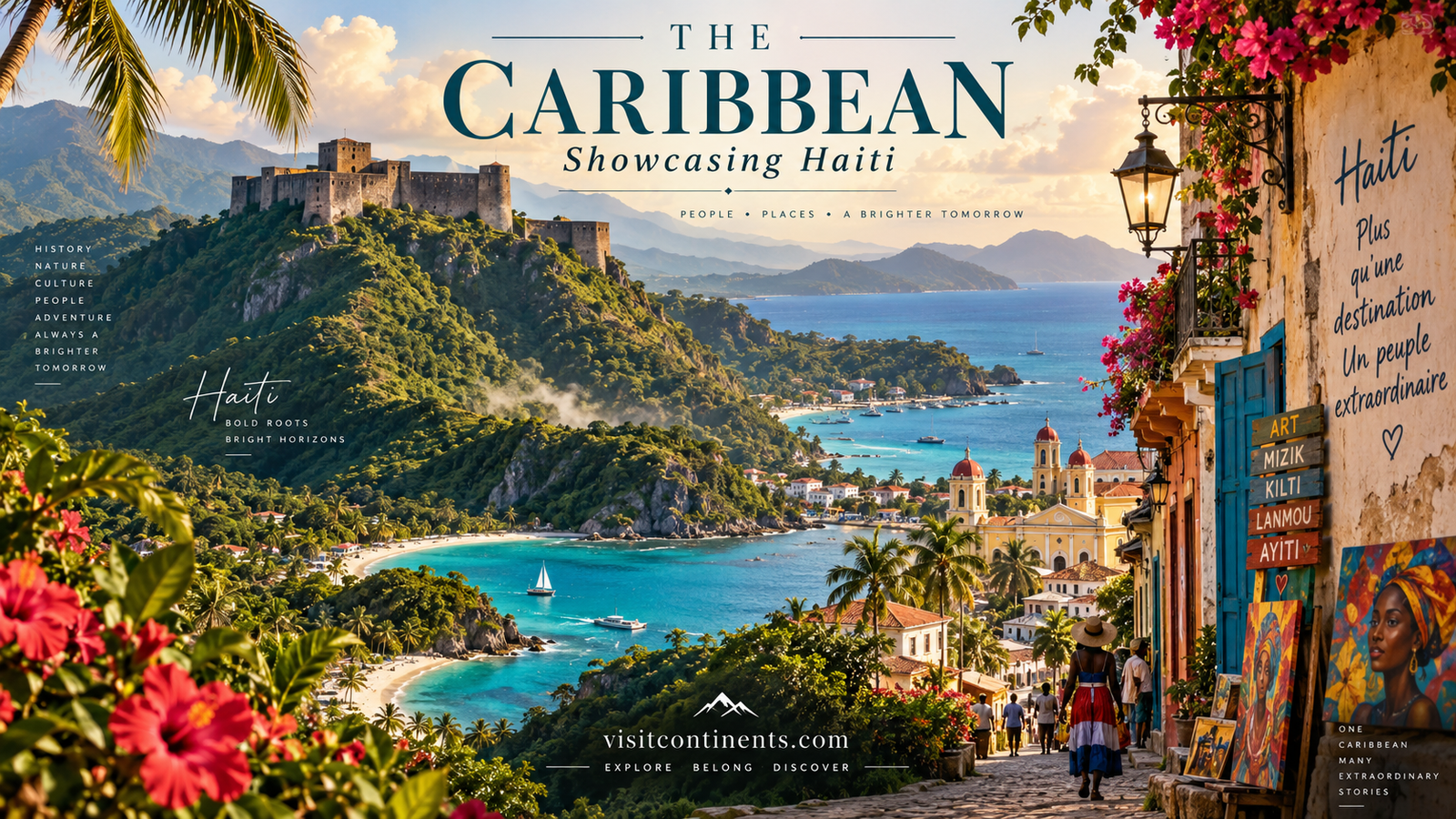
Haiti occupies the western portion of Hispaniola and is a country of remarkable historical significance, rich artistic traditions, vibrant cultural heritage, and beautiful natural landscapes.
Haiti declared independence on January 1, 1804, following the Haitian Revolution, becoming the first independent Black republic and the first modern nation established through a successful revolt by enslaved people.
This achievement represents an important chapter in the history of freedom, independence, and the abolition of slavery.
The Citadelle Laferrière, located in northern Haiti, is one of the Caribbean’s most extraordinary historical landmarks.
Built in the early nineteenth century, the fortress stands high above the surrounding mountains and symbolizes Haiti’s independence.
Nearby, the ruins of Sans-Souci Palace form part of a UNESCO World Heritage property together with the Citadelle and the buildings at Ramiers.
Cap-Haïtien and the surrounding northern region contain important historical and cultural attractions.
Jacmel is recognized for its artistic heritage, historic architecture, and traditional carnival craftsmanship.
Haitian cultural contributions include konpa, rara, painting, literature, traditional dance, and distinctive cuisine.
Popular dishes include griot, diri kole ak pwa, pikliz, legim, and soup joumou, a dish closely associated with Haitian independence and national identity.
Haiti also possesses beautiful beaches, waterfalls, mountain landscapes, and coastal environments.
However, serious security and humanitarian conditions currently affect travel throughout the country. Historical and natural attractions should not be assumed to be safely accessible, and travelers should consult current official advisories before making plans.
Haiti cultural and historical highlights
Notable destinations: Citadelle Laferrière, Sans-Souci Palace, Cap-Haïtien, Jacmel, and Bassin Bleu.
Cultural experiences: Haitian music, traditional cuisine, historical heritage, visual arts, and carnival traditions.
Travel consideration: Any proposed visit must account for current security conditions, entry requirements, and the availability of reliable transportation and essential services.
19. Jamaica
Capital: Kingston | Region: Caribbean
Jamaica is internationally recognized for its reggae music, beaches, waterfalls, tropical mountains, and cultural heritage.
Kingston is an important cultural center associated with the development of reggae and the legacy of Bob Marley.
Montego Bay, Negril, and Ocho Rios are well-known coastal destinations.
Dunn’s River Falls is one of Jamaica’s most recognizable natural attractions, while the Blue Mountains offer beautiful forested landscapes and coffee-growing regions.
Jamaican cuisine includes jerk chicken, ackee and saltfish, rice and peas, and numerous regional specialties.
Travel highlights: Kingston, Montego Bay, Negril, Dunn’s River Falls, Blue Mountains, and reggae culture.
20. Saint Kitts and Nevis
Capital: Basseterre | Region: Caribbean
Saint Kitts and Nevis is a two-island country in the eastern Caribbean known for its volcanic mountains, beaches, historic buildings, and tropical vegetation.
Brimstone Hill Fortress National Park is an important historical landmark with spectacular coastal views.
The island of Nevis offers beaches, traditional architecture, and the distinctive volcanic landscape of Mount Nevis.
Visitors can explore historic settlements, scenic viewpoints, and the islands’ maritime heritage.
Travel highlights: Basseterre, Brimstone Hill Fortress, Nevis, historic plantations, and coastal scenery.
21. Saint Lucia
Capital: Castries | Region: Caribbean
Saint Lucia is famous for its dramatic volcanic mountains, beautiful beaches, tropical rainforests, and picturesque coastal communities.
The Pitons, two steep volcanic formations rising above the southwestern coastline, are among the Caribbean’s most recognizable landmarks.
Soufrière offers access to geothermal landscapes, waterfalls, botanical gardens, and scenic coastal destinations.
Travelers can participate in guided hiking, nature exploration, cultural tours, and marine activities.
Travel highlights: Gros Piton, Petit Piton, Soufrière, Sulphur Springs, Pigeon Island, and tropical beaches.
22. Saint Vincent and the Grenadines
Capital: Kingstown | Region: Caribbean
Saint Vincent and the Grenadines consists of the main island of Saint Vincent and a chain of smaller islands in the eastern Caribbean.
The country is known for its sailing destinations, tropical forests, beautiful beaches, and remarkable marine environments.
Saint Vincent contains La Soufrière, an active volcano, while the Grenadines include islands such as Bequia, Canouan, Mayreau, and Union Island.
The Tobago Cays Marine Park is recognized for its clear waters, coral reefs, and coastal scenery.
Travel highlights: Kingstown, La Soufrière, Bequia, Tobago Cays, sailing, and snorkeling.
23. Trinidad and Tobago
Capital: Port of Spain | Region: Caribbean
Trinidad and Tobago is a twin-island country located near the northeastern coast of South America.
Trinidad is recognized for its cultural festivals, music, culinary diversity, forests, and wetlands.
Tobago offers beautiful beaches, coral reefs, coastal villages, and tropical rainforest landscapes.
Port of Spain is internationally associated with Trinidad Carnival, a major cultural celebration featuring music, dance, traditional costumes, and public performances.
The country has played an important role in the development of calypso, soca, and steelpan music.
Visitors can explore Maracas Bay, Caroni Swamp, Pigeon Point, Buccoo Reef, and the Main Ridge Forest Reserve.
Travel highlights: Trinidad Carnival, Port of Spain, Maracas Bay, Caroni Swamp, Pigeon Point, and Tobago’s marine environments.
4. Other Important North American Destinations and Territories


8
North America includes several remarkable geographical destinations that are not independent sovereign countries.
Some are overseas territories or constituent countries within larger kingdoms, while others are self-governing territories or other political jurisdictions.
They are not included in the continent’s 23-country count, but many offer distinctive cultural and natural travel experiences.
Greenland: Discover the Arctic’s Enormous Ice Sheet

Greenland is the world’s largest island and is geographically part of North America.
It is a self-governing territory within the Kingdom of Denmark.
Most of Greenland is covered by an immense ice sheet, while its coastal regions contain glaciers, mountains, fjords, and communities with a rich Inuit cultural heritage.
Ilulissat is renowned for its spectacular icefjord, where enormous icebergs move from a glacier toward the sea.
Nuuk, Greenland’s capital, offers museums, cultural institutions, restaurants, and opportunities to learn about contemporary Greenlandic life.
Travelers can enjoy guided boat excursions, designated hiking routes, wildlife observation, and experiences organized by local communities.
Travel highlights: Ilulissat Icefjord, Nuuk, glaciers, Arctic landscapes, and Inuit cultural heritage.
Puerto Rico: Historic Cities and Tropical Rainforests

Puerto Rico is an unincorporated territory of the United States, located in the northeastern Caribbean.
It offers beautiful beaches, historic neighborhoods, tropical forests, and vibrant cultural traditions.
San Juan, its capital, is famous for the colorful architecture and historic fortifications of Old San Juan.
El Yunque National Forest contains lush tropical vegetation, rivers, and waterfalls.
The islands of Vieques and Culebra offer additional coastal and marine experiences.
Puerto Rican culture reflects Indigenous, African, Spanish, and other historical influences, expressed through its music, cuisine, art, and traditions.
Travel highlights: Old San Juan, El Yunque, Vieques, Culebra, historic fortifications, and Caribbean beaches.
Aruba and Curaçao: Discover the Dutch Caribbean

Aruba and Curaçao are constituent countries within the Kingdom of the Netherlands.
Both are located in the southern Caribbean near the coast of Venezuela.
Aruba is famous for its beautiful beaches, relatively dry climate, and distinctive desert-like landscapes.
Curaçao is known for its colorful capital, Willemstad, historic architecture, coral reefs, and sheltered coastal coves.
The neighboring island of Bonaire is a special municipality of the Netherlands and is recognized for its marine conservation areas and diving opportunities.
These destinations are part of North America geographically but are not independent sovereign countries.
Travel highlights: Eagle Beach, Arikok National Park, Willemstad, coral reefs, and coastal marine excursions.
Bermuda: Pink-Sand Beaches and Atlantic Island Heritage

Bermuda is a British Overseas Territory located in the North Atlantic Ocean.
Although it lies north of the Caribbean and is not geographically part of the Caribbean island chain, it is associated with North America.
Bermuda is known for its pink-sand beaches, limestone landscapes, historic towns, and maritime heritage.
Hamilton is the territory’s capital, while St. George’s is recognized for its historic architecture and cultural significance.
Visitors can explore coastal trails, caves, beaches, museums, and marine environments.
Travel highlights: Horseshoe Bay, Hamilton, St. George’s, Crystal Caves, and coastal exploration.
5. North America’s Most Beautiful Natural Wonders

North America contains some of the world’s most recognizable natural landmarks.
Its geography ranges from Arctic ice sheets and immense mountain ranges to tropical rainforests, volcanic landscapes, extensive freshwater systems, and coral reefs.
The following attractions illustrate the continent’s remarkable environmental diversity.

The Grand Canyon — United States
Located in Arizona, the Grand Canyon is an immense geological landscape shaped by the Colorado River and millions of years of erosion. Visitors can enjoy designated viewpoints, guided hiking, and educational programs about its natural and cultural history.

Niagara Falls — Canada and the United States
Niagara Falls is a spectacular waterfall system along the international border between Ontario and New York. Visitors can experience the falls through scenic viewpoints, designated walking areas, and authorized boat excursions.

The Canadian Rockies — Canada
The Canadian Rockies contain towering mountain peaks, turquoise glacial lakes, forests, and remarkable wildlife habitats. Banff and Jasper National Parks are among the region’s established nature tourism destinations.

Yellowstone National Park — United States
Yellowstone is famous for its geothermal features, including geysers, hot springs, and colorful thermal pools. The park also supports wildlife such as bison, elk, wolves, and bears.

Arenal Volcano — Costa Rica
Arenal is one of Central America’s most recognizable volcanic landscapes, surrounded by tropical vegetation and scenic natural environments. The wider region offers designated hiking routes and guided nature excursions.

Ilulissat Icefjord — Greenland
This remarkable Arctic landscape contains enormous icebergs that break away from glaciers and move through the fjord toward the sea. Visitors can explore designated viewpoints and participate in suitable guided excursions.

The Great Blue Hole — Belize
This large marine sinkhole is located within Lighthouse Reef and is internationally recognized for its distinctive circular shape and underwater geological features.

The Pitons — Saint Lucia
Gros Piton and Petit Piton are dramatic volcanic formations rising above the southwestern coast of Saint Lucia. Their surrounding landscapes contain tropical forests, coastal environments, and culturally significant sites.
6. Wildlife in North America: From Polar Bears to Tropical Rainforests


5
North America’s extraordinary variety of climates and ecosystems supports a remarkable diversity of wildlife.
The continent contains Arctic species adapted to freezing environments, large mammals living in forests and grasslands, desert wildlife, tropical rainforest animals, and extensive marine biodiversity.
Polar bears and Arctic wildlife
The northern regions of Canada, Greenland, and Alaska provide habitats for Arctic wildlife.
Polar bears depend heavily on sea ice for hunting and other activities.
Other northern species include Arctic foxes, musk oxen, caribou, seals, and numerous migratory birds.
Travelers should observe these animals only from appropriate distances and follow local wildlife protection requirements.
Bears, bison, and mountain wildlife

The United States and Canada contain extensive habitats supporting black bears, brown bears, bison, elk, moose, mountain goats, and other large mammals.
Yellowstone National Park is recognized for its bison herds and predator populations.
Alaska offers opportunities to observe brown bears and other wildlife through professionally organized experiences.
National parks in the Canadian Rockies support mountain wildlife, including elk, bighorn sheep, and mountain goats.
Wildlife sightings are never guaranteed, and visitors must follow park regulations concerning safe distances, food storage, and animal encounters.
Tropical rainforest wildlife
Central America contains some of North America’s most biologically diverse tropical environments.
Costa Rica, Panama, Belize, Guatemala, and neighboring countries support habitats for monkeys, sloths, toucans, colorful frogs, reptiles, and numerous other species.
The region also contains important wildlife corridors connecting forests and protected areas.
Visitors can learn about tropical ecology through guided nature walks, educational conservation programs, and authorized wildlife-viewing excursions.
Marine wildlife and coral reefs

North America’s surrounding oceans support whales, dolphins, seals, sea turtles, reef fish, sharks, and numerous other marine species.
The Caribbean Sea contains important coral reef habitats, while the Pacific and Atlantic coasts provide different marine environments.
Seasonal whale-watching experiences are available in suitable locations, including parts of Canada, Alaska, Mexico, and the Caribbean.
Visitors should choose responsible operators and follow wildlife protection rules.
7. The People, Cultures, and Languages of North America


7
North America’s cultural diversity reflects thousands of years of Indigenous history, the development of distinct civilizations, European colonization, the transatlantic slave trade, migration, independence movements, and contemporary cultural exchange.
The continent is home to many different languages, religious traditions, artistic movements, cuisines, and ways of life.
It is important to recognize that North America does not have a single cultural identity. Each country contains its own communities and traditions, often with significant regional differences.
Indigenous peoples and historical heritage
Indigenous peoples inhabited North America long before European colonization.
The continent is home to numerous Indigenous nations and communities, including Inuit, First Nations, Métis, Maya, Nahua, Haudenosaunee, Diné, Cherokee, and many others.
Their histories, languages, governance traditions, artistic practices, and relationships with the land are important parts of North America’s cultural heritage.
Ancient Maya civilizations developed remarkable cities, writing systems, astronomical knowledge, and architectural traditions across parts of Mexico and Central America.
Other civilizations and societies flourished throughout the continent, leaving important archaeological and cultural evidence.
Visitors can learn about these histories through museums, archaeological sites, community-led educational experiences, and cultural institutions.
Languages of North America
English, Spanish, and French are widely spoken across the continent, but they represent only part of its linguistic diversity.
English is the principal language used in the United States and several Caribbean countries, while Spanish is widely spoken in Mexico, Central America, Cuba, the Dominican Republic, and other communities throughout the region.
French is one of Canada’s official languages and is also spoken in Haiti and other Caribbean destinations.
Haitian Creole is an official language of Haiti and is spoken by the overwhelming majority of the country’s population.
North America is also home to numerous Indigenous languages, including Inuktitut, Cree, Navajo, Nahuatl, and various Maya languages.
Caribbean communities speak a wide variety of Creole languages and regional linguistic forms.
Music and artistic traditions

North America has contributed significantly to global music, cinema, literature, dance, and contemporary artistic expression.
The United States played a central role in the development of jazz, blues, rock and roll, hip-hop, and numerous other musical forms.
Mexico is internationally recognized for mariachi and a wide variety of regional musical traditions.
Canada has distinctive Indigenous, French-speaking, English-speaking, and multicultural artistic communities.
The Caribbean has contributed reggae, dancehall, konpa, merengue, bachata, calypso, soca, steelpan music, and other influential traditions.
Central America’s artistic heritage includes Indigenous textile production, ceramics, traditional music, contemporary visual art, and regional festivals.
Exploring these cultural traditions can provide travelers with a deeper understanding of the communities that shape North America.
8. North American Food: Discover the Flavors of the Continent


5
North American cuisine reflects the continent’s enormous geographical and cultural diversity.
Regional food traditions have been shaped by Indigenous agricultural knowledge, historical trade, migration, local ingredients, and centuries of cultural exchange.
Canadian cuisine
Canada offers a wide variety of regional dishes, including poutine, tourtière, seafood, traditional Indigenous foods, and specialties associated with its many communities.
Maple syrup is an internationally recognized Canadian product and an important ingredient in some regional food traditions.
United States cuisine
The United States contains diverse culinary traditions, including barbecue, regional seafood, Southern cooking, Indigenous cuisines, and numerous immigrant-influenced food cultures.
Different states and communities have distinctive dishes and cooking methods.
Mexican cuisine
Mexican cuisine includes tacos, tamales, mole, pozole, enchiladas, and numerous regional specialties.
Corn, beans, chili peppers, tomatoes, and other ingredients have deep historical importance in Mexican and broader Mesoamerican food traditions.
Central American cuisine
Central American countries offer a wide variety of traditional dishes.
El Salvador is particularly associated with pupusas, while Guatemala, Honduras, Nicaragua, Costa Rica, Belize, and Panama each have distinctive preparations of rice, beans, corn, plantains, seafood, and regional ingredients.
Caribbean cuisine
Caribbean food traditions include Jamaican jerk chicken, Haitian griot and soup joumou, Dominican mangú, Trinidadian doubles, Barbadian flying fish, and numerous other regional dishes.
The Caribbean’s culinary heritage reflects Indigenous, African, European, Asian, and other historical influences.
Exploring local food provides opportunities to learn about the continent’s agricultural traditions, historical connections, and cultural diversity.
9. When Is the Best Time to Visit North America?

North America’s immense geographical range means that no single travel season is suitable for every destination.
The continent stretches from the Arctic to tropical Central America and the Caribbean, creating dramatically different weather patterns.
Northern destinations experience cold winters and relatively short summers, while tropical regions generally remain warm throughout the year and may have distinct wet and dry seasons.
The following table provides general seasonal guidance for popular travel regions.
|
Destination or region
|
General travel window
|
| — | — |
|
Canadian Rockies
|
June–September for many summer outdoor activities
|
|
Alaska
|
June–early September for many wilderness excursions
|
|
Northeastern United States
|
Spring through autumn for city sightseeing and outdoor recreation
|
|
Southwestern United States
|
Spring and autumn for many desert destinations
|
|
Southern Mexico
|
Varies by destination; November–April is popular in many areas
|
|
Costa Rica
|
December–April for the dry season in many Pacific regions
|
|
Guatemala
|
November–April for many highland and archaeological itineraries
|
|
Caribbean
|
December–April for generally drier weather in many destinations
|
|
Greenland
|
June–September for many summer coastal excursions
|
These periods are approximate rather than guarantees.
For example, the Caribbean’s Atlantic hurricane season officially runs from June 1 through November 30, while parts of Central America’s Pacific coast experience significant seasonal rainfall.
Travelers should research destination-specific conditions, current forecasts, and seasonal transportation availability before booking.
10. How to Plan a Trip Across North America

Traveling across North America’s 23 countries requires careful consideration of distance, transportation connections, entry requirements, personal interests, and available time.
A journey from Alaska to Panama covers an immense geographical distance, while visiting the Caribbean may require multiple flights or ferries between island nations.
A traveler who wants to explore North America in depth may find it practical to divide the journey into several regional trips.
For example, one trip could focus on Canada and the United States, another on Mexico and Central America, and a third on selected Caribbean islands.
Suggested itinerary: A 30-day introduction to North America
The following itinerary combines seven countries across Northern America, Central America, and the Caribbean.
It is an illustrative travel route, not a confirmed transportation schedule. Travelers should verify actual flight connections, border requirements, seasonal conditions, and the feasibility of each transfer.

Days 1–4
Canada — Toronto and Niagara Falls
Explore Toronto’s museums and cultural attractions before experiencing the spectacular waterfalls along the Canada–United States border.

Days 5–8
United States — New York City
Discover major landmarks, historic neighborhoods, museums, parks, and the city’s diverse cultural and culinary traditions.

Days 9–12
Mexico — Mexico City and Teotihuacán
Explore museums, traditional markets, historic architecture, regional cuisine, and important archaeological landmarks.

Days 13–16
Guatemala — Antigua and Lake Atitlán
Discover historic architecture, spectacular volcanic scenery, cultural heritage, and beautiful highland communities.

Days 17–21
Costa Rica — San José and Arenal
Experience tropical landscapes, volcanic scenery, guided rainforest excursions, and opportunities to observe local wildlife.

Days 22–25
Dominican Republic — Santo Domingo and coastal attractions
Explore the historic Colonial City, experience Dominican music and cuisine, and enjoy selected coastal destinations.
Days 26–30
Jamaica — Kingston and Ocho Rios
Discover Jamaica’s musical heritage, explore tropical landscapes, enjoy local cuisine, and visit scenic waterfalls.
This itinerary is best understood as an introduction rather than a comprehensive journey through North America.
Travelers who prefer a slower pace may choose fewer destinations, allowing additional time for cultural experiences, outdoor activities, and unexpected delays.
11. How Much Does It Cost to Visit North America?

The cost of traveling across North America depends on destination choices, travel duration, accommodation preferences, transportation, and planned activities.
A traveler exploring major cities in the United States and Canada may have different daily expenses from someone visiting rural Central America or selected Caribbean islands.
Likewise, remote Arctic expeditions, national park tours, luxury resorts, and specialized wildlife excursions can significantly increase the overall budget.
|
Travel expense
|
What to include
|
| — | — |
|
International flights
|
Transportation to and from North America
|
|
Regional transportation
|
Domestic flights, intercity buses, trains, ferries, rental cars, and fuel
|
|
Accommodation
|
Hotels, hostels, guesthouses, vacation rentals, and campsites
|
|
Food
|
Restaurants, groceries, traditional cuisine, and daily refreshments
|
|
Activities
|
Guided excursions, archaeological sites, national parks, museums, and marine tours
|
|
Travel documentation
|
Passports, visas, permits, and applicable entry authorizations
|
|
Travel insurance
|
Medical coverage, emergency evacuation, cancellations, and travel disruptions
|
|
Emergency reserve
|
Unexpected transportation, medical, or accommodation expenses
|
Travelers should compare current prices for their selected destinations rather than relying on one fixed budget for the entire continent.
Grouping geographically nearby destinations can reduce unnecessary long-distance transportation costs, although actual flight and ferry connections should always be verified.
12. Essential Travel Tips Before Visiting North America

North America contains numerous countries and territories with different legal systems, immigration requirements, climates, cultural traditions, and transportation networks.
Careful preparation can help travelers organize a more practical and enjoyable journey.
Check passport and visa requirements
Each country maintains its own immigration and entry regulations.
A visa or travel authorization valid for Canada or the United States does not automatically authorize entry into Mexico, Central America, or the Caribbean.
Travelers should verify passport validity, visa requirements, transit regulations, and any documentation required for their particular nationality.
Research local transportation
Major cities may have extensive public transportation systems, while remote destinations may depend on limited flights, rental vehicles, ferries, or specialized transport.
Travel between Caribbean islands can be more complicated than the short distances on a map might suggest.
When planning a multicountry trip, allow sufficient time for international transfers and potential delays.
Prepare for different climates
North America’s climates range from Arctic and subarctic conditions to deserts, temperate forests, tropical rainforests, and marine environments.
Travelers visiting several regions should pack according to the destinations and seasons rather than assuming that weather conditions will be similar throughout the journey.
Respect cultural and historical sites
North America contains important Indigenous cultural landscapes, archaeological sites, historic religious buildings, museums, and memorials.
Visitors should follow access rules, respect cultural traditions, and seek appropriate permission before photographing people or restricted areas.
Protect wildlife and natural environments
When exploring national parks and protected environments, maintain appropriate distances from wildlife and follow all designated routes.
Do not feed wild animals, disturb nesting sites, touch coral reefs, or remove natural and archaeological materials.
Choosing responsible tour operators can help support conservation and local communities.
Review current travel and safety conditions
Security, health, weather, and transportation conditions vary considerably across the continent.
Travelers should review official destination-specific advisories, especially before visiting remote regions or areas affected by conflict, severe weather, or infrastructure disruptions.
13. Frequently Asked Questions About North America
1. How many countries are in North America?
North America contains 23 independent countries under the commonly used geographical model: three in Northern America, seven in Central America, and 13 in the Caribbean.
2. What are the three largest mainland countries in North America?
Canada, the United States, and Mexico are the three largest countries on the continent’s main northern landmass by area.
3. What is the largest country in North America?
Canada is the largest country in North America by total area and the second-largest country in the world.
4. What is the most populous country in North America?
The United States has the largest population of any North American country.
5. Is Mexico part of North America or Central America?
Mexico is geographically part of North America. The United Nations statistical classification groups Mexico within Central America, while the narrower seven-country definition of Central America begins with Belize and Guatemala. Mexico is also part of Latin America.
6. Is the Caribbean part of North America?
Yes. The Caribbean belongs geographically to North America in the commonly used seven-continent model.
7. How many countries are in Central America?
Central America contains seven independent countries under the commonly used narrower definition: Belize, Costa Rica, El Salvador, Guatemala, Honduras, Nicaragua, and Panama.
8. How many independent countries are in the Caribbean?
The Caribbean contains 13 sovereign island countries under the commonly used geographical classification.
9. Is Greenland a country in North America?
Greenland is geographically part of North America, but it is a self-governing territory within the Kingdom of Denmark rather than an independent sovereign country.
10. What is the highest mountain in North America?
Denali, located in Alaska, is the highest mountain in North America, reaching approximately 6,190 meters above sea level.
11. What is the largest freshwater lake in North America?
Lake Superior is the largest freshwater lake in North America by surface area. It is shared by Canada and the United States.
12. Can you visit all 23 North American countries?
Visiting all 23 independent countries is a possible long-term travel goal, but access depends on immigration requirements, transportation connections, personal circumstances, and current security conditions. Some destinations may need to be postponed or visited during separate trips.
13. How long does it take to explore North America?
A one- or two-week trip can provide a meaningful introduction to selected destinations. Travelers hoping to visit all 23 countries and explore their attractions in depth may prefer several months or multiple journeys spread over several years.
14. Is North America one of the seven continents?
Yes. North America is one of the seven continents in the commonly used model, alongside Africa, Antarctica, Asia, Australia, Europe, and South America.
Conclusion: North America, a Continent of Endless Discovery

North America is a continent of extraordinary geographical diversity, fascinating history, vibrant cultures, remarkable wildlife, and unforgettable travel experiences.
Its 23 independent countries offer opportunities to discover environments ranging from the frozen Arctic landscapes of Canada and Alaska to the deserts of Mexico, the tropical forests of Central America, and the beautiful island destinations of the Caribbean.
Travelers can explore major cities such as New York, Toronto, Mexico City, and Panama City; experience the natural beauty of the Canadian Rockies, Yellowstone, and the Grand Canyon; discover the ancient Maya civilization; and learn about the rich cultural traditions of Haiti, Jamaica, the Dominican Republic, and other Caribbean nations.
Beyond its independent countries, North America also includes remarkable destinations such as Greenland, Puerto Rico, Aruba, Curaçao, and Bermuda, each offering its own history, culture, and natural attractions.
However, exploring such an immense continent requires careful planning. Long travel distances, varying climates, different immigration regulations, regional transportation networks, and local safety conditions should all be considered when preparing an itinerary.
There is no need to visit every country during one continuous journey. Some travelers may prefer to explore one region at a time, while others may organize an extended adventure connecting several neighboring destinations.
The true value of travel lies not simply in the number of countries visited, but in the knowledge gained, communities encountered, environments explored, and experiences remembered.
Whether your dream is to photograph the Grand Canyon, witness the northern lights, explore ancient Maya cities, discover Haiti’s remarkable historical heritage, experience Caribbean music, or hike through Costa Rica’s tropical rainforests, North America offers countless opportunities for adventure and cultural discovery.
For travelers seeking to visit all seven continents, North America provides a remarkable introduction to the natural beauty and cultural diversity of our planet.
VISIT CONTINENTS
Explore North America. Discover All 23 Countries.
Experience breathtaking landscapes, vibrant cities, extraordinary cultures, historic landmarks, tropical islands, remarkable wildlife, and unforgettable adventures across North America.
Explore the World. Discover Every Continent.
visitcontinents.com