VISIT CONTINENTS
VISIT CONTINENTS
Explore the World. Discover Every Continent.
visitcontinents.com
Middle East: The Ultimate Travel Guide to Its Countries, Cities, Cultures, and Beautiful Destinations

MIDDLE EAST TRAVEL GUIDE | COUNTRIES • CITIES • HISTORY • CULTURE • NATURE • ADVENTURE
The Middle East is one of the world’s most fascinating geographical and cultural regions, celebrated for its ancient civilizations, extraordinary architecture, magnificent desert landscapes, historic cities, religious heritage, and vibrant modern destinations.
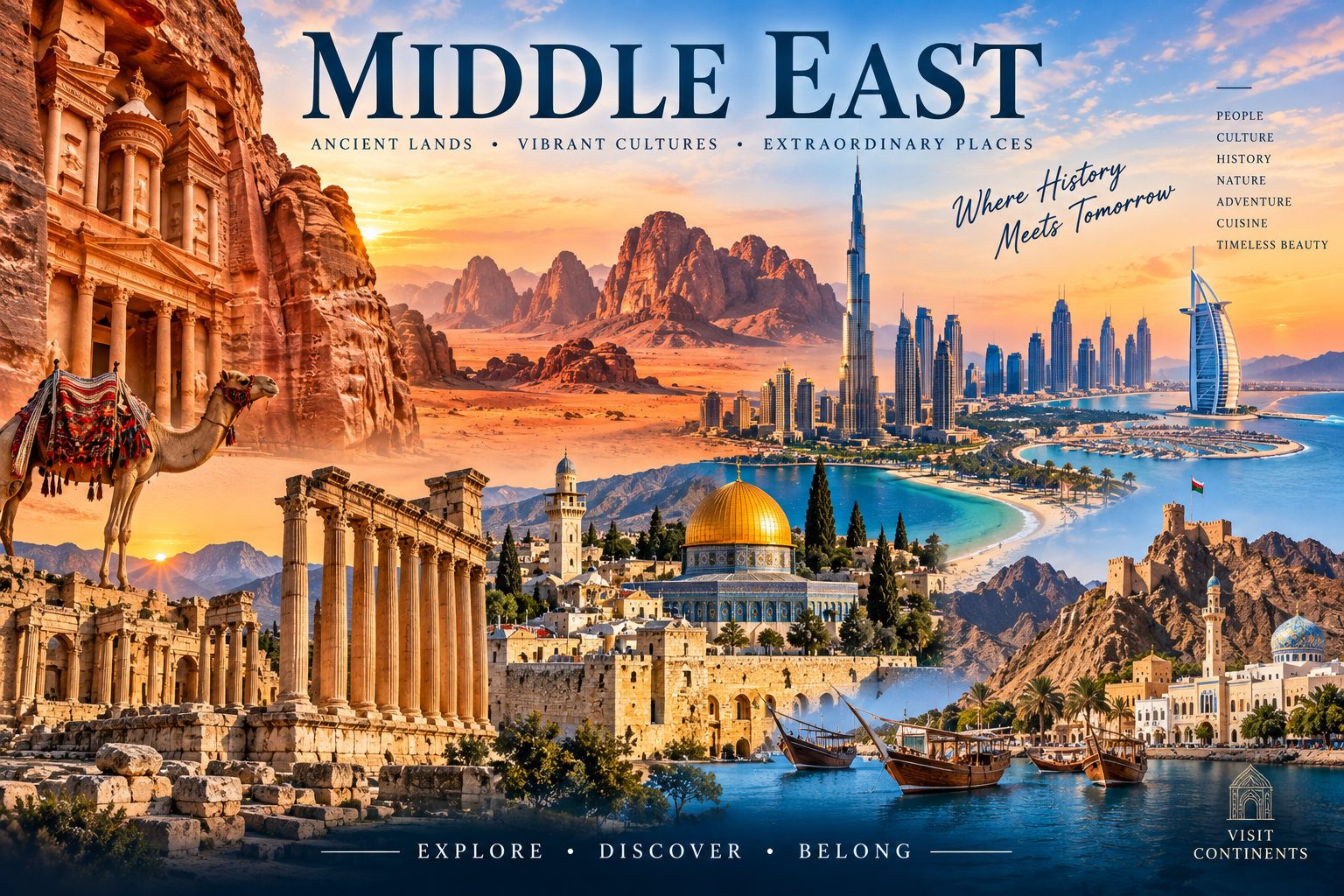
From the breathtaking skyscrapers of Dubai and the ancient pyramids of Egypt to the magnificent archaeological city of Petra in Jordan, the historic streets of Jerusalem, the colorful markets of Istanbul, and the dramatic mountains of Oman, the Middle East offers an extraordinary variety of places to discover.
The region is home to some of humanity’s earliest urban civilizations, important ancient trade routes, remarkable archaeological sites, and religious traditions that have influenced societies across the world.
Visitors can explore centuries-old mosques, churches, synagogues, temples, and archaeological monuments; experience traditional markets and regional cuisine; discover spectacular desert landscapes; and learn about the cultures and communities that shape contemporary life.
The Middle East is also a region of considerable geographical diversity. Its landscapes include the fertile valleys of the Nile, Tigris, and Euphrates rivers; the immense Arabian Desert; the mountains of Iran and Türkiye; the Mediterranean and Red Sea coastlines; and the spectacular fjords of Oman’s Musandam Peninsula.
Although the region is often associated with deserts and ancient history, it also contains thriving metropolitan areas, mountain forests, coastal ecosystems, modern universities, museums, and internationally recognized cultural institutions.
The countries and territories of the Middle East differ significantly in language, culture, history, geography, economic development, and travel conditions.
In this comprehensive Visit Continents guide, discover the countries commonly included in the Middle East, their capital cities, remarkable attractions, cultural traditions, natural landscapes, and essential information for planning a journey through this extraordinary region.
1. Discover the Middle East: Where Ancient Civilizations Meet Modern Life


4
The Middle East is a geographical and historical region centered on Western Asia and extending into northeastern Africa.
It occupies a position between Europe, Africa, and the rest of Asia, making it an important crossroads for trade, migration, cultural exchange, and international transportation.
Over thousands of years, its location contributed to the development of major civilizations, cities, commercial networks, and cultural traditions.
Today, the Middle East contains both major international cities and remote environments where communities maintain longstanding connections with local landscapes and traditional livelihoods.
The Middle East at a glance
Is the Middle East a continent?
No. The Middle East is a geographical and cultural region, not a separate continent.
Most of the region lies in Western Asia, while Egypt is primarily located in northeastern Africa. Türkiye extends across Asia and Europe.
For travelers planning to visit all seven continents, a trip to the Middle East can therefore include destinations on more than one continent.
Is the Middle East the same as the Arab world?
No. Although Arabic is widely spoken across the region, not every Middle Eastern country is an Arab country.
Iran is predominantly Persian-speaking, Türkiye is predominantly Turkish-speaking, and Israel is predominantly Hebrew-speaking. Numerous other languages are spoken throughout the region.
The Arab world is a broader cultural and linguistic grouping that also includes countries in North Africa and other parts of Africa.
The Middle East contains many distinct national, ethnic, linguistic, and religious communities and should not be understood as a single uniform culture.
2. How Many Countries Are in the Middle East?

Unlike continents with commonly established country counts, the Middle East does not have one universally accepted geographical boundary or country total.
Different sources use different definitions. Some include Egypt, Cyprus, and Türkiye, while broader definitions extend into North Africa or other parts of Asia. The United Nations uses geographical classifications such as Western Asia rather than a single statistical region named the Middle East.
Methodology
+1
For this Visit Continents guide, we will explore 16 widely recognized sovereign countries commonly associated with the Middle East, together with Palestine, whose international status and territorial circumstances require separate explanation.
This grouping is intended for geographical and travel education rather than as a statement about disputed borders or sovereignty.
List of the 16 Middle Eastern countries and Palestine
Palestine has UN non-member observer state status and is recognized as a state by many countries, but its statehood and territorial arrangements are not universally recognized. Jerusalem’s status is disputed. Sana’a is Yemen’s constitutional capital, although the location and operation of government institutions have been affected by conflict.
Methodology
+1
The following sections introduce each destination through its geography, cultural heritage, historical landmarks, and potential travel experiences. Describing a destination’s attractions does not mean that it is currently safe or accessible to tourists.
3. Explore the Countries and Destinations of the Middle East
1. Bahrain: Discover an Island Kingdom in the Persian Gulf


6
Capital: Manama | Location: Persian Gulf
Bahrain is a small island country located in the Persian Gulf, connected to Saudi Arabia by the King Fahd Causeway.
Despite its relatively small size, Bahrain has a rich history associated with ancient maritime trade, pearl diving, regional commerce, and cultural exchange.
Its capital, Manama, combines modern skyscrapers, traditional markets, museums, and historic neighborhoods.
One of Bahrain’s important archaeological attractions is Qal’at al-Bahrain, a historic settlement mound and fort associated with the ancient Dilmun civilization.
Visitors can also explore the Bahrain National Museum and the traditional neighborhoods of Muharraq, where historic buildings reflect the island’s pearl-trading heritage.
The country offers coastal recreation, restaurants, cultural institutions, and opportunities to learn about life in the Persian Gulf.
Travel highlights: Manama, Bahrain Fort, Muharraq, traditional markets, museums, and coastal experiences.
2. Cyprus: Mediterranean Beaches and Ancient Civilizations


6
Capital: Nicosia | Location: Eastern Mediterranean
Cyprus is an island country in the eastern Mediterranean, geographically associated with Western Asia but politically and culturally connected to Europe.
It is a member of the European Union and is often included in both Middle Eastern and European travel itineraries.
The island contains beautiful beaches, mountain villages, ancient archaeological sites, historic churches, and Mediterranean landscapes.
Paphos is recognized for its archaeological heritage, including ancient mosaics and historical monuments.
The Troodos Mountains offer hiking routes, forests, traditional villages, and historic religious sites.
Cyprus has been divided since 1974. The Republic of Cyprus is internationally recognized as sovereign over the island apart from the British Sovereign Base Areas, but it does not exercise effective control over the north. The Turkish Republic of Northern Cyprus is recognized only by Türkiye.
Visitors should verify applicable border-crossing, insurance, and entry requirements when planning travel between different parts of the island.
Travel highlights: Nicosia, Paphos, the Troodos Mountains, historic villages, Mediterranean beaches, and archaeological sites.
3. Egypt: Explore the Land of the Pharaohs


7
Capital: Cairo | Location: Northeastern Africa and the Sinai Peninsula
Egypt is one of the world’s most historically significant travel destinations.
Although most of Egypt lies in Africa, the Sinai Peninsula is geographically part of Asia, making Egypt a transcontinental country.
The country is famous for its ancient civilization, remarkable monuments, Nile River landscapes, desert environments, and Red Sea coastline.
The Pyramids of Giza and the Great Sphinx are among the most recognizable archaeological landmarks on Earth.
Travelers can explore the temples of Luxor, the Valley of the Kings, Aswan, and the magnificent temples of Abu Simbel.
Cairo offers museums, historic neighborhoods, markets, mosques, churches, and a rich urban cultural heritage.
Egypt’s Red Sea coast also provides opportunities for beach holidays, snorkeling, diving, and marine exploration.
The country combines ancient history with contemporary cultural life, making it a distinctive destination for travelers interested in archaeology, architecture, and regional traditions.
Travel highlights: Cairo, Giza, Luxor, Aswan, Abu Simbel, the Nile River, and Red Sea coastal destinations.
4. Iran: Ancient Persia, Historic Cities, and Mountain Landscapes


6
Capital: Tehran | Location: Western Asia
Iran is a country of immense historical and cultural significance, known for its Persian heritage, ancient civilizations, architectural achievements, mountain ranges, deserts, and artistic traditions.
Its geography includes the Zagros Mountains, the Alborz Mountains, the central Iranian plateau, and coastlines along the Caspian Sea and Persian Gulf.
Tehran is a major metropolitan center with museums, cultural institutions, historic palaces, and contemporary urban life.
Isfahan is celebrated for its monumental architecture, particularly Naqsh-e Jahan Square and its surrounding historic buildings.
Shiraz is associated with Persian poetry, gardens, and cultural heritage, while nearby Persepolis preserves the monumental remains of the ancient Achaemenid Empire.
Yazd is renowned for its traditional desert architecture, windcatchers, and historic neighborhoods.
Iran’s cultural heritage includes Persian literature, calligraphy, miniature painting, architecture, traditional crafts, and distinctive regional cuisine.
Current military and security conditions, international restrictions, and entry rules may severely affect travel. These historical attractions should be researched as cultural destinations rather than assumed to be accessible for tourism at present.
Travel highlights: Tehran, Isfahan, Shiraz, Persepolis, Yazd, Persian gardens, and historic architecture.
5. Iraq: Discover Ancient Mesopotamia


6
Capital: Baghdad | Location: Western Asia
Iraq occupies much of the historic region of Mesopotamia, where some of the world’s earliest cities and urban civilizations developed.
The Tigris and Euphrates rivers have shaped its geography, agriculture, settlement patterns, and cultural history for thousands of years.
Baghdad was a major center of scholarship, literature, trade, and scientific activity during the Islamic Golden Age.
The archaeological remains of ancient Babylon reflect the importance of Mesopotamian civilization.
Other significant historic sites include Ur and the ancient Assyrian city of Ashur.
Erbil, in the Kurdistan Region of Iraq, contains a historic citadel and a long history of urban settlement.
Iraq’s cultural heritage includes Arab, Kurdish, Assyrian, Turkmen, Yazidi, and many other communities.
However, security conditions, regional tensions, and access restrictions can make tourism difficult or dangerous. Visitors should review current official advice and local conditions before considering travel.
Travel highlights: Baghdad, Babylon, Ur, Erbil Citadel, ancient Mesopotamian heritage, and historic religious and cultural sites.
6. Israel: Historic Cities, Religious Heritage, and Diverse Landscapes


6
Declared capital: Jerusalem | Location: Eastern Mediterranean
Israel is located along the eastern Mediterranean coast and contains historically important cities, archaeological sites, coastal landscapes, mountain regions, and desert environments.
Jerusalem holds deep religious significance for Judaism, Christianity, and Islam.
Its historic sites include the Western Wall, the Church of the Holy Sepulchre, and the Haram al-Sharif/Temple Mount compound, which includes the Al-Aqsa Mosque and Dome of the Rock.
The city’s political status remains disputed and is central to the Israeli-Palestinian conflict.
Tel Aviv is known for its Mediterranean coastline, urban architecture, cultural institutions, restaurants, and contemporary arts scene.
Other historically and geographically significant locations include the ancient fortress of Masada, the Dead Sea, and the Negev Desert.
Travel conditions can change rapidly because of conflict, security measures, military activity, and restrictions on movement. Historic and cultural attractions should not be assumed to be accessible at the time of a planned visit.
Travel highlights: Jerusalem’s historic sites, Tel Aviv, Masada, the Dead Sea, archaeological heritage, and Mediterranean coastal landscapes.
7. Jordan: Petra, Wadi Rum, and the Dead Sea


6
Capital: Amman | Location: Western Asia
Jordan is known for its extraordinary archaeological heritage, desert landscapes, historic cities, and distinctive natural environments.
Petra, the ancient Nabataean city carved into rose-colored sandstone cliffs, is one of the country’s most recognizable landmarks.
Visitors can explore its monumental rock-cut architecture, historic pathways, tombs, and surrounding archaeological landscape.
Wadi Rum offers spectacular desert scenery, including towering sandstone mountains, dramatic rock formations, and expansive sandy valleys.
The Dead Sea, located along the border with Israel and the West Bank, is famous for its exceptionally saline waters and low elevation.
Amman offers museums, traditional markets, restaurants, and historic sites, while Jerash contains impressive archaeological remains associated with the Roman period.
Jordan provides opportunities to combine historical exploration, desert excursions, cultural experiences, and nature-based activities.
Travel highlights: Petra, Wadi Rum, Amman, Jerash, the Dead Sea, and the historic town of Madaba.
8. Kuwait: Modern Gulf Culture and Maritime Heritage


6
Capital: Kuwait City | Location: Persian Gulf
Kuwait is a small country on the northwestern coast of the Persian Gulf.
Its historical development is closely connected to maritime trade, fishing, pearl diving, and regional commerce.
Kuwait City is a modern urban center featuring contemporary architecture, museums, shopping areas, restaurants, and waterfront attractions.
The Kuwait Towers are among its most recognizable architectural landmarks.
Souq Al-Mubarakiya offers visitors an opportunity to experience traditional market culture, regional foods, and historic commercial surroundings.
The country’s museums and cultural institutions provide insights into Kuwaiti history, archaeology, and artistic traditions.
Visitors can also explore coastal environments and participate in organized marine or desert activities where conditions permit.
Travel highlights: Kuwait Towers, Souq Al-Mubarakiya, museums, waterfront attractions, and traditional Gulf culture.
9. Lebanon: Mediterranean Beauty and Ancient Heritage


4
Capital: Beirut | Location: Eastern Mediterranean
Lebanon is a country of remarkable geographical and cultural diversity, featuring Mediterranean coastlines, forested mountains, historic cities, archaeological sites, and longstanding culinary traditions.
Beirut is an important center of Lebanese culture, arts, education, and commerce.
Byblos is recognized for its ancient history, archaeological heritage, and picturesque harbor.
The monumental ruins of Baalbek contain some of the region’s most impressive surviving examples of Roman-era temple architecture.
Lebanon’s mountain regions provide opportunities for scenic exploration, while its traditional villages preserve distinctive architecture and regional customs.
Lebanese cuisine is internationally recognized for dishes such as hummus, tabbouleh, kibbeh, and numerous grilled and vegetable preparations.
Lebanon’s cultural and historical heritage remains significant, but armed conflict, displacement, and changing security conditions can affect access to different areas.
Travel highlights: Beirut, Byblos, Baalbek, mountain villages, historic architecture, and Lebanese cuisine.
10. Oman: Mountains, Deserts, and Coastal Adventures


4
Capital: Muscat | Location: Southeastern Arabian Peninsula
Oman is celebrated for its dramatic mountain landscapes, coastal scenery, historic forts, traditional markets, and extensive desert environments.
Muscat, the capital, offers a mixture of traditional architecture and modern urban development.
The Sultan Qaboos Grand Mosque is one of the country’s important architectural landmarks.
Visitors can explore the traditional Mutrah Souq, historic forts, coastal neighborhoods, and cultural institutions.
Wadi Shab is known for its spectacular canyon scenery and natural pools, while the Hajar Mountains provide opportunities for hiking and mountain exploration.
The Wahiba Sands, also known as the Sharqiya Sands, offer extensive desert landscapes and guided camping experiences.
Oman’s Musandam Peninsula features dramatic coastal mountains and fjord-like waterways where visitors can enjoy organized boat excursions.
Travel highlights: Muscat, Wadi Shab, Nizwa, the Hajar Mountains, Wahiba Sands, and Musandam.
11. Palestine: Historic Cities and Cultural Heritage


6
Claimed capital: East Jerusalem | Principal administrative center: Ramallah
Palestine has a rich cultural and historical heritage associated with ancient settlements, religious traditions, agriculture, architecture, literature, art, and regional cuisine.
The West Bank contains important historical destinations including Bethlehem, Jericho, Hebron, and Nablus.
Bethlehem is internationally recognized for the Church of the Nativity, a site of great importance in Christian tradition.
Jericho is associated with some of the world’s oldest evidence of urban settlement.
Palestinian cultural traditions include embroidery, ceramics, olive cultivation, traditional music, storytelling, and distinctive culinary practices.
Palestinian cuisine features dishes such as musakhan, maqluba, knafeh, and various preparations of bread, vegetables, grains, and olive oil.
The State of Palestine has United Nations non-member observer state status. The West Bank, including East Jerusalem, and Gaza are central to the unresolved Israeli-Palestinian conflict, and the movement of people is affected by security and administrative restrictions.
Methodology
+1
Ongoing conflict, severe humanitarian conditions, and restrictions on access make many destinations inaccessible or unsafe for ordinary tourism.
Cultural and historical highlights: Bethlehem, Jericho, Hebron, Nablus, historic religious sites, Palestinian art, and traditional cuisine.
12. Qatar: Modern Architecture and Arabian Heritage


8
Capital: Doha | Location: Arabian Peninsula
Qatar is a small peninsula extending into the Persian Gulf.
Its capital, Doha, is known for contemporary architecture, museums, cultural institutions, and extensive waterfront development.
The Museum of Islamic Art contains important collections representing artistic traditions from across the Islamic world.
Souq Waqif offers traditional market experiences, restaurants, crafts, and cultural attractions.
Visitors can explore Katara Cultural Village, the Doha Corniche, and modern architectural landmarks.
Outside the city, Qatar features desert environments, coastal landscapes, and Khor Al Adaid, a distinctive natural area where sand dunes meet the sea.
The country combines contemporary urban development with opportunities to learn about Arabian Peninsula history and cultural traditions.
Travel highlights: Doha, Museum of Islamic Art, Souq Waqif, Katara Cultural Village, and Khor Al Adaid.
13. Saudi Arabia: Ancient Cities, Desert Landscapes, and Cultural Heritage


4
Capital: Riyadh | Location: Arabian Peninsula
Saudi Arabia is the largest country on the Arabian Peninsula and contains extensive deserts, mountain ranges, historic settlements, and coastlines along the Red Sea and Persian Gulf.
Riyadh is a major modern city with museums, cultural institutions, shopping districts, and contemporary architecture.
Jeddah is known for its historic Al-Balad district, traditional buildings, and Red Sea coastal location.
AlUla is internationally recognized for its dramatic desert landscapes and archaeological heritage, including Hegra, an ancient Nabataean site featuring monumental tombs carved into sandstone formations.
The Asir Mountains in southwestern Saudi Arabia provide green highland landscapes and distinctive regional cultural traditions.
Saudi Arabia is also home to Mecca and Medina, Islam’s two holiest cities. Access to Mecca is restricted to Muslims, and other religious, visa, and entry requirements apply to pilgrimage and visits to sacred sites.
The country’s natural and historical destinations are significant, but regional security developments can affect travel and transportation. Travelers should verify current conditions before booking.
Travel highlights: Riyadh, Jeddah, AlUla, Hegra, Asir Mountains, desert landscapes, and Arabian cultural heritage.
14. Syria: Ancient Cities and Architectural Heritage


6
Capital: Damascus | Location: Eastern Mediterranean
Syria is a country with an exceptionally rich historical heritage, shaped by ancient civilizations, regional trade, religious traditions, and centuries of cultural exchange.
Damascus is among the world’s oldest continuously inhabited major cities and contains historic markets, religious monuments, traditional houses, and distinctive urban architecture.
Aleppo has a long history as an important commercial and cultural center.
The ancient city of Palmyra preserves important archaeological remains associated with Roman-era and earlier civilizations.
Syria is also home to historic castles, churches, mosques, traditional villages, and significant archaeological landscapes.
However, years of conflict have caused extensive destruction, displacement, and damage to historical monuments and public infrastructure.
Security conditions, territorial administration, and access restrictions remain important considerations. Travelers should not interpret the presence of historical attractions as an indication that ordinary tourism is safe or feasible.
Cultural and historical highlights: Damascus, Aleppo, Palmyra, historic architecture, ancient trade routes, and Syrian cultural traditions.
15. Türkiye: Where Europe and Asia Meet


4
Capital: Ankara | Location: Europe and Asia
Türkiye is a transcontinental country whose territory extends across southeastern Europe and Western Asia.
Its geographical position has made it an important crossroads of civilizations, trade routes, cultures, and empires.
Istanbul is one of the country’s most internationally recognized cities and stretches across both sides of the Bosphorus.
The city contains historic landmarks including Hagia Sophia, the Blue Mosque, Topkapı Palace, and the Grand Bazaar.
Cappadocia is famous for its remarkable volcanic rock formations, historic cave dwellings, and scenic hot-air balloon experiences.
Ephesus preserves impressive archaeological remains of an ancient city, while Pamukkale is recognized for its distinctive white travertine terraces.
Türkiye also offers Mediterranean and Aegean beaches, mountain landscapes, traditional villages, and a diverse culinary heritage.
Travel highlights: Istanbul, Cappadocia, Ephesus, Pamukkale, Antalya, and the Turkish Mediterranean coastline.
16. United Arab Emirates: Modern Cities and Desert Adventures


4
Capital: Abu Dhabi | Location: Arabian Peninsula
The United Arab Emirates, commonly known as the UAE, is a federation of seven emirates located along the Persian Gulf and Gulf of Oman.
Dubai is internationally recognized for its modern skyline, luxury hotels, extensive shopping districts, beaches, and contemporary attractions.
The Burj Khalifa is one of Dubai’s most recognizable landmarks and is among the tallest structures ever built.
Abu Dhabi, the federal capital, is home to the Sheikh Zayed Grand Mosque, major cultural institutions, museums, and extensive coastal development.
Visitors can also explore the historic neighborhoods of Dubai, traditional markets, desert conservation areas, and the mountains and coastlines of other emirates.
The UAE offers opportunities to experience contemporary architecture, Arabian cultural heritage, museums, coastal recreation, and guided desert excursions.
Travel highlights: Dubai, Abu Dhabi, Burj Khalifa, Sheikh Zayed Grand Mosque, historic markets, museums, and desert landscapes.
17. Yemen: Historic Architecture and the Landscapes of Socotra


6
Constitutional capital: Sana’a | Location: Southern Arabian Peninsula
Yemen is located at the southern end of the Arabian Peninsula and possesses a remarkable cultural and architectural heritage.
Its historic settlements reflect centuries of regional trade, distinctive building traditions, and connections between Africa, Arabia, and the Indian Ocean.
The old city of Sana’a is famous for its traditional multistory buildings decorated with intricate geometric patterns.
Shibam, in the Hadramaut region, is internationally recognized for its remarkable mud-brick tower houses.
The island of Socotra contains extraordinary biodiversity, including the distinctive dragon’s blood tree, whose umbrella-shaped canopy creates a remarkable landscape.
Yemeni culture includes traditional architecture, poetry, music, regional cuisine, and longstanding commercial traditions.
However, Yemen has experienced prolonged armed conflict and a severe humanitarian crisis. Access to many areas is restricted, infrastructure has been damaged, and ordinary tourism can be extremely dangerous.
Cultural and natural highlights: Historic Sana’a, Shibam, Socotra, traditional architecture, and Yemen’s distinctive biodiversity.
4. The Most Beautiful Natural Attractions in the Middle East

The Middle East contains an extraordinary range of natural environments, including vast deserts, mountains, coastlines, valleys, volcanic formations, coral reefs, and distinctive geological landscapes.
While some destinations are known for their arid environments, the region also includes forests, fertile agricultural valleys, alpine landscapes, and extensive marine ecosystems.

Wadi Rum — Jordan
Wadi Rum features towering sandstone mountains, dramatic rock formations, and expansive desert valleys. Guided excursions provide opportunities to learn about the region’s geology and Bedouin cultural heritage.

Wadi Shab — Oman
This spectacular canyon contains rocky landscapes, palm-lined sections, and natural pools. Access and swimming conditions depend on local weather and safety guidance.

The Dead Sea — Jordan, Israel, and the West Bank
This exceptionally saline lake lies at one of Earth’s lowest land elevations. Its surrounding landscape features dramatic desert mountains, salt formations, and historically significant settlements.

Cappadocia — Türkiye
Cappadocia is recognized for its unusual volcanic rock formations, historic cave settlements, and remarkable valleys. Scenic balloon flights are available when weather and operational conditions permit.

AlUla — Saudi Arabia
AlUla offers dramatic sandstone formations, desert valleys, historic oasis landscapes, and significant archaeological heritage.

The Red Sea — Egypt, Jordan, and Saudi Arabia
The Red Sea supports extensive coral reef ecosystems and diverse marine wildlife. Selected coastal destinations offer snorkeling, diving, and guided marine excursions.
5. The People, Cultures, and Languages of the Middle East


7
The Middle East’s cultural heritage reflects thousands of years of migration, trade, settlement, scientific development, artistic exchange, and religious history.
Its communities have contributed significantly to architecture, mathematics, astronomy, medicine, literature, philosophy, music, and the visual arts.
The region is home to many ethnic, linguistic, and religious communities whose identities and traditions vary greatly across countries and within individual societies.
Languages of the Middle East
Arabic is widely spoken throughout the Arabian Peninsula, the Levant, Iraq, and Egypt.
However, Arabic itself includes numerous regional varieties, and Modern Standard Arabic differs from the everyday spoken languages used in many communities.
Persian, also known as Farsi, is the principal official language of Iran.
Turkish is the principal official language of Türkiye, while Hebrew and Arabic are widely spoken in Israel, with Hebrew being its official state language and Arabic holding special status.
Kurdish is spoken by communities in parts of Türkiye, Iraq, Iran, and Syria.
Other languages include Armenian, Assyrian Neo-Aramaic, Azerbaijani, Baluchi, Circassian, and many additional regional and minority languages.
English is also widely used in international business and tourism in several Gulf countries.
Religious and historical heritage

The Middle East is historically significant to Judaism, Christianity, and Islam.
The region also contains important communities and historical sites associated with other religious traditions, including Zoroastrianism, Yazidism, Druze traditions, the Bahá’í Faith, and several ancient religious communities.
Religious buildings and historic sites are important parts of the region’s cultural landscape.
Visitors should respect local religious customs, dress requirements, photography restrictions, and the rules governing access to sacred places.
Traditional and contemporary arts
Middle Eastern artistic traditions include calligraphy, ceramics, weaving, carpet making, metalwork, jewelry, poetry, architecture, and music.
The region is also home to contemporary galleries, film festivals, universities, museums, and major cultural institutions.
Traditional artistic practices continue to evolve alongside modern design, music, literature, and digital creativity.
Travelers can discover local heritage through museums, artisan workshops, cultural festivals, and community-led experiences.
6. Middle Eastern Food: Discover the Flavors of the Region


5
Food is an important part of the Middle Eastern travel experience.
Regional cuisines reflect diverse agricultural environments, maritime trade, migration, historical cultural exchange, and longstanding culinary traditions.
Although certain ingredients and dishes are shared across borders, each country and community has its own distinctive preparations and food customs.
Levantine cuisine
Countries and communities across the Levant prepare dishes such as hummus, falafel, tabbouleh, fattoush, kibbeh, and various grilled meats and vegetables.
Traditional meals may include mezze, a selection of small dishes shared among family members and guests.
Arabian Peninsula cuisine
The Arabian Peninsula features dishes such as kabsa, mandi, machboos, and numerous regional preparations of rice, meat, seafood, dates, and spices.
Hospitality traditions often include serving coffee and dates to visitors.
Persian cuisine
Iranian cuisine includes saffron rice, kebabs, herb-rich stews, grilled meats, and a variety of traditional breads.
Regional ingredients and cooking techniques differ across the country.
Turkish cuisine
Türkiye is internationally recognized for its kebabs, börek, baklava, simit, and diverse regional specialties.
Istanbul and other major cities offer traditional markets, bakeries, restaurants, and contemporary culinary experiences.
Egyptian cuisine
Egyptian food includes koshari, ful medames, ta’ameya, molokhia, and various bread, vegetable, and meat dishes.
Traditional street food and local markets provide opportunities to experience Egyptian culinary heritage.
7. When Is the Best Time to Visit the Middle East?

The most suitable time to visit the Middle East depends on the destination, elevation, climate, and planned activities.
Much of the Arabian Peninsula experiences extremely hot summer temperatures, particularly in inland desert areas.
However, mountainous regions, Mediterranean coastal destinations, and northern countries have different seasonal patterns.
|
Travel period
|
General travel considerations
|
| — | — |
|
March–May
|
Spring conditions can be comfortable for sightseeing and outdoor activities in many destinations
|
|
June–August
|
Extreme heat affects many desert and Gulf destinations; some mountains and coastal regions have different conditions
|
|
September–November
|
Autumn often provides milder temperatures for historic cities and desert exploration
|
|
December–February
|
Cooler conditions in many Gulf destinations, with winter weather and possible snow in mountainous areas
|
For desert activities in destinations such as Oman, Jordan, and Saudi Arabia, cooler months are generally preferable to periods of extreme summer heat.
Türkiye has substantial climatic variation. Its Mediterranean coastline experiences different seasonal conditions from Istanbul, Cappadocia, and the mountainous eastern regions.
Travelers should also research religious holidays, cultural festivals, and local operating schedules before booking.
8. How to Plan a Middle Eastern Travel Itinerary

A journey through the Middle East requires careful consideration of geographical distances, entry requirements, transportation connections, climate, and personal safety.
Some destinations have extensive international flight networks and established visitor infrastructure, while others may have severe security restrictions or limited tourism services.
Travelers should organize their itinerary around destinations where current conditions permit appropriate and lawful travel rather than assuming that every country in the region can be visited during one continuous journey.
Suggested itinerary: 14 days exploring selected Middle Eastern destinations
The following is an illustrative itinerary combining cultural and natural attractions in the Arabian Peninsula. It is not a confirmed flight schedule or a current safety clearance for the destinations included.

Days 1–4
United Arab Emirates — Dubai and Abu Dhabi
Explore contemporary architecture, traditional markets, museums, historic neighborhoods, and selected desert attractions.

Days 5–8
Oman — Muscat and the surrounding region
Discover Omani architecture, historic forts, coastal scenery, traditional markets, and mountain or desert landscapes.

Days 9–11
Qatar — Doha
Visit museums, explore Souq Waqif, discover modern architectural landmarks, and experience Qatari cultural heritage.

Days 12–14
Bahrain — Manama
Explore Bahrain Fort, the historic streets of Muharraq, traditional markets, and the island’s maritime heritage.
This proposed journey requires verification of international flight availability, border requirements, insurance coverage, and the security situation in each destination.
Regional security conditions have recently affected aviation and transportation in parts of the Middle East, making it especially important to review current official notices shortly before departure.
Reuters
+1
9. How Much Does It Cost to Visit the Middle East?

The cost of visiting the Middle East depends on the countries selected, accommodation preferences, transportation, duration, and planned activities.
Major international cities offer a wide variety of hotels and dining options, while remote desert excursions, specialized guided tours, and private transportation can increase the overall budget.
A traveler visiting one city for a few days may require substantially less money than someone organizing a multicountry itinerary involving several flights and guided excursions.
|
Travel expense
|
What to include
|
| — | — |
|
International flights
|
Transportation to and from the region
|
|
Regional travel
|
Flights, trains, buses, taxis, car rentals, and airport transfers
|
|
Accommodation
|
Hotels, guesthouses, resorts, and authorized desert camps
|
|
Food
|
Restaurants, traditional markets, groceries, and refreshments
|
|
Attractions
|
Museums, archaeological sites, cultural tours, and guided excursions
|
|
Travel documentation
|
Passports, visas, entry authorizations, and applicable fees
|
|
Insurance
|
Medical coverage, evacuation, cancellations, and travel disruptions
|
|
Emergency reserve
|
Unexpected transportation, accommodation, and other necessary expenses
|
Travelers should request current prices before finalizing their budget and allow flexibility for unexpected changes.
10. Essential Travel Tips Before Visiting the Middle East

The Middle East contains many different national legal systems, cultural traditions, environmental conditions, and transportation networks.
Careful preparation is important, particularly when visiting multiple countries.
Check passport and visa requirements
Entry rules depend on the traveler’s nationality, passport type, destination, and purpose of visit.
Some countries provide electronic visas or visa-free entry for eligible travelers, while others require advance approval.
Certain destinations may impose additional entry restrictions based on travel history, nationality, or documentation.
Always verify requirements directly with the appropriate official immigration authorities before booking.
Research current security conditions
Security conditions in parts of the Middle East can change rapidly because of armed conflict, regional tensions, border restrictions, and disruptions to aviation or other transportation services.
As of September 2026, renewed military escalation has affected several parts of the region, including reported attacks involving Saudi Arabia and heightened security alerts.
Reuters
+1
Travelers should consult current official travel advisories for every destination and transit country and avoid relying solely on a general regional travel guide when making safety decisions.
Respect local cultures and customs
Cultural practices and legal requirements vary significantly across Middle Eastern countries.
Visitors should research local expectations concerning clothing, religious sites, public behavior, photography, and cultural etiquette.
Some religious sites restrict access to particular groups or require specific forms of dress.
Respectful travel involves following local regulations and asking permission before photographing people.
Prepare for heat and desert conditions
High temperatures, strong sunlight, and dry conditions can create serious risks during outdoor activities.
Carry sufficient drinking water, wear appropriate clothing, and avoid strenuous activities during periods of extreme heat.
Remote desert travel should be undertaken with suitable vehicles, communications, supplies, and experienced guides.
Protect historical and natural sites
The Middle East contains archaeological monuments, religious sites, protected landscapes, and sensitive marine ecosystems.
Visitors should follow designated routes, avoid removing archaeological materials, respect cultural restrictions, and use responsible tour operators.
11. Frequently Asked Questions About the Middle East
1. Is the Middle East a continent?
No. The Middle East is a geographical and cultural region located primarily in Western Asia, with geographical connections to northeastern Africa and southeastern Europe.
2. How many countries are in the Middle East?
There is no universally agreed count. This guide covers 16 sovereign UN member countries commonly associated with the region, together with Palestine, which has UN non-member observer state status. Other geographical definitions include additional countries or use a different grouping.
3. Is Egypt part of the Middle East or Africa?
Egypt is primarily located in Africa and is also commonly included in the Middle East. Its Sinai Peninsula lies geographically in Asia.
4. Is Türkiye in Europe or Asia?
Türkiye is a transcontinental country with territory in both Europe and Asia. Most of its land area lies in Asia.
5. What languages are spoken in the Middle East?
Arabic, Persian, Turkish, Hebrew, Kurdish, and many other regional languages are spoken throughout the Middle East.
6. What are the most famous historical attractions in the Middle East?
Well-known historical destinations include Petra in Jordan, the Pyramids of Giza in Egypt, Persepolis in Iran, Ephesus in Türkiye, and numerous ancient cities and religious landmarks throughout the region.
7. Are all Middle Eastern countries desert countries?
No. The Middle East includes deserts, mountains, forests, fertile river valleys, Mediterranean coastlines, islands, and extensive marine environments.
8. When is the best time to visit the Middle East?
Spring and autumn often provide comfortable sightseeing temperatures in many destinations. The most suitable season depends on the location, elevation, climate, and activities.
9. Can you visit multiple Middle Eastern countries during one trip?
Yes, when entry requirements, transportation connections, and security conditions permit. Travelers should verify current information for each destination before planning a multicountry journey.
10. Is the Middle East part of the seven continents?
The Middle East is not a separate continent. It is primarily part of Asia, while some of its commonly included destinations are geographically located in Africa or Europe.
Conclusion: The Middle East, a Region of Extraordinary History and Discovery

The Middle East is a region of remarkable cultural diversity, ancient history, extraordinary architecture, dramatic natural landscapes, and distinctive traditions.
From the monumental archaeological sites of Egypt and Jordan to the mountain villages of Oman, the modern cities of the Gulf, the historic neighborhoods of Türkiye, and the ancient cultural heritage of Mesopotamia and the Levant, the region contains countless opportunities for learning and discovery.
Its countries and communities have played important roles in the development of urban civilization, international trade, architecture, science, literature, religion, and artistic expression.
The Middle East also offers extraordinary geographical variety, including golden deserts, rugged mountain ranges, fertile river valleys, Mediterranean coastlines, and colorful marine ecosystems.
However, travel conditions vary considerably across the region. Some destinations have extensive visitor infrastructure, while others are affected by conflict, restrictions, or serious security challenges.
A meaningful journey requires realistic planning, respect for local communities, careful attention to entry and safety requirements, and a willingness to learn about the different cultures and histories of the places being explored.
For travelers seeking to visit all seven continents, the Middle East offers a fascinating opportunity to discover the historical and geographical connections between Asia, Africa, and Europe.
Whether your interest lies in ancient civilizations, cultural traditions, spectacular architecture, desert adventures, or modern urban experiences, the Middle East provides an extraordinary subject for exploration and learning.
VISIT CONTINENTS
Explore the Middle East. Discover Its Extraordinary Heritage.
Experience ancient civilizations, magnificent architecture, remarkable landscapes, vibrant cultures, and unforgettable destinations across the Middle East and beyond.
Explore the World. Discover Every Continent.
visitcontinents.com