VISIT CONTINENTS
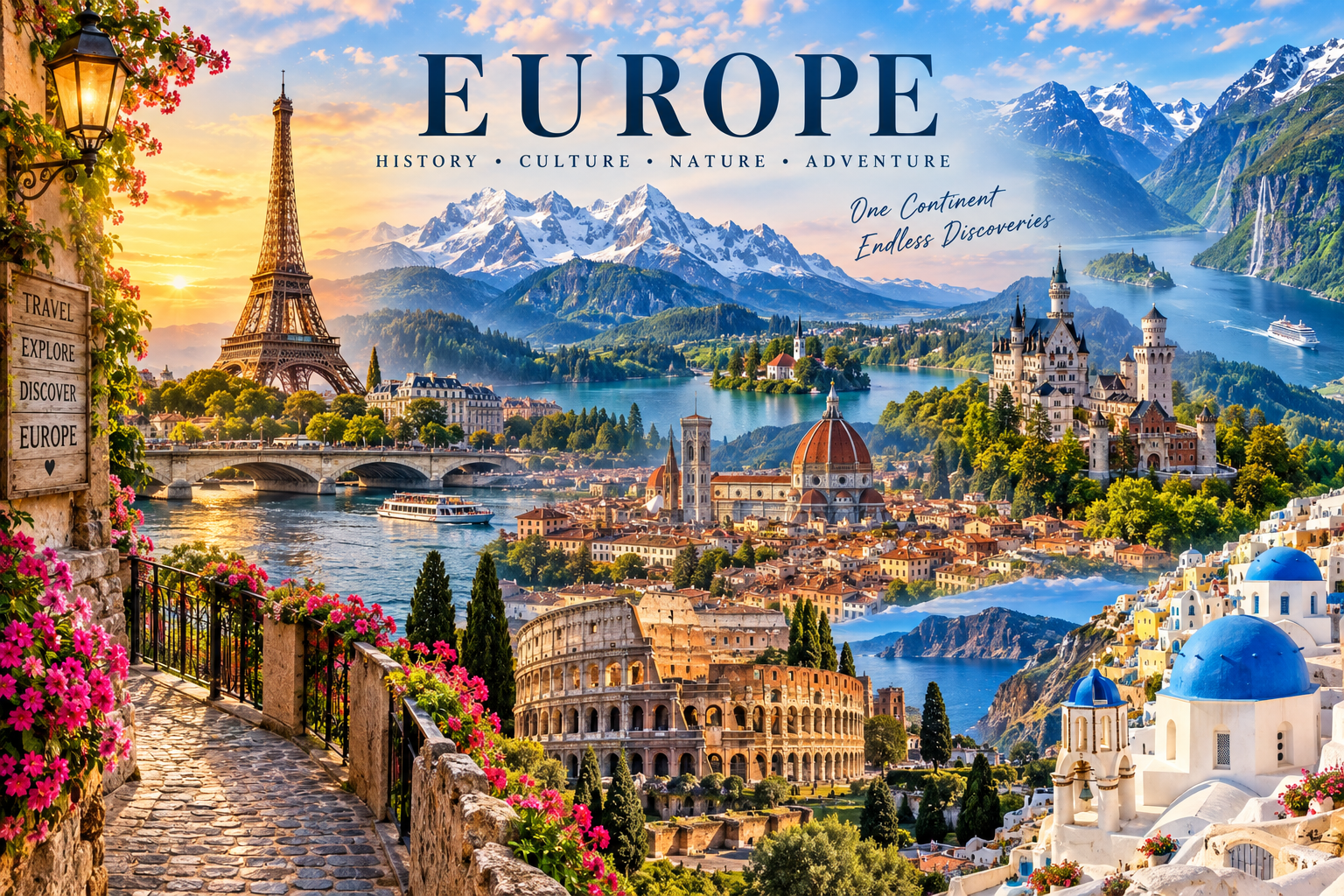
Explore the World. Discover Every Continent.
visitcontinents.com
Europe: The Ultimate Travel Guide to Its Countries, Cities, Cultures, and Beautiful Destinations

EUROPE TRAVEL GUIDE | COUNTRIES • CITIES • HISTORY • CULTURE • ADVENTURE
Europe is one of the world’s most fascinating travel destinations, celebrated for its historic cities, magnificent architecture, breathtaking natural landscapes, diverse cultures, and remarkable artistic heritage.
From the romantic streets of Paris and the ancient monuments of Rome to the snow-covered mountains of Switzerland, the coastal villages of Greece, the dramatic fjords of Norway, and the vibrant cities of Spain, Europe offers an extraordinary variety of places to explore.
Travelers can discover medieval castles, admire Renaissance masterpieces, visit centuries-old cathedrals, explore famous museums, experience cultural festivals, and enjoy cuisines that reflect the continent’s rich history and regional diversity.
Europe is also home to impressive natural environments, including the Alps, the Mediterranean coastline, the Scottish Highlands, Iceland’s volcanic landscapes, and the forests and mountain ranges of Central and Eastern Europe.
Its extensive transportation networks make it possible to travel between many countries by train, bus, airplane, ferry, or car, allowing visitors to experience multiple destinations during a single journey.
However, Europe is not a single cultural or political unit. Its countries have distinct languages, traditions, histories, economies, and travel requirements.
In this comprehensive Visit Continents guide, discover Europe’s countries, capital cities, geographical regions, famous landmarks, natural attractions, cultural traditions, cuisines, and essential information for planning your next European adventure.
1. Discover Europe: A Continent of History, Culture, and Natural Beauty


4
Europe is located primarily in the Northern Hemisphere and forms the western portion of the larger Eurasian landmass.
It is bordered by the Arctic Ocean to the north, the Atlantic Ocean to the west, and the Mediterranean, Black Sea, and neighboring regions to the south.
Europe’s eastern geographical boundary is conventionally associated with the Ural Mountains, the Ural River, the Caspian Sea, and the broader boundary between Europe and Asia. The precise boundary varies according to geographical conventions.
Although Europe is relatively small compared with Asia and Africa, it contains an extraordinary diversity of environments.
Northern Europe includes Arctic landscapes, fjords, forests, and islands. Southern Europe is known for its Mediterranean climate, beaches, and mountains. Central Europe features historic cities, forests, rivers, and alpine landscapes, while Eastern Europe encompasses extensive plains, mountain regions, and culturally diverse countries.
Europe at a glance
Is Europe the same as the European Union?
No. Europe is a geographical continent, while the European Union (EU) is a political and economic union of 27 member countries.
Several European countries are not members of the European Union, including Norway, Switzerland, Iceland, and the United Kingdom.
The Schengen Area is another distinct arrangement. It allows travel across participating countries without routine internal border checks, although entry rules, security checks, and temporary border controls may still apply.
Travelers should not assume that all European countries share the same currency, visa rules, immigration requirements, or political institutions.
2. How Many Countries Are in Europe?

Europe is commonly described as having 44 countries when using the United Nations statistical geographical classification.
However, the exact number varies according to how the geographical boundary between Europe and Asia is defined and how countries with disputed international status are counted.
For example, Russia spans Europe and Asia and is included in Europe under the UN statistical classification. Türkiye also spans both continents but is grouped statistically with Western Asia.
Cyprus is geographically located in the eastern Mediterranean and classified within Western Asia by the United Nations, although it is a member of the European Union and is frequently included in European travel guides.
Kosovo is often included in European country lists, but its independence is not universally recognized and it is not a UN member state.
For this guide, the main list follows the 44-country UN geographical classification, with additional European and transcontinental destinations discussed separately.
The complete list of Europe’s 44 countries and their capitals
ALPHABETICAL COUNTRY LIST
The Netherlands has its constitutional capital in Amsterdam, while its government and parliament are based in The Hague. Switzerland’s Bern is officially its federal city and serves as its de facto capital. Monaco and Vatican City are city-states.
3. Explore the 44 Countries of Europe
Every European country offers a distinctive combination of history, geography, culture, architecture, and natural beauty.
Some countries are known for their medieval cities and castles, while others attract travelers with beaches, mountain ranges, historical monuments, museums, and lively modern capitals.
The following guide introduces all 44 countries and highlights their notable destinations and travel experiences.
Countries 1–10: Albania to Denmark


4
1. Albania
Capital: Tirana | Region: Southern Europe
Albania is located on the Balkan Peninsula and is recognized for its Adriatic and Ionian coastlines, mountainous landscapes, historic towns, and cultural heritage.
The Albanian Riviera contains beautiful beaches, turquoise waters, and scenic coastal villages. Visitors can explore Ksamil, Sarandë, and the historic town of Himarë.
Berat and Gjirokastër are famous for their traditional architecture and historic urban landscapes.
Albania’s mountainous interior also offers opportunities for hiking, photography, and exploring traditional communities.
2. Andorra
Capital: Andorra la Vella | Region: Southern Europe
Andorra is a small, landlocked country located in the Pyrenees Mountains between France and Spain.
It is known for its mountain scenery, ski resorts, hiking trails, and traditional stone villages.
During winter, travelers can enjoy skiing and other snow-based activities, while summer provides opportunities for hiking and mountain exploration.
Andorra la Vella offers shopping, cultural attractions, and access to the surrounding valleys.
3. Austria
Capital: Vienna | Region: Western Europe
Austria is a Central European country famous for its Alpine landscapes, classical music, elegant architecture, and historic cities.
Vienna is internationally recognized for its imperial palaces, museums, concert halls, and artistic heritage.
Salzburg is associated with the composer Wolfgang Amadeus Mozart and features a beautiful historic center surrounded by mountains.
The village of Hallstatt is known for its lakeside scenery, while the Austrian Alps offer skiing, hiking, and spectacular mountain views.
4. Belarus
Capital: Minsk | Region: Eastern Europe
Belarus is a landlocked country characterized by extensive forests, lakes, agricultural landscapes, and historic towns.
Minsk, the capital, features broad avenues, museums, monuments, and cultural institutions.
The country contains important historical landmarks, including Mir Castle and the architectural complex at Nesvizh.
Belarus also has extensive forest ecosystems, including part of the ancient Białowieża Forest.
Current political conditions, security concerns, and international travel restrictions can significantly affect access, so visitors should review official guidance before considering travel.
5. Belgium
Capital: Brussels | Region: Western Europe
Belgium is known for its medieval towns, historic architecture, museums, chocolate, waffles, and culinary traditions.
Brussels is home to important European Union institutions and famous landmarks such as the Grand Place and the Atomium.
Bruges attracts visitors with its picturesque canals, cobblestone streets, and well-preserved medieval architecture.
Ghent offers historic buildings, waterfront scenery, museums, and a vibrant cultural atmosphere.
Belgium’s compact size and extensive rail network make it possible to explore several cities during a relatively short journey.
6. Bosnia and Herzegovina
Capital: Sarajevo | Region: Southern Europe
Bosnia and Herzegovina is a Balkan country known for its dramatic mountain landscapes, historic cities, rivers, and diverse cultural heritage.
Sarajevo reflects centuries of Ottoman, Austro-Hungarian, and other historical influences through its architecture, markets, and religious landmarks.
Mostar is famous for its reconstructed historic bridge, Stari Most, which spans the Neretva River.
The country also offers waterfalls, forests, mountain hiking, and traditional villages.
Visitors can explore historical museums and memorial sites that document the country’s complex twentieth-century history.
7. Bulgaria
Capital: Sofia | Region: Eastern Europe
Bulgaria is known for its Black Sea coastline, mountain ranges, Orthodox monasteries, and ancient archaeological sites.
Sofia contains historic churches, museums, Roman remains, and modern urban attractions.
Plovdiv is recognized for its historic old town, Roman theater, and cultural heritage.
Rila Monastery, located in the mountains, is one of Bulgaria’s most famous landmarks.
Travelers can also explore the Black Sea resort towns, the Rila and Pirin Mountains, and traditional villages.
8. Croatia
Capital: Zagreb | Region: Southern Europe
Croatia is celebrated for its beautiful Adriatic coastline, historic cities, islands, and national parks.
Dubrovnik is famous for its preserved medieval walls, historic old town, and spectacular coastal setting.
Split contains important Roman-era architecture, including Diocletian’s Palace.
Plitvice Lakes National Park offers remarkable waterfalls, lakes, and forest environments.
Croatia’s islands, including Hvar, Brač, and Korčula, provide opportunities for beach holidays, sailing, and coastal exploration.
9. Czechia (Czech Republic)
Capital: Prague | Region: Eastern Europe
Czechia is a Central European country known for its historic cities, castles, architecture, and cultural traditions.
Prague is famous for Charles Bridge, Prague Castle, Old Town Square, and its remarkable Gothic and Baroque architecture.
Český Krumlov features a picturesque historic center surrounded by a winding river.
Visitors can also explore Karlovy Vary, a traditional spa town, and the country’s forests, hills, and historic castles.
10. Denmark
Capital: Copenhagen | Region: Northern Europe
Denmark is a Northern European country consisting of the Jutland Peninsula and numerous islands.
Copenhagen is known for its colorful Nyhavn waterfront, historic palaces, museums, cycling culture, and contemporary architecture.
Visitors can explore Tivoli Gardens, Rosenborg Castle, and the city’s waterfront neighborhoods.
Beyond Copenhagen, Denmark offers coastal landscapes, historic villages, Viking heritage sites, and the island of Bornholm.
The Kingdom of Denmark also includes the self-governing territories of Greenland and the Faroe Islands, which have distinct identities and travel attractions.
Countries 11–20: Estonia to Latvia


4
11. Estonia
Capital: Tallinn | Region: Northern Europe
Estonia is a Baltic country recognized for its medieval architecture, forests, coastal landscapes, and digital innovation.
Tallinn’s historic old town contains cobblestone streets, medieval towers, churches, and beautiful public squares.
Outside the capital, Estonia offers national parks, wetlands, islands, and traditional rural communities.
Saaremaa is known for its coastal scenery, historic architecture, and distinctive island culture.
12. Finland
Capital: Helsinki | Region: Northern Europe
Finland is famous for its extensive forests, thousands of lakes, northern wilderness, and distinctive cultural traditions.
Helsinki offers museums, contemporary architecture, historic landmarks, and waterfront attractions.
Finnish Lapland is internationally recognized for northern lights viewing, snowy landscapes, reindeer-related experiences, and winter recreation.
During summer, travelers can explore national parks, lakeside villages, forests, and coastal islands.
Finland’s sauna tradition is also an important part of its cultural heritage.
13. France
Capital: Paris | Region: Western Europe
France is one of Europe’s major cultural and travel destinations, known for its historic cities, art, cuisine, mountains, countryside, and coastline.
Paris is famous for the Eiffel Tower, the Louvre Museum, Notre-Dame Cathedral, and its historic neighborhoods.
The French Riviera offers beautiful Mediterranean coastal destinations, including Nice and Cannes.
Visitors can explore the Loire Valley’s castles, the vineyards of Bordeaux and Burgundy, the French Alps, and the historic landscapes of Normandy.
France also includes overseas regions and territories in other parts of the world.
14. Germany
Capital: Berlin | Region: Western Europe
Germany is recognized for its historic cities, castles, forests, industrial heritage, museums, and cultural traditions.
Berlin offers important historical landmarks, including the Brandenburg Gate and sites associated with the Berlin Wall.
Munich is known for Bavarian architecture, museums, public gardens, and traditional festivals.
Travelers can explore the Black Forest, the Rhine Valley, Neuschwanstein Castle, and the Bavarian Alps.
Germany’s extensive rail network allows visitors to connect major cities and smaller regional destinations.
15. Greece
Capital: Athens | Region: Southern Europe
Greece is celebrated for its ancient civilization, archaeological sites, Mediterranean islands, coastal scenery, and distinctive cuisine.
Athens contains the Acropolis and Parthenon, among the most important surviving monuments of ancient Greek civilization.
The islands of Santorini, Crete, Rhodes, and Mykonos offer different combinations of beaches, historic sites, architecture, and traditional communities.
Meteora is famous for its monasteries perched atop dramatic rock formations.
Greece also offers mountain landscapes, ancient theaters, archaeological museums, and opportunities to explore the origins of important philosophical and artistic traditions.
16. Hungary
Capital: Budapest | Region: Eastern Europe
Hungary is a landlocked Central European country known for its historic architecture, thermal baths, rivers, cultural heritage, and culinary traditions.
Budapest is famous for the Hungarian Parliament Building, Buda Castle, the Chain Bridge, and its thermal bathing culture.
Lake Balaton is a popular destination for lakeside recreation and regional tourism.
Visitors can also discover traditional towns, historic castles, vineyards, and the landscapes of Hortobágy National Park.
17. Iceland
Capital: Reykjavík | Region: Northern Europe
Iceland is a North Atlantic island country known for its volcanoes, glaciers, waterfalls, hot springs, and dramatic landscapes.
Reykjavík offers museums, contemporary architecture, restaurants, and cultural attractions.
The Golden Circle includes Þingvellir National Park, the Geysir geothermal area, and Gullfoss waterfall.
Iceland’s southern coast features black-sand beaches, glaciers, and spectacular waterfalls.
During suitable seasons, travelers may have opportunities to observe the northern lights or experience the midnight sun.
18. Ireland
Capital: Dublin | Region: Northern Europe
Ireland is an island country known for its green landscapes, historic castles, dramatic coastline, literature, and musical traditions.
Dublin offers cultural landmarks, museums, historic architecture, and a lively urban atmosphere.
The Cliffs of Moher provide spectacular views of the Atlantic Ocean.
Travelers can explore the Ring of Kerry, the Dingle Peninsula, Connemara, and traditional villages.
Ireland also offers opportunities to learn about its Gaelic cultural heritage, historic monasteries, and literary traditions.
19. Italy
Capital: Rome | Region: Southern Europe
Italy is internationally celebrated for its ancient history, Renaissance art, architecture, cuisine, and remarkable natural landscapes.
Rome contains the Colosseum, Roman Forum, Pantheon, and numerous other historic landmarks.
Florence is famous for Renaissance art and architecture, while Venice attracts visitors with its canals and historic urban setting.
The Amalfi Coast offers dramatic Mediterranean scenery, and the Dolomites provide exceptional mountain landscapes.
Visitors can also explore Tuscany, Sicily, Naples, Milan, and the country’s many historic towns and archaeological sites.
20. Latvia
Capital: Riga | Region: Northern Europe
Latvia is a Baltic country known for its forests, sandy beaches, historic towns, and architectural heritage.
Riga features a beautiful old town and an important collection of Art Nouveau architecture.
The coastal town of Jūrmala is recognized for its beaches and traditional wooden buildings.
Gauja National Park offers forests, river valleys, castles, and outdoor recreation opportunities.
Latvian culture includes distinctive folk music, traditional crafts, and national song and dance celebrations.
Countries 21–30: Liechtenstein to Norway


5
21. Liechtenstein
Capital: Vaduz | Region: Western Europe
Liechtenstein is a small, landlocked country situated in the Alps between Switzerland and Austria.
Despite its small size, the country offers magnificent mountain landscapes, historic villages, hiking trails, and cultural attractions.
Vaduz, the capital, is known for its castle overlooking the Rhine Valley, museums, and scenic Alpine surroundings.
Visitors can explore mountain trails, enjoy winter sports, and experience the country’s distinctive cultural and historical heritage.
22. Lithuania
Capital: Vilnius | Region: Northern Europe
Lithuania is a Baltic country known for its historic cities, forests, lakes, coastal environments, and cultural traditions.
Vilnius features a beautiful historic center with Baroque architecture, churches, museums, and public squares.
Trakai is famous for its island castle surrounded by lakes.
The Curonian Spit, a narrow sandy peninsula shared with Russia’s Kaliningrad region, contains remarkable dunes, beaches, and forest landscapes.
Lithuania also offers opportunities to explore traditional villages, national parks, and historic religious sites.
23. Luxembourg
Capital: Luxembourg | Region: Western Europe
Luxembourg is a small European country bordered by Belgium, France, and Germany.
Its capital, Luxembourg City, is recognized for its historic fortifications, dramatic valleys, bridges, and distinctive urban landscape.
Visitors can explore the city’s old quarters, museums, and cultural institutions.
Beyond the capital, Luxembourg offers forests, castles, vineyards, and scenic countryside.
The Müllerthal region is particularly known for its rock formations and hiking trails.
24. Malta
Capital: Valletta | Region: Southern Europe
Malta is an island country located in the Mediterranean Sea, south of Sicily.
It is celebrated for its ancient archaeological sites, historic fortifications, beautiful coastlines, and distinctive architecture.
Valletta, the capital, contains historic churches, palaces, museums, and spectacular views of the Grand Harbour.
The island of Gozo offers rural landscapes, coastal attractions, and traditional villages.
Malta is also home to prehistoric megalithic temples and the historic walled city of Mdina.
Its cultural heritage reflects centuries of Mediterranean maritime history.
25. Moldova
Capital: Chișinău | Region: Eastern Europe
Moldova is a landlocked country located between Romania and Ukraine.
The country is known for its vineyards, agricultural landscapes, traditional villages, and historical monasteries.
Chișinău offers museums, parks, markets, and cultural institutions.
Orheiul Vechi is one of Moldova’s notable heritage destinations, featuring archaeological remains, traditional settlements, and a monastery complex within a scenic river valley.
Visitors can also explore the country’s wine-making traditions and rural cultural heritage.
The status of the breakaway Transnistria region creates additional political and travel considerations.
26. Monaco
Capital: Monaco | Region: Western Europe
Monaco is a small sovereign city-state located along the Mediterranean coast, surrounded by France.
It is internationally recognized for its coastal scenery, luxury hotels, marinas, historic architecture, and the Monaco Grand Prix.
Monte Carlo is famous for its casino, elegant streets, and cultural attractions.
Visitors can explore the Prince’s Palace, the Oceanographic Museum, the historic old town, and scenic viewpoints overlooking the Mediterranean.
Monaco’s compact size makes it possible to visit several major attractions during a short stay.
27. Montenegro
Capital: Podgorica | Region: Southern Europe
Montenegro is a Balkan country famous for its Adriatic coastline, dramatic mountains, medieval towns, and beautiful national parks.
The Bay of Kotor is one of its most recognizable landscapes, surrounded by steep mountains and historic coastal settlements.
Kotor’s old town contains medieval architecture, churches, narrow streets, and historic fortifications.
Budva offers beaches and coastal attractions, while Durmitor National Park provides opportunities for mountain hiking and outdoor exploration.
Montenegro also contains Lake Skadar, an important natural environment shared with Albania.
28. Netherlands
Capital: Amsterdam | Region: Western Europe
The Netherlands is known for its historic canals, cycling culture, museums, windmills, and distinctive low-lying landscapes.
Amsterdam is famous for its canal network, historic architecture, and internationally recognized museums, including the Rijksmuseum and Van Gogh Museum.
The Hague serves as the seat of government and contains important international institutions.
Rotterdam is recognized for its modern architecture and major port.
Travelers can also explore traditional windmill sites, flower-growing regions, historic towns, and the country’s extensive network of cycling routes.
29. North Macedonia
Capital: Skopje | Region: Southern Europe
North Macedonia is a landlocked Balkan country with mountainous landscapes, historic settlements, lakes, and diverse cultural traditions.
Skopje features museums, historic bridges, religious buildings, and public squares.
Lake Ohrid, shared with Albania, is recognized for its natural environment and cultural heritage.
The town of Ohrid offers historic churches, traditional architecture, and scenic lakeside surroundings.
Visitors can also explore mountain national parks, rural communities, and archaeological sites.
30. Norway
Capital: Oslo | Region: Northern Europe
Norway is celebrated for its spectacular fjords, mountains, waterfalls, northern lights, and extensive coastal landscapes.
Oslo offers museums, contemporary architecture, cultural institutions, and waterfront attractions.
Bergen is a historic coastal city that serves as a gateway to some of Norway’s magnificent fjord regions.
The Lofoten Islands are famous for their dramatic mountain peaks, fishing villages, beaches, and scenic coastline.
Farther north, Tromsø offers opportunities for northern lights viewing and Arctic experiences.
Svalbard, a Norwegian archipelago in the Arctic Ocean, provides a more remote polar environment with glaciers, wildlife habitats, and expedition tourism.
Countries 31–40: Poland to Sweden


5
31. Poland
Capital: Warsaw | Region: Eastern Europe
Poland is a Central European country recognized for its historic cities, medieval castles, mountain landscapes, and cultural heritage.
Warsaw features museums, historic architecture, parks, and a reconstructed old town.
Kraków is famous for its medieval market square, Wawel Castle, and historic neighborhoods.
Visitors can explore the Tatra Mountains, the Baltic coastline, and the country’s forests and lakes.
Auschwitz-Birkenau, a former Nazi German concentration and extermination camp, is an important memorial and educational site that documents the crimes of the Holocaust.
32. Portugal
Capital: Lisbon | Region: Southern Europe
Portugal is located on the western edge of the Iberian Peninsula and is known for its Atlantic coastline, historic towns, traditional architecture, and maritime heritage.
Lisbon features historic neighborhoods, scenic viewpoints, colorful tiled buildings, and distinctive trams.
Porto is recognized for its historic riverside district and wine-making heritage.
The Algarve offers coastal cliffs, beaches, and seaside towns, while the Douro Valley provides beautiful vineyard landscapes.
Portugal also includes the Atlantic archipelagos of Madeira and the Azores, known for their volcanic scenery, mountains, and natural environments.
33. Romania
Capital: Bucharest | Region: Eastern Europe
Romania is recognized for its Carpathian Mountains, historic castles, medieval towns, forests, and traditional rural landscapes.
Bucharest contains grand boulevards, museums, historic buildings, and contemporary cultural attractions.
The region of Transylvania is famous for its medieval towns, fortified churches, and mountain scenery.
Bran Castle is one of the country’s most recognizable historic landmarks.
The Danube Delta is an important wetland ecosystem supporting numerous bird species and other wildlife.
34. Russia
Capital: Moscow | Region: Eastern Europe and Northern Asia
Russia is the world’s largest country by land area and extends across both Europe and Asia.
Its European portion includes major historic cities, forests, rivers, and important cultural landmarks.
Moscow is recognized for Red Square, the Kremlin, historic churches, museums, and major cultural institutions.
Saint Petersburg is famous for its canals, imperial architecture, the Hermitage Museum, and historical significance.
Russia’s extensive geography also contains remarkable natural environments, from northern forests and Arctic coastlines to mountain ranges and large freshwater lakes.
Current international conditions, entry restrictions, and security concerns can make travel to Russia difficult or inadvisable for many visitors.
35. San Marino
Capital: San Marino | Region: Southern Europe
San Marino is a small sovereign country surrounded by Italy.
It is famous for its mountainous landscape, medieval fortifications, and historic city center.
The country’s principal landmark is Mount Titano, which is crowned by three distinctive towers.
Visitors can explore narrow streets, museums, historic architecture, and scenic viewpoints overlooking the surrounding Italian countryside.
San Marino is one of the world’s smallest sovereign states and offers a distinctive cultural and historical experience.
36. Serbia
Capital: Belgrade | Region: Southern Europe
Serbia is a landlocked Balkan country known for its historical landmarks, rivers, cultural traditions, mountain landscapes, and lively urban centers.
Belgrade is located near the confluence of the Sava and Danube rivers and features the historic Belgrade Fortress, museums, traditional neighborhoods, and cultural attractions.
Novi Sad is recognized for Petrovaradin Fortress and its arts and music scene.
The country also offers national parks, monasteries, spa towns, and opportunities for hiking and rural exploration.
37. Slovakia
Capital: Bratislava | Region: Eastern Europe
Slovakia is a Central European country recognized for its mountain ranges, medieval castles, forests, and historic towns.
Bratislava is situated along the Danube River and features a historic old town, castle, museums, and scenic waterfront.
The High Tatras offer remarkable mountain landscapes and opportunities for hiking, skiing, and nature exploration.
Slovakia is also home to traditional wooden churches, historic mining towns, and numerous castles.
38. Slovenia
Capital: Ljubljana | Region: Southern Europe
Slovenia is a small European country known for its Alpine landscapes, lakes, forests, caves, and short Adriatic coastline.
Ljubljana, the capital, is recognized for its riverside architecture, bridges, public squares, and cultural institutions.
Lake Bled is famous for its scenic island church, castle, and surrounding mountains.
Triglav National Park offers hiking and outdoor adventure opportunities, while Postojna Cave and Škocjan Caves reveal remarkable underground landscapes.
The coastal town of Piran provides Mediterranean architecture and seaside scenery.
39. Spain
Capital: Madrid | Region: Southern Europe
Spain is celebrated for its historic cities, Mediterranean beaches, distinctive architecture, regional cultures, and diverse landscapes.
Madrid offers important art museums, grand public squares, historic neighborhoods, and cultural attractions.
Barcelona is known for the architectural works of Antoni Gaudí, including the Sagrada Família.
Seville, Granada, and Córdoba contain important examples of Andalusian architectural and cultural heritage.
Visitors can also explore the Pyrenees, the Balearic Islands, the Canary Islands, and Spain’s extensive Mediterranean and Atlantic coastlines.
40. Sweden
Capital: Stockholm | Region: Northern Europe
Sweden is a Northern European country known for its forests, lakes, islands, historic cities, and Arctic landscapes.
Stockholm is built across several islands and is recognized for its historic old town, royal palace, museums, and waterfront scenery.
Gothenburg offers coastal attractions and a vibrant urban cultural scene.
Swedish Lapland provides opportunities for northern lights viewing, winter recreation, and learning about Sami cultural heritage.
The country’s national parks, forests, and archipelagos offer extensive opportunities for hiking, cycling, kayaking, and nature exploration.
Countries 41–44: Switzerland to Vatican City


4
41. Switzerland
Federal city: Bern | Region: Western Europe
Switzerland is famous for its breathtaking Alpine landscapes, beautiful lakes, picturesque villages, and historic cities.
Zurich offers museums, shopping streets, waterfront scenery, and cultural attractions.
Geneva is recognized for its international institutions and location beside Lake Geneva.
Lucerne features a historic old town, scenic lake, and access to nearby mountain excursions.
The Swiss Alps contain renowned destinations such as Zermatt, Interlaken, and the Jungfrau region.
Visitors can explore mountain trails, enjoy scenic train journeys, experience winter sports, and discover traditional Swiss cuisine.
42. Ukraine
Capital: Kyiv | Region: Eastern Europe
Ukraine is the largest country located entirely within Europe by land area.
Its landscape includes extensive plains, forests, mountains, rivers, and a Black Sea coastline.
Kyiv is known for its historic churches, monasteries, museums, and cultural institutions.
Lviv contains a historic urban center with important architectural heritage, while the Carpathian Mountains offer scenic landscapes and traditional communities.
Ukraine has a rich cultural heritage encompassing literature, music, folk art, cuisine, and historic religious architecture.
Russia’s ongoing invasion has caused extensive destruction, displacement, and serious security risks. Ordinary tourism should not be planned on the assumption that Ukraine’s attractions are safely accessible.
43. United Kingdom
Capital: London | Region: Northern Europe
The United Kingdom consists of four constituent countries: England, Scotland, Wales, and Northern Ireland.
London is famous for landmarks such as the Houses of Parliament, Tower of London, Buckingham Palace, and British Museum.
Scotland offers historic Edinburgh, the Scottish Highlands, castles, and spectacular coastal landscapes.
Wales is known for its mountain national parks, medieval castles, and distinctive cultural heritage.
Northern Ireland contains the Giant’s Causeway, historic Belfast, and scenic coastal routes.
Travelers can explore the United Kingdom through extensive rail connections, regional flights, buses, and road trips.
44. Vatican City
Capital: Vatican City | Region: Southern Europe
Vatican City is the smallest sovereign country in the world, located entirely within the city of Rome, Italy.
It is the spiritual and administrative center of the Roman Catholic Church and contains important religious, historical, and artistic landmarks.
St. Peter’s Basilica is one of its most recognizable attractions, while the Vatican Museums house extraordinary collections of art and historical objects.
The Sistine Chapel is famous for its ceiling frescoes painted by Michelangelo.
Visitors should respect religious services, dress requirements, photography restrictions, and other visitor regulations when exploring Vatican City.
4. Other European and Transcontinental Destinations


4
The 44-country list above is a useful statistical convention, but it does not cover every country or destination commonly included in European travel itineraries.
Several countries have geographical, cultural, or political connections with both Europe and Asia, while the international status of some territories remains disputed.
Cyprus
Cyprus is an island country in the eastern Mediterranean with strong historical and political connections to Europe.
Its capital is Nicosia.
The island is known for its beaches, ancient archaeological sites, mountain villages, historic churches, and Mediterranean cuisine.
Cyprus is a member of the European Union, although the UN statistical geographical classification places it in Western Asia.
Türkiye
Türkiye spans southeastern Europe and Western Asia, with Istanbul extending across both sides of the Bosphorus.
Ankara is the national capital.
Istanbul offers historic landmarks, including Hagia Sophia, the Blue Mosque, and the Grand Bazaar.
Other notable destinations include the landscapes of Cappadocia, the ruins of Ephesus, and Türkiye’s extensive Mediterranean and Aegean coastlines.
Georgia, Armenia, and Azerbaijan
These three countries are located in the South Caucasus and are sometimes included in broader discussions of Europe because of their historical, cultural, and institutional connections.
Georgia is known for Tbilisi, Caucasus mountain scenery, historic monasteries, and wine-making traditions.
Armenia offers ancient religious architecture, mountain landscapes, and cultural heritage sites.
Azerbaijan combines historic Baku, Caspian Sea landscapes, and cultural traditions associated with the Caucasus and Western Asia.
Their geographical classification varies by convention. The United Nations statistical system places all three in Western Asia.
Kosovo
Kosovo is located in the Balkans, with Pristina as its capital.
Its destinations include historic Prizren, mountain landscapes, Ottoman-era architecture, and cultural heritage sites.
Kosovo declared independence from Serbia in 2008 and is recognized by many countries, but not by Serbia or all UN member states. It is not a United Nations member.
Travelers should check applicable entry and border-crossing rules, particularly when combining Kosovo with neighboring destinations.
5. Explore Europe’s Four Major Geographical Regions

Europe is commonly divided into four geographical regions under the United Nations statistical classification: Northern, Western, Eastern, and Southern Europe.
These classifications provide a useful framework for organizing countries and planning regional travel. They do not imply that every country within a region has the same language, culture, history, or geographical characteristics.
Northern Europe

1. Northern Europe — 10 countries
Northern Europe offers Arctic landscapes, forests, lakes, historic cities, islands, and extensive coastlines.
Countries: Denmark, Estonia, Finland, Iceland, Ireland, Latvia, Lithuania, Norway, Sweden, and the United Kingdom.
Travelers can experience the northern lights, explore Norwegian fjords, discover medieval Baltic cities, visit Iceland’s glaciers, or enjoy the historic architecture of London and Dublin.
Western Europe

2. Western Europe — 9 countries
Western Europe is known for major cultural capitals, castles, museums, Alpine landscapes, historic architecture, and picturesque countryside.
Countries: Austria, Belgium, France, Germany, Liechtenstein, Luxembourg, Monaco, the Netherlands, and Switzerland.
Notable destinations include Paris, Vienna, Berlin, Amsterdam, the Swiss Alps, and the French Riviera.
Eastern Europe

3. Eastern Europe — 10 countries
Eastern Europe contains historic cities, mountain ranges, forests, agricultural plains, castles, and rich cultural traditions.
Countries: Belarus, Bulgaria, Czechia, Hungary, Poland, Moldova, Romania, Russia, Slovakia, and Ukraine.
Travelers can discover Prague’s historic architecture, Budapest’s thermal baths, Poland’s medieval cities, and Romania’s Carpathian Mountains.
Access and safety conditions differ greatly across the region, and ongoing armed conflict and associated restrictions affect travel to Ukraine, Russia, and Belarus.
Southern Europe

4. Southern Europe — 15 countries
Southern Europe is known for Mediterranean coastlines, ancient civilizations, historic settlements, islands, mountains, and diverse culinary traditions.
Countries: Albania, Andorra, Bosnia and Herzegovina, Croatia, Greece, Italy, Malta, Montenegro, North Macedonia, Portugal, San Marino, Serbia, Slovenia, Spain, and Vatican City.
Popular experiences include exploring Rome’s ancient monuments, discovering the Greek islands, visiting Barcelona, hiking in Slovenia, and enjoying the Adriatic coastline.
6. Europe’s Most Famous Landmarks and Natural Wonders
Europe contains some of the world’s most recognizable architectural monuments, archaeological sites, and natural landscapes.
From centuries-old cathedrals and magnificent palaces to mountain ranges and dramatic coastlines, the continent offers opportunities for history, culture, photography, and outdoor exploration.

Eiffel Tower — France
The Eiffel Tower is one of Paris’s most recognizable landmarks and offers spectacular views of the city. Visitors can explore the surrounding Champ de Mars and nearby museums and cultural attractions.

The Colosseum — Italy
This ancient Roman amphitheater is an important architectural and historical monument. Its surrounding archaeological area includes the Roman Forum and Palatine Hill.

The Swiss Alps — Switzerland
The Swiss Alps feature towering peaks, glaciers, lakes, scenic villages, and opportunities for hiking, skiing, and mountain railway journeys.

The Acropolis — Greece
Rising above Athens, the Acropolis contains some of ancient Greece’s most significant architectural monuments, including the Parthenon.

Norwegian Fjords — Norway
Norway’s fjords are famous for their steep mountains, deep waterways, waterfalls, and spectacular scenery. Visitors can explore selected areas by ferry, cruise, road, or hiking trail.

Sagrada Família — Spain
Barcelona’s famous basilica is renowned for its distinctive architectural design, elaborate façades, and remarkable interior.

Plitvice Lakes — Croatia
This national park features interconnected lakes, cascading waterfalls, and forest landscapes, providing memorable opportunities for nature photography and designated walking excursions.

Santorini — Greece
Santorini is known for its volcanic landscape, whitewashed villages, blue-domed churches, beautiful sunsets, and dramatic views over the Aegean Sea.
7. European Culture, Languages, and Traditions


8
Europe’s cultural heritage has developed over thousands of years through interactions among different civilizations, communities, languages, religions, and artistic movements.
Ancient Greek and Roman civilizations influenced architecture, literature, philosophy, law, and other fields.
Medieval societies developed distinctive artistic, religious, and architectural traditions, while the Renaissance, Enlightenment, and Industrial Revolution contributed to major cultural, intellectual, technological, and economic transformations.
Contemporary Europe is home to diverse communities whose identities and traditions reflect both longstanding local heritage and more recent migration and cultural exchange.
Languages of Europe
Europe contains numerous languages belonging to different linguistic families.
Romance languages include French, Spanish, Italian, Portuguese, and Romanian.
Germanic languages include English, German, Dutch, Swedish, Norwegian, Danish, and Icelandic.
Slavic languages include Polish, Czech, Slovak, Ukrainian, Bulgarian, and several other languages.
Europe is also home to languages such as Greek, Albanian, Finnish, Hungarian, Estonian, Basque, and Irish.
Many European countries recognize regional and minority languages alongside their principal national languages.
Learning a few basic expressions in the local language can enrich the travel experience and help visitors communicate respectfully.
Art, music, and architecture

Europe has contributed enormously to the development of painting, sculpture, architecture, classical music, literature, and contemporary artistic expression.
Visitors can explore museums containing works by artists such as Leonardo da Vinci, Michelangelo, Rembrandt, and Claude Monet.
Music enthusiasts can discover the cultural heritage associated with composers such as Mozart, Beethoven, and Vivaldi.
Architectural styles vary throughout Europe, from ancient Roman monuments and Gothic cathedrals to Renaissance palaces, Baroque churches, and modern buildings.
These traditions coexist with regional folk arts, contemporary music, cinema, theater, and digital creativity.
Festivals and celebrations
European festivals offer opportunities to experience local music, food, traditions, and community life.
Examples include Carnival celebrations in Venice, Oktoberfest in Munich, the Edinburgh Festival Fringe, and traditional Christmas markets in parts of Central Europe.
Numerous smaller regional festivals celebrate historical events, agricultural traditions, religious holidays, and local artistic heritage.
Travelers should check the dates and availability of specific events before arranging their itineraries.
8. European Food: Discover the Flavors of the Continent


5
European cuisine is remarkably diverse, with distinct regional traditions shaped by geography, climate, agriculture, trade, history, and cultural exchange.
Food can be an important part of exploring a destination, providing opportunities to learn about local communities and their heritage.
Italian cuisine
Italy is internationally recognized for pasta, pizza, risotto, regional cheeses, and many traditional dishes.
Different regions have distinct culinary traditions, from Neapolitan pizza to Tuscan cuisine and Sicilian specialties.
French cuisine
France is known for its bread, pastries, cheeses, regional dishes, and culinary traditions.
Travelers can explore local markets, bakeries, cafés, and restaurants offering regional specialties.
Spanish cuisine
Spanish cuisine includes paella, tortilla española, gazpacho, tapas, and numerous regional seafood and meat dishes.
The country’s culinary traditions vary considerably between the Mediterranean coast, northern regions, inland cities, and islands.
Greek cuisine
Greek food features dishes such as souvlaki, moussaka, Greek salad, and traditional pies.
Olive oil, vegetables, grains, herbs, seafood, and dairy products play important roles in many regional dishes.
German and Central European cuisine
Germany and neighboring Central European countries offer distinctive breads, dumplings, soups, stews, sausages, pastries, and regional specialties.
Traditional food markets and local restaurants provide opportunities to explore these culinary traditions.
Northern European cuisine
Northern European cuisines feature a variety of fish, seafood, berries, grains, dairy products, vegetables, and locally adapted dishes.
Traditional food cultures coexist with contemporary restaurants and international culinary influences.
9. When Is the Best Time to Visit Europe?

Europe can be visited throughout the year, but the most suitable travel season depends on the destination, activities, weather preferences, and budget.
Southern Europe generally experiences warmer summers and milder winters than northern destinations. Mountain regions can experience significant snowfall, while Mediterranean coastal areas attract visitors during warmer months.
The following seasonal guide can help travelers plan their journeys.

Spring · March–May
Historic cities, gardens, and countryside
Spring brings milder weather to many European destinations. It is a popular time to explore cities such as Paris, Rome, Amsterdam, and Prague.

Summer · June–August
Mediterranean beaches and outdoor adventures
Summer is popular for coastal vacations, island exploration, mountain hiking, and visiting northern European destinations with extended daylight.

Autumn · September–November
Cultural exploration and seasonal landscapes
Autumn often provides comfortable sightseeing conditions in many regions, with changing foliage, harvest festivals, and generally fewer visitors at some popular destinations.

Winter · December–February
Snowy mountains and seasonal celebrations
Winter offers opportunities for skiing in the Alps, visiting traditional Christmas markets, and experiencing northern lights activities in parts of northern Europe.
Travelers should also consider local holidays, school vacation periods, major festivals, and seasonal transportation schedules.
Destinations such as Venice, Paris, Rome, and Santorini can attract substantial visitor numbers during peak travel periods.
Booking popular attractions and accommodation in advance can help reduce unexpected scheduling difficulties.
10. How to Plan a European Travel Itinerary

One of Europe’s advantages for travelers is the variety of transportation options connecting cities and countries.
Many destinations can be explored by train, bus, ferry, or regional flight, allowing visitors to organize multicountry journeys.
However, travelers should avoid attempting to visit too many countries during a short trip.
An itinerary that includes time for local experiences, cultural attractions, and unexpected transportation delays can be more enjoyable than one that focuses solely on visiting as many destinations as possible.
Suggested itinerary: Seven European countries in 21 days
The following itinerary provides an example of a journey combining several well-connected European destinations.

Days 1–3
France — Paris
Visit the Eiffel Tower, explore the Louvre Museum, discover historic neighborhoods, and enjoy the city’s architecture and cultural attractions.

Days 4–5
Belgium — Brussels and Bruges
Explore Brussels’s Grand Place, discover traditional Belgian cuisine, and visit the historic canals and medieval architecture of Bruges.

Days 6–8
Netherlands — Amsterdam
Experience the city’s historic canals, museums, markets, and neighborhoods. Consider a day trip to a nearby historic town.

Days 9–11
Germany — Munich
Discover Bavarian architecture, explore museums and historic squares, and enjoy regional food and cultural attractions.

Days 12–14
Austria — Salzburg
Explore Salzburg’s historic center, visit museums, admire Alpine scenery, and discover the city’s musical heritage.

Days 15–18
Italy — Venice and Florence
Discover Venice’s canals and historic architecture before traveling to Florence to experience Renaissance art and Tuscan culture.

Days 19–21
Slovenia — Ljubljana and Lake Bled
Complete the journey with a visit to Ljubljana’s historic center and the spectacular mountain and lakeside scenery of Lake Bled.
This itinerary is an illustrative route, not a confirmed transportation schedule. Travelers should verify current train and flight connections, travel times, immigration requirements, and attraction availability before booking.
For a shorter trip, focusing on two or three neighboring countries may provide more time to explore individual destinations.
11. How Much Does a European Vacation Cost?

The cost of traveling through Europe depends on the countries visited, accommodation preferences, transportation choices, travel duration, and planned activities.
Major cities and popular resort destinations may have substantially different prices from smaller towns and rural regions.
Likewise, a traveler choosing hostels and public transportation will have different expenses from someone staying in luxury hotels and using private transportation.
Major expenses to consider
|
Travel expense
|
What to include
|
| — | — |
|
International flights
|
Flights to Europe and return transportation
|
|
Transportation within Europe
|
Trains, buses, regional flights, ferries, and local transit
|
|
Accommodation
|
Hotels, hostels, apartments, and guesthouses
|
|
Food
|
Restaurants, cafés, groceries, and regional cuisine
|
|
Attractions
|
Museums, historical sites, guided tours, and cultural experiences
|
|
Travel documentation
|
Passports, visas, and any applicable entry authorizations
|
|
Insurance
|
Medical coverage, trip cancellations, and personal belongings
|
|
Emergency reserve
|
Unexpected transportation, medical, or accommodation expenses
|
Travelers can manage expenses by comparing transportation options, booking accommodation in advance, and grouping geographically nearby destinations together.
Regional rail passes may provide value for certain itineraries, but individual tickets can sometimes be more economical. Compare the actual cost of both options before purchasing.
12. Essential Travel Tips Before Visiting Europe

A successful European journey requires careful preparation, particularly when visiting several countries during the same trip.
Check passport and visa requirements
European countries do not all have identical entry regulations.
Travelers should verify their requirements based on nationality, passport type, destination, and length of stay.
Some European countries belong to the Schengen Area, while others, including the United Kingdom and Ireland, have separate immigration arrangements.
The commonly used Schengen short-stay allowance of 90 days within any rolling 180-day period applies to many eligible non-EU visitors, but individual circumstances and visa conditions may differ.
Travelers should check current official entry requirements rather than assume that permission to enter one country automatically grants access to every European destination.
Research transportation options
Europe offers extensive international and regional transportation networks.
High-speed trains connect major cities in several countries, while buses and regional services provide access to many smaller destinations.
However, transportation infrastructure varies, and some remote mountain or island destinations may require additional planning.
Book popular attractions in advance
Major European landmarks and museums can attract large numbers of visitors, particularly during peak travel periods.
Advance reservations may be necessary for certain attractions, guided tours, and cultural events.
Travelers should use official ticketing services whenever possible and verify cancellation policies before purchasing.
Respect local cultures and customs
Europe contains many different cultural traditions, languages, religious practices, and social customs.
Visitors should research appropriate behavior at religious sites, museums, historical landmarks, and local communities.
Learning basic expressions in the local language and respecting regional etiquette can enrich the travel experience.
Prepare for seasonal weather
Europe’s climate varies greatly between Mediterranean coastlines, Alpine mountain regions, and northern Arctic destinations.
Travelers should pack clothing appropriate to the specific countries and activities in their itinerary.
Mountain conditions can change rapidly, while southern European cities may experience extreme summer heat.
Follow local safety guidance
As with any international destination, travelers should take precautions against theft, fraud, transportation disruptions, and other risks.
Keep important documents secure, use reputable transportation services, and review official travel advisories before visiting destinations affected by conflict or significant security concerns.
13. Frequently Asked Questions About Europe
1. How many countries are in Europe?
Europe contains 44 countries under the United Nations statistical geographical classification. Other geographical and political conventions may produce different counts, particularly when including transcontinental countries and Kosovo.
2. What is the largest country in Europe?
Russia is the largest country with territory in Europe. Ukraine is the largest country located entirely within Europe.
3. What is the smallest country in Europe?
Vatican City is Europe’s smallest sovereign country and the smallest sovereign state in the world by land area.
4. Is Europe the same as the European Union?
No. Europe is a continent, while the European Union is a political and economic union of 27 member countries.
5. Is the United Kingdom part of Europe?
Yes. The United Kingdom is geographically part of Europe, although it is no longer a member of the European Union.
6. Is Türkiye in Europe or Asia?
Türkiye is a transcontinental country with territory in both Europe and Asia. Most of its land area lies in Asia, while a smaller portion, including part of Istanbul, lies in Europe.
7. Is Cyprus part of Europe?
Cyprus is geographically located in the eastern Mediterranean and classified within Western Asia under the UN statistical system. It is also a member of the European Union and is commonly included in European travel itineraries.
8. Which European countries use the euro?
Many European Union countries use the euro, but not all European countries do. Currency arrangements vary and can change over time, so travelers should check the currency used by each destination before departure.
9. Can you visit several European countries during one trip?
Yes. Europe’s transportation networks make multicountry travel possible, particularly when destinations are geographically close and have reliable train, bus, ferry, or flight connections.
10. When is the best time to visit Europe?
Spring and autumn are popular for sightseeing in many European cities. Summer is suitable for many coastal and northern destinations, while winter offers skiing, seasonal festivals, and northern lights experiences in selected regions.
11. How long should you spend exploring Europe?
One or two weeks can provide a meaningful introduction to a few destinations. Travelers hoping to visit numerous countries or explore several regions in depth may prefer several months or multiple trips.
12. Is Europe one of the seven continents?
Yes. Europe is one of the seven continents in the commonly used geographical model, alongside Africa, Antarctica, Asia, Australia, North America, and South America.
Conclusion: Europe, a Continent of Endless Discovery

Europe is a continent of extraordinary cultural diversity, fascinating history, remarkable architecture, breathtaking landscapes, and unforgettable travel experiences.
From the historic streets of Rome, Paris, and Prague to the spectacular fjords of Norway, the mountain landscapes of Switzerland, the beautiful islands of Greece, and the dramatic coastlines of Portugal and Croatia, Europe offers countless opportunities for discovery.
Its 44 countries under the commonly used UN geographical classification each have their own identities, histories, languages, traditions, and natural environments.
Beyond these countries, transcontinental destinations and places with distinctive political arrangements add further depth to Europe’s geographical and cultural connections with neighboring regions.
Travelers can explore ancient monuments, admire magnificent works of art, discover medieval castles, experience cultural festivals, enjoy regional cuisine, and journey through landscapes that range from Mediterranean beaches to Arctic wilderness.
Europe’s extensive transportation networks make it possible to combine multiple destinations during the same trip, although thoughtful planning remains essential.
Whether your dream is to photograph the Eiffel Tower, explore the ancient ruins of Rome, sail through Norwegian fjords, experience the northern lights, hike through the Alps, or discover Europe’s smaller historic towns, the continent offers opportunities for many different travel interests.
For travelers seeking to visit all seven continents, Europe represents an extraordinary journey through thousands of years of history, diverse cultures, and remarkable natural beauty.
With careful preparation, curiosity, and respect for local communities, a European adventure can provide lasting memories and a deeper appreciation of the world’s cultural and geographical diversity.
VISIT CONTINENTS
Explore Europe. Discover Every Country.
Experience magnificent historic cities, breathtaking landscapes, extraordinary cultures, beautiful coastlines, and unforgettable adventures across Europe.
Explore the World. Discover Every Continent.
visitcontinents.com