VISIT CONTINENTS

ANTARCTICA TRAVEL GUIDE | EXPEDITIONS • WILDLIFE • GLACIERS • ADVENTURE
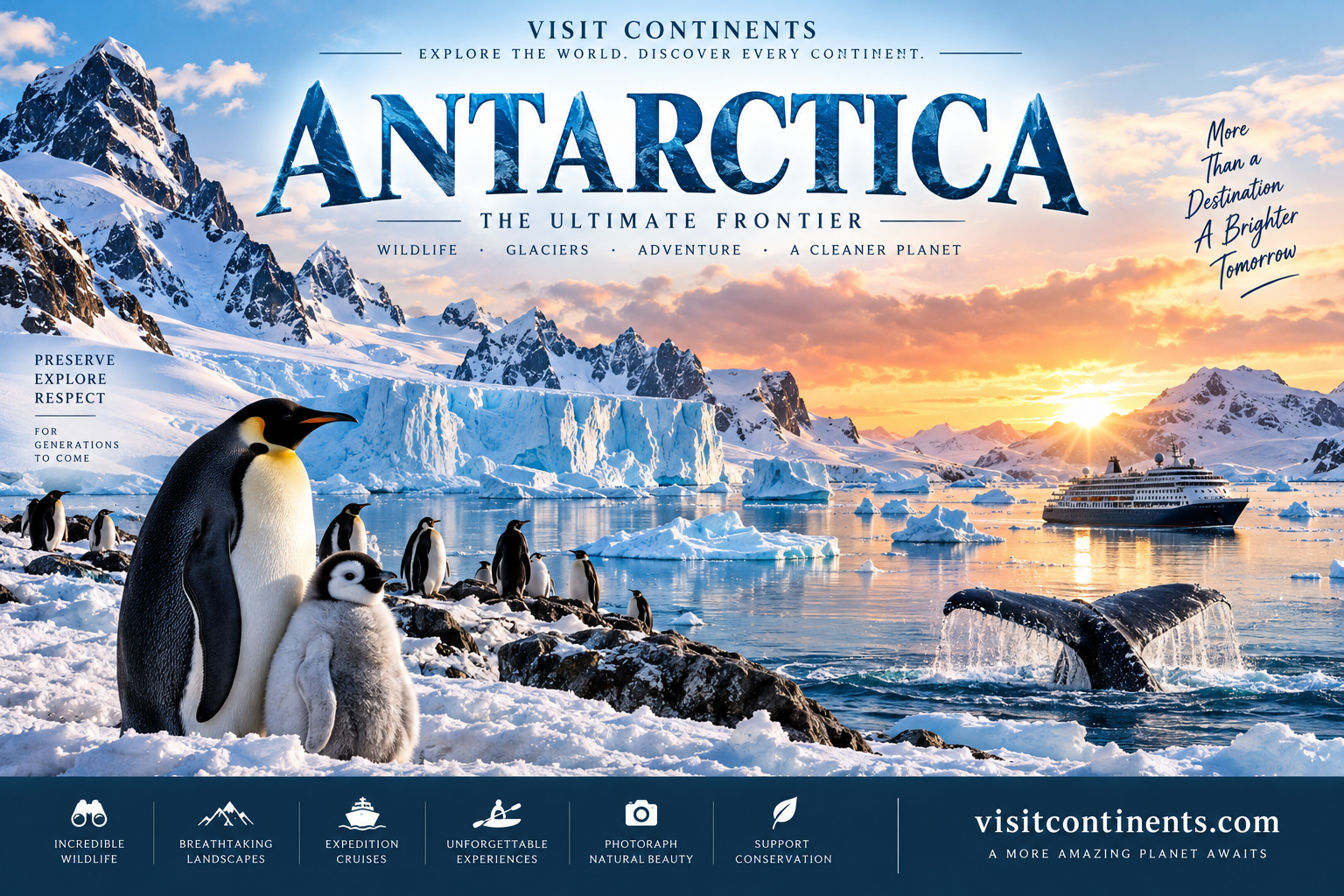
Antarctica is one of the most extraordinary and remote places on Earth. Located at the southernmost end of the planet, this vast frozen continent is renowned for its towering glaciers, enormous icebergs, snow-covered mountains, remarkable wildlife, and breathtaking polar landscapes.
Unlike the other six continents, Antarctica has no permanent cities, no indigenous human population, and no conventional road networks connecting tourist destinations. Most of its land is covered by an immense ice sheet, creating an environment unlike anywhere else in the world.
Despite its isolation and extreme conditions, Antarctica has become a remarkable destination for travelers seeking expedition adventures, wildlife encounters, scientific discovery, and opportunities to experience one of Earth’s last great wilderness regions.
Visitors can observe penguins in their natural habitats, watch whales swimming through icy waters, explore spectacular coastal landscapes, and participate in guided activities such as kayaking, photography, and expedition cruising.
However, visiting Antarctica requires careful preparation. Travel is highly seasonal, transportation options are limited, and weather conditions can change rapidly.
In this comprehensive Visit Continents guide, discover Antarctica’s geography, wildlife, history, most remarkable destinations, expedition activities, travel seasons, and everything you should know before planning a journey to the frozen continent.
1. Discover Antarctica: The Seventh Continent


6
Antarctica is the fifth-largest continent, covering approximately 14 million square kilometers, although its total ice-covered extent varies seasonally.
It surrounds the South Pole and is bordered by the Southern Ocean.
Approximately 98% of its land surface is covered by ice, with some portions of the continental ice sheet reaching several kilometers in thickness.
Antarctica is also Earth’s coldest, driest, and windiest continent. Its interior receives very little precipitation, making much of the region a polar desert despite the immense quantity of ice.
During the Antarctic summer, extended daylight provides opportunities for scientific work, exploration, and expedition tourism. During winter, much of the continent experiences prolonged darkness and extreme environmental conditions.
Antarctica at a glance
| Continent | Antarctica |
| Location | Southernmost continent, surrounding the South Pole |
| Land area | Approximately 14 million km² |
| Countries | 0 sovereign countries |
| Capital city | None |
| Permanent population | No permanent resident population |
| Climate | Polar; extremely cold and dry |
| Main travel season | November–March |
| Common gateway | Ushuaia, Argentina |
Although Antarctica has no permanent resident population, scientists, researchers, support personnel, and expedition teams live and work at research stations for varying periods.
Their presence supports important research into climate change, atmospheric conditions, marine ecosystems, geology, astronomy, and the history of Earth’s environment.
2. How Many Countries Are in Antarctica?
Unlike Africa, which has 54 widely recognized sovereign countries, Antarctica has no sovereign countries, capital cities, national government, or permanent civilian settlements.
The continent is governed through a distinctive international framework known as the Antarctic Treaty System.
The Antarctic Treaty was signed in Washington, D.C., on December 1, 1959, and entered into force on June 23, 1961.
It establishes Antarctica as a region dedicated to peaceful purposes and scientific cooperation. It also prohibits military measures such as weapons testing and military fortifications, while allowing military personnel and equipment to be used for scientific research or other peaceful purposes.
The treaty preserves the status of existing territorial claims without recognizing, invalidating, or allowing the enlargement of those claims while it remains in force.
Which countries have territorial claims in Antarctica?
Seven countries have formally asserted territorial claims to portions of Antarctica:
TERRITORIAL CLAIMANTS
1
Argentina
2
Australia
3
Chile
4
France
5
New Zealand
6
Norway
7
United Kingdom
Some claims overlap, and they are not universally recognized. The existence of these claims does not mean that Antarctica contains seven sovereign countries.
Other countries, including the United States and Russia, maintain a substantial scientific presence in Antarctica without recognizing the territorial claims of other states.
The Antarctic Treaty System provides a framework for international cooperation, environmental protection, scientific investigation, and the management of human activities on the continent.
For travelers, Antarctica’s unique political and legal status means that visiting the continent is very different from entering an ordinary country. Visitors must comply with applicable national laws, expedition requirements, and Antarctic environmental regulations.
3. The Most Beautiful Places to Visit in Antarctica

Antarctica is not a conventional tourist destination with cities, hotels, highways, and historic town centers. Instead, its attractions are natural environments shaped by ice, mountains, oceans, weather, and wildlife.
Most visitors travel along the Antarctic Peninsula and nearby islands, where expedition vessels can reach spectacular coastal landscapes during the Antarctic summer.
The specific locations accessible during any voyage depend on sea ice, weather conditions, conservation rules, vessel capabilities, and the expedition operator’s itinerary.
The Antarctic Peninsula


7
The Antarctic Peninsula is a long, mountainous extension of Antarctica that reaches northward toward South America.
It is among the continent’s most visited regions because of its relative proximity to South American departure ports and its remarkable concentration of glaciers, icebergs, wildlife habitats, and sheltered coastal waters.
Visitors may encounter large penguin colonies, seals resting on ice, and whales feeding in the surrounding waters.
The peninsula’s scenery includes steep snow-covered mountains, immense glaciers extending toward the ocean, and icebergs in striking shades of white and blue.
Many expedition cruises offer guided shore landings and small-boat excursions, allowing passengers to experience the environment beyond the main vessel.
Paradise Bay

Paradise Bay is a spectacular coastal area along the Antarctic Peninsula, famous for its mountains, glaciers, and sheltered waters.
Under calm conditions, the surrounding peaks and ice formations can create remarkable reflections on the ocean’s surface.
Expedition passengers may explore the bay aboard small boats, observe floating ice, and enjoy panoramic views of the surrounding landscape.
The area is also associated with scientific research stations, including Argentina’s Brown Station.
Wildlife sightings may include penguins, seals, and whales, although encounters vary with the season and local conditions.
Lemaire Channel

The Lemaire Channel is a narrow waterway between the Antarctic Peninsula and Booth Island.
It is renowned for its spectacular scenery, with steep mountain slopes rising above waters that may contain floating ice and large icebergs.
Expedition vessels sometimes navigate the channel when sea ice and weather conditions permit.
The surrounding landscape creates exceptional opportunities for photography, particularly when the water is calm and the mountains are reflected on its surface.
Navigation through the channel is not guaranteed, and captains may choose alternative routes when conditions are unsuitable.
Deception Island

Deception Island is a volcanic island in the South Shetland Islands, north of the Antarctic Peninsula.
Unlike Antarctica’s predominantly white landscapes, Deception Island features dark volcanic sand, rocky slopes, and a large flooded volcanic caldera.
Expedition vessels can sometimes enter the sheltered waters of the caldera through a narrow opening known as Neptune’s Bellows.
The island also contains historical remains associated with Antarctic exploration, commercial whaling, and scientific research.
Visitors may have opportunities to explore designated shore areas with expedition guides, subject to environmental restrictions and volcanic safety considerations.
South Shetland Islands

The South Shetland Islands form an archipelago north of the Antarctic Peninsula.
These islands are important habitats for seabirds, penguins, seals, and other wildlife.
King George Island is one of the archipelago’s major islands and contains several research stations operated by different countries.
Livingston Island and other parts of the archipelago feature glaciers, rocky shorelines, wildlife colonies, and extensive coastal scenery.
Many Antarctic expedition itineraries include visits to the South Shetland Islands, although the exact landing sites and available activities vary.
The South Pole

The geographic South Pole is located deep within Antarctica’s interior at 90 degrees south latitude.
Unlike the coastal regions visited by many expedition cruise passengers, the South Pole lies on the high Antarctic ice sheet, far from the ocean.
The United States operates the Amundsen-Scott South Pole Station, an important scientific research facility in this remote environment.
Reaching the South Pole typically requires specialized aircraft operations or carefully organized overland expeditions.
Visits are considerably more complex and expensive than conventional Antarctic Peninsula cruises, and access is subject to operational, environmental, and logistical restrictions.
For travelers interested in reaching the geographic South Pole itself, a standard Antarctic cruise is not sufficient.
4. Wildlife in Antarctica: Meet the Animals of the Frozen Continent


7
Despite its extreme climate, Antarctica supports a remarkable variety of wildlife.
Most of the continent’s larger animals live in marine environments or along coastal areas, where the Southern Ocean provides food and suitable habitats.
Marine food webs depend heavily on Antarctic krill, small crustaceans that serve as a vital food source for many penguins, seals, whales, fish, and seabirds.
Wildlife observation is one of the principal attractions of Antarctic expedition tourism.
Penguins
Penguins are among Antarctica’s most recognizable animals.
These flightless seabirds are specially adapted to life in cold marine environments, using their streamlined bodies and powerful flippers to swim efficiently through the water.
Several penguin species breed in Antarctica or on nearby subantarctic islands.

Emperor penguin
The emperor penguin is the largest living penguin species. It breeds on Antarctic sea ice during the harsh winter months and is famous for its remarkable adaptations to extreme cold.

Adélie penguin
Adélie penguins breed around the Antarctic coastline and nearby islands. Their distinctive white eye rings and energetic movements make them recognizable during wildlife excursions.

Gentoo penguin
Gentoo penguins are commonly encountered on Antarctic Peninsula itineraries. They are known for their orange-red bills, white markings above their eyes, and impressive swimming ability.

Chinstrap penguin
Chinstrap penguins have a narrow black line beneath the chin that gives the species its name. They gather in large breeding colonies on rocky coastal areas and nearby islands.
Travelers should choose an expedition itinerary based on the species they hope to encounter. Emperor penguins, for example, are not generally seen on standard Antarctic Peninsula cruises.
Whales

The Southern Ocean is an important feeding area for several whale species.
Humpback whales migrate to Antarctic waters to feed on krill and other small marine animals during the productive summer season.
Orcas, Antarctic minke whales, and other cetaceans may also be observed during Antarctic expeditions.
Whale sightings are especially memorable when animals surface near the expedition vessel or move through waters surrounded by icebergs.
Travelers must follow responsible wildlife-viewing procedures and allow animals to behave naturally without disturbance.
Seals

Antarctica is home to several seal species, including Weddell seals, crabeater seals, leopard seals, and Ross seals.
Weddell seals are particularly adapted to life around sea ice and can remain underwater for extended periods while searching for food.
Crabeater seals feed primarily on krill despite their name.
Leopard seals are powerful predators that feed on fish, penguins, krill, and other animals.
Expedition visitors may observe seals resting on ice floes or swimming near the coastline, but they must maintain appropriate distances and never attempt to touch or feed wildlife.
Seabirds and marine life

The Southern Ocean also supports albatrosses, petrels, skuas, and numerous other seabirds.
Beneath the water, fish, squid, krill, and many smaller organisms form interconnected marine ecosystems.
These ecosystems are important to scientific research because changes in ocean temperature, sea ice, and food availability can affect wildlife populations throughout the region.
5. What Can You Do in Antarctica? The Most Memorable Travel Experiences

Antarctica provides a range of guided activities that allow visitors to discover its landscapes and wildlife.
Unlike conventional vacations, Antarctic travel is organized around environmental conditions. Weather, sea ice, wildlife protection rules, and safety requirements determine which activities can take place.
Expedition cruising

Expedition cruising is one of the most common ways to visit Antarctica.
Specialized ships transport passengers through Antarctic waters, visiting selected coastal locations and nearby islands.
Many expedition vessels carry smaller boats that allow guides to organize shore landings and excursions.
During a voyage, travelers can attend educational presentations, learn about polar science, and observe wildlife from the ship.
Expedition itineraries commonly range from around 10 to 14 days for Antarctic Peninsula voyages departing from Ushuaia, although shorter fly-cruise options and longer voyages are also available.
Kayaking through Antarctic waters

Guided sea kayaking allows travelers to explore sheltered Antarctic waters from a different perspective.
Paddling near enormous ice formations and snow-covered coastlines can be an extraordinary experience.
Kayaking programs generally require suitable weather, appropriate equipment, and instruction from trained expedition guides.
Because some operators limit the number of participants, travelers interested in kayaking should confirm availability when selecting an expedition.
Guided shore landings

Shore landings give expedition passengers opportunities to walk through designated areas and experience Antarctica beyond the ship.
Depending on the landing location, visitors may observe penguin colonies, explore rocky or snowy terrain, view historic sites, or admire the surrounding glaciers.
Guides establish appropriate walking routes and explain how to avoid disturbing wildlife or damaging sensitive environments.
Visitors should wear suitable waterproof clothing and follow all instructions concerning safe distances, restricted areas, and biosecurity procedures.
Antarctic photography

Antarctica is a remarkable destination for landscape and wildlife photography.
Its scenery includes enormous glaciers, floating icebergs, dramatic mountains, and constantly changing light.
Wildlife photographers may capture images of penguins moving between colonies and the sea, seals resting on ice, and whales surfacing in Antarctic waters.
The Antarctic summer provides extended daylight, creating opportunities for photography at different times.
However, freezing temperatures, moisture, and rapidly changing conditions require appropriate equipment protection and careful planning.
Camping on the Antarctic Peninsula

Some expedition operators offer supervised overnight camping on the Antarctic Peninsula.
Participants may spend a night in specialized camping equipment on the snow, experiencing the quiet and isolation of Antarctica in a memorable way.
These experiences are subject to weather, operator permissions, environmental rules, and safety considerations.
Camping is not available on every expedition and should be reserved in advance when offered.
Visiting research stations and historic sites

Antarctica contains research stations and historical sites associated with scientific exploration, early expeditions, and human activity in the polar region.
Some itineraries include visits to designated historic locations or research facilities when access is permitted.
These experiences can provide insights into the challenges of working in extreme environments and the scientific importance of Antarctica.
Research stations are operational facilities rather than conventional tourist attractions, and visits are never guaranteed.
6. How Do You Get to Antarctica?

Antarctica has no conventional international airport serving ordinary commercial passenger routes to major tourist destinations.
Most travelers arrive aboard specialized expedition ships, although certain organized trips include flights to Antarctic landing sites.
The journey usually begins in South America, with Ushuaia in southern Argentina serving as a major gateway for Antarctic Peninsula voyages.
Traveling from Ushuaia, Argentina
Ushuaia is located near the southern tip of South America, along the Beagle Channel.
Travelers typically fly to Buenos Aires and then take a domestic flight to Ushuaia, where they board their Antarctic expedition vessel.
Most traditional cruises cross the Drake Passage, a stretch of ocean between South America and Antarctica.
The crossing generally takes approximately two days in each direction, depending on the ship, weather, and sea conditions.
The Drake Passage is known for potentially rough seas, although conditions can also be relatively calm.
Passengers should prepare for the possibility of seasickness and follow medical guidance regarding suitable preventive measures or treatment.
Flying to Antarctica
Some specialized expeditions offer flights from Punta Arenas, Chile, to King George Island in the South Shetland Islands.
Passengers then board an expedition vessel for their Antarctic voyage.
These fly-cruise itineraries can reduce time spent crossing the Drake Passage by ship, but flights remain highly weather-dependent and may be delayed or rescheduled.
Other specialized aviation expeditions can provide access to parts of Antarctica’s interior, including journeys associated with the South Pole.
Such trips require substantially different logistics from conventional coastal cruises.
Can you travel independently?
Most Antarctic visitors travel through organized expeditions because of the continent’s extreme conditions, limited infrastructure, environmental protections, and complex transportation requirements.
Private expeditions are possible under specific circumstances, but they require extensive planning, relevant authorizations, appropriate equipment, reliable communications, and emergency arrangements.
Antarctica should not be approached as a conventional independent backpacking destination.
7. When Is the Best Time to Visit Antarctica?


6
The main Antarctic tourism season occurs during the Southern Hemisphere’s summer, generally from November through March.
During this period, temperatures in many coastal areas are less extreme than in winter, daylight is extensive, and expedition vessels can access selected locations when sea ice permits.
However, wildlife activity, environmental conditions, and available experiences change throughout the season.
| Month | General travel experience |
|---|---|
| November | Early-season landscapes, substantial snow cover, penguin courtship and nesting activity in many areas |
| December | Long daylight hours, increasing penguin breeding activity, and extensive summer exploration opportunities |
| January | Active penguin colonies, growing chicks, and a wide range of coastal expedition activities |
| February | Penguin chicks developing and increasing opportunities for whale observations in many Antarctic Peninsula waters |
| March | Late-season wildlife encounters, changing light conditions, and the conclusion of many expedition schedules |
These descriptions are general rather than guaranteed. Weather, ice conditions, and wildlife activity differ by location and year.
Travelers primarily interested in penguins may prefer a different departure period from those hoping to observe feeding whales or see early-season sea ice.
The chosen expedition route can be just as important as the travel month.
8. How Much Does a Trip to Antarctica Cost?
Traveling to Antarctica is generally more expensive than visiting many conventional international destinations because of its remote location, specialized transportation, limited infrastructure, and strict operational requirements.
The total cost depends on the expedition operator, itinerary, vessel, cabin type, departure period, activities, and the traveler’s starting location.
For planning purposes, a conventional Antarctic Peninsula expedition may require a budget of several thousand to well over $20,000 per person for the cruise alone. Premium cabins, fly-cruise itineraries, longer expeditions, and specialized inland journeys can cost considerably more.
These figures are broad planning estimates, not current offers or confirmed prices. Travelers should request up-to-date quotations before setting a final budget.
Expenses to include
Expedition cruise
Vessel accommodation, meals, expedition staff, and included activities, as specified by the operator.
International and regional flights
Transportation to the South American departure point, including required domestic connections.
Accommodation before and after the expedition
Hotel stays and meals in departure cities, including contingency nights for transportation delays.
Travel insurance
Medical coverage, evacuation protection, trip interruption, and any activity-specific coverage required by the operator.
Cold-weather clothing and equipment
Thermal layers, waterproof clothing, gloves, appropriate footwear, and other equipment not provided by the expedition company.
Optional activities and emergency reserve
Kayaking, camping, additional excursions, gratuities, and funds for unexpected expenses.
Travelers should compare what each expedition package includes rather than selecting an itinerary based solely on its advertised price.
9. Essential Travel Preparation for Antarctica

Antarctica’s remote location and rapidly changing conditions make preparation essential.
Although guided expedition tourism provides access to specialized transportation and experienced personnel, visitors remain responsible for understanding the requirements of their chosen itinerary.
Choose a suitable expedition operator
Research expedition companies carefully before booking.
Compare their experience, vessel characteristics, passenger capacity, safety procedures, environmental practices, included activities, cancellation policies, and emergency arrangements.
Travelers can also look for operators that participate in the International Association of Antarctica Tour Operators (IAATO), an industry organization that promotes environmentally responsible Antarctic tourism.
Prepare appropriate clothing
Antarctic travelers need clothing suitable for cold temperatures, wind, snow, and wet conditions.
A layered clothing system generally includes moisture-wicking base layers, insulating garments, waterproof outerwear, warm gloves, and appropriate head protection.
Many expedition companies provide specialized boots or outerwear, but the exact equipment included varies.
Travelers should confirm the operator’s clothing requirements before purchasing or packing equipment.
Review medical and insurance requirements
Antarctica’s remoteness means access to hospitals and emergency medical facilities can be extremely limited.
Medical evacuation may be difficult, delayed by weather, or impossible under certain conditions.
Travelers should review their expedition operator’s medical requirements and disclose relevant health information through the appropriate medical screening process.
Insurance coverage should match the destination, activities, and potential evacuation needs.
Protect Antarctica’s environment

Antarctica is an environmentally sensitive destination, and visitor activities are subject to strict conservation rules.
Tourists should never feed wildlife, disturb nesting birds, remove natural materials, or leave waste behind.
Clothing and equipment must be cleaned according to expedition biosecurity procedures to reduce the risk of introducing non-native organisms.
Visitors should maintain appropriate distances from wildlife and follow all guidance from their expedition leaders.
Respect for the environment is essential to preserving Antarctica’s ecosystems and supporting continued scientific research.
10. Antarctica’s Scientific Importance

Antarctica is much more than an adventure tourism destination. It is an important center for international scientific research.
Scientists study its ice sheets, atmosphere, oceans, wildlife, and geological history to better understand Earth and the processes shaping its environment.
Climate and ice-sheet research
Antarctica contains most of the world’s freshwater ice.
Its ice sheets are important to global sea levels, and changes in their mass influence the amount of water entering the oceans.
Scientists monitor glaciers, sea ice, snowfall, ocean temperatures, and ice movement to better understand how the Antarctic environment is changing.
Ice cores extracted from the continent also preserve evidence of past atmospheric conditions, providing information about historical greenhouse gas concentrations and climate variability.
Marine ecosystems and wildlife research
Researchers study Antarctic krill, penguins, seals, whales, fish, and other organisms to understand the relationships within Southern Ocean ecosystems.
Changes in sea ice, ocean temperature, and food availability can influence where animals feed, reproduce, and migrate.
Long-term monitoring helps scientists identify ecological changes and evaluate the environmental pressures affecting wildlife populations.
Astronomy and atmospheric science
Antarctica’s dry atmosphere, remote environment, and extended polar nights make certain locations valuable for specialized astronomical observations.
Scientists also study atmospheric chemistry, including processes associated with the Antarctic ozone hole.
The continent continues to contribute important information to fields ranging from biology and geology to physics, meteorology, and oceanography.
11. The History of Antarctic Exploration

Antarctica has a remarkable history of exploration, scientific investigation, and human endurance.
Early explorers faced immense difficulties, including extreme cold, dangerous sea conditions, limited navigation technology, and the challenge of surviving in an unfamiliar environment.
Early exploration
European and American maritime expeditions encountered Antarctic waters and the continent’s surrounding islands during the eighteenth and nineteenth centuries.
In 1820, several expeditions made important observations of the Antarctic continental region, and the question of which explorer first sighted the continent remains historically debated.
Over time, additional expeditions mapped coastlines, investigated natural environments, and established a greater understanding of Antarctic geography.
The race to the South Pole

The early twentieth century included some of Antarctica’s most famous exploration journeys.
Norwegian explorer Roald Amundsen and his team became the first people confirmed to have reached the geographic South Pole on December 14, 1911.
British explorer Robert Falcon Scott and his team reached the South Pole on January 17, 1912, but died during their return journey.
These expeditions remain important chapters in the history of polar exploration.
Ernest Shackleton and the Endurance expedition

Ernest Shackleton’s Imperial Trans-Antarctic Expedition of 1914–1917 is remembered for the remarkable survival of its crew after their ship, Endurance, became trapped and was eventually crushed by sea ice.
Shackleton and his companions endured extreme conditions before a rescue mission brought the expedition’s stranded members to safety.
The shipwreck of Endurance was located in the Weddell Sea in March 2022, more than a century after the vessel sank.
Today, the history of Antarctic exploration continues to inspire travelers, historians, scientists, and those interested in the challenges of human survival in remote environments.
12. Frequently Asked Questions About Antarctica
How many countries are in Antarctica?
Antarctica has no sovereign countries. Seven countries have asserted territorial claims to portions of the continent, but those claims are not universally recognized and are subject to the Antarctic Treaty framework.
Does Antarctica have a capital city?
No. Antarctica has no national government or capital city. Scientific research stations operate in various locations across the continent.
Can tourists visit Antarctica?
Yes. Tourists can visit Antarctica through organized expeditions, typically aboard specialized ships or through selected aviation-supported programs. All visitors must comply with applicable environmental and safety requirements.
When is the best time to visit Antarctica?
The main expedition tourism season generally runs from November through March. The most suitable departure period depends on the desired wildlife experiences, activities, and itinerary.
Are there hotels in Antarctica?
Antarctica does not have conventional towns or hotel infrastructure comparable to other continents. Most tourists stay aboard expedition vessels, while some specialized inland expeditions provide temporary camp accommodation.
Do people live in Antarctica?
Antarctica has no permanent indigenous or civilian population. Scientists, researchers, and support personnel live and work at research stations for limited periods, with staffing varying by season.
Are there polar bears in Antarctica?
No. Polar bears live in the Arctic region of the Northern Hemisphere. Antarctica is known for penguins, seals, whales, seabirds, and other animals adapted to the Southern Ocean environment.
Can you see emperor penguins on an Antarctic cruise?
Emperor penguins are not generally encountered on standard Antarctic Peninsula cruises. Travelers specifically interested in seeing them should research specialized expeditions that visit appropriate habitats during suitable seasons.
Can you fly directly to Antarctica?
Specialized charter and expedition flights operate to selected Antarctic locations. However, there is no ordinary commercial airline network connecting the continent’s tourist destinations.
Can you visit the South Pole on a regular Antarctic cruise?
No. Standard Antarctic Peninsula cruises explore coastal areas and nearby islands. The geographic South Pole is located far inland and requires specialized transportation and expedition arrangements.
How long should you spend visiting Antarctica?
Many Antarctic Peninsula voyages from Ushuaia last approximately 10–14 days, including the ocean crossings. Longer itineraries and specialized expeditions may require several additional days or weeks.
Is Antarctica safe for tourists?
Organized expeditions employ trained personnel and specialized equipment, but Antarctic travel still involves risks associated with severe weather, rough seas, remote locations, wildlife, and limited emergency services. Travelers should select reputable operators and carefully assess their medical and insurance requirements.
Conclusion: Antarctica, a Continent Unlike Any Other

Antarctica is one of Earth’s most extraordinary destinations. Its vast ice sheets, towering mountains, magnificent glaciers, remarkable wildlife, and remote wilderness create experiences unlike those found on any other continent.
From observing penguins along the Antarctic Peninsula and watching whales swim through icy waters to exploring dramatic coastal landscapes, visiting historic expedition sites, and learning about scientific research, Antarctica offers travelers an opportunity to discover a remarkable part of the natural world.
Unlike the other six continents, Antarctica has no sovereign countries, permanent cities, or conventional tourism infrastructure. Its unique environment and international governance make careful preparation and responsible travel especially important.
For travelers planning to visit all seven continents, Antarctica represents a distinctive part of the journey. Reaching its shores requires planning, financial preparation, specialized transportation, and flexibility in the face of changing environmental conditions.
Yet the experience offers more than an opportunity to complete a travel milestone. Visiting Antarctica can deepen our understanding of Earth’s natural systems, the importance of scientific research, and the responsibility we share to protect vulnerable environments.
Whether your dream is to photograph enormous blue icebergs, watch penguins in their natural habitats, kayak through sheltered Antarctic waters, or simply experience the extraordinary silence of a polar landscape, the frozen continent offers a world of discovery.
VISIT CONTINENTS
Explore Antarctica. Discover the Frozen Continent.
Experience remarkable destinations, discover extraordinary wildlife, and find inspiration for your next adventure across all seven continents.
Explore the World. Discover Every Continent.
visitcontinents.com