VISIT CONTINENTS

ARCTIC TRAVEL GUIDE | POLAR EXPLORATION • WILDLIFE • NORTHERN LIGHTS • GLACIERS
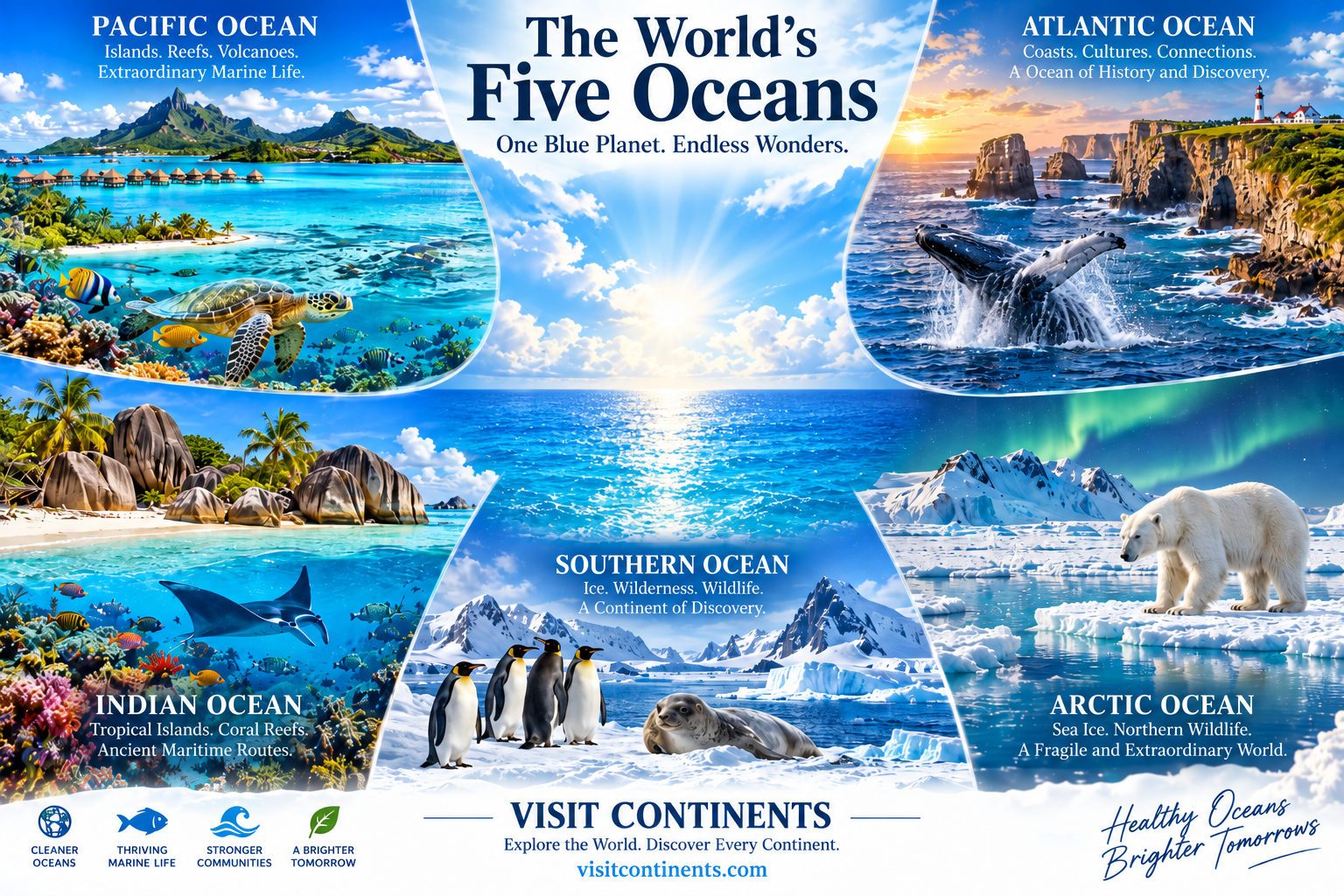
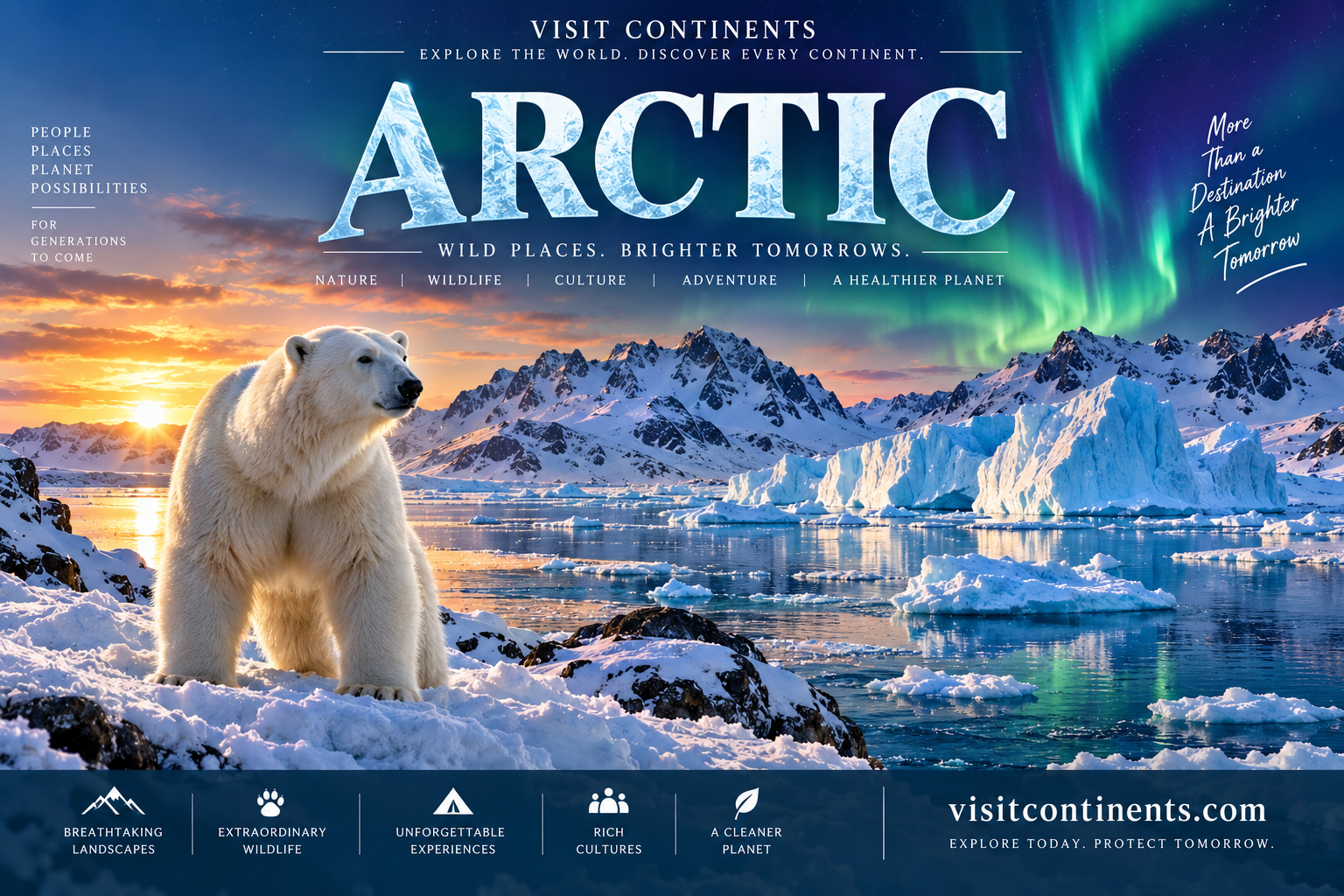
The Arctic is one of the most extraordinary regions on Earth. Located around the North Pole, this vast northern wilderness is famous for its frozen ocean, towering glaciers, snow-covered mountains, magnificent wildlife, and spectacular displays of the northern lights.
From the dramatic fjords of Norway and the enormous icebergs of Greenland to the remote landscapes of northern Canada, Alaska, Iceland, and Siberia, the Arctic offers remarkable opportunities for adventure, scientific discovery, cultural exploration, and encounters with nature.
Unlike Antarctica, the Arctic is not a continent. It is a geographical region surrounding the North Pole that includes the Arctic Ocean and northern portions of Europe, Asia, and North America.
The Arctic is also home to millions of people, including Indigenous communities whose cultures, languages, traditions, and livelihoods have developed in close connection with northern environments over thousands of years.
Travelers can experience the midnight sun, observe polar bears and other Arctic wildlife from appropriate distances, explore breathtaking glaciers, cruise through magnificent fjords, and visit northern communities with distinct cultural traditions.
However, traveling to the Arctic requires careful planning. Weather conditions can change rapidly, transportation options vary considerably, and some destinations are accessible only during particular seasons.
In this comprehensive Visit Continents guide, discover the Arctic’s geography, countries and territories, extraordinary wildlife, remarkable travel destinations, northern lights, cultural heritage, and everything you should know before planning an adventure to the northern polar region.
1. Discover the Arctic: The Northernmost Region of the World


6
The Arctic surrounds the geographic North Pole and extends across the northernmost areas of the Northern Hemisphere.
Unlike Antarctica, which consists of a continental landmass surrounded by the Southern Ocean, the Arctic is centered on an ocean surrounded by continents.
Its geographical boundaries can be defined in several ways. One commonly used definition includes all areas north of the Arctic Circle, located at approximately 66.5 degrees north latitude.
Other scientific definitions use climatic or ecological characteristics, such as the average summer temperature or the northern tree line.
The region includes an extraordinary variety of environments, from ocean-covered sea ice and glaciers to tundra, forests, mountains, rivers, and coastal settlements.
The Arctic at a glance
| Geographical type | Polar region, not a continent |
| Location | Northern Hemisphere, surrounding the North Pole |
| Central ocean | Arctic Ocean |
| Arctic countries | 8 countries with territory within the Arctic |
| Capital city | None for the region as a whole |
| Climate | Polar and subpolar, varying by location |
| Famous natural phenomenon | Aurora borealis, or northern lights |
| Notable wildlife | Polar bears, Arctic foxes, reindeer, walruses, seals, and whales |
Is the Arctic the same as the North Pole?
The Arctic is a broad geographical region that includes the North Pole, but the two terms do not mean the same thing.
The geographic North Pole is the northernmost point on Earth, located at 90 degrees north latitude. It lies within the Arctic Ocean, where floating sea ice moves over the water.
The Arctic encompasses this location as well as surrounding islands, coastlines, ocean waters, and northern continental territories.
Why is the Arctic so cold?
The Arctic receives relatively little solar energy compared with lower latitudes. Sunlight reaches the region at a low angle, particularly during winter, spreading its energy over a larger surface area.
Snow and ice also reflect much of the incoming sunlight, contributing to the region’s cold conditions.
However, Arctic temperatures vary considerably. Coastal regions influenced by ocean currents can experience much milder conditions than the remote interior of Greenland or the central Arctic Ocean.
The Arctic is therefore not a single uniform frozen environment. It contains many different climates and ecosystems.
2. Which Countries Are in the Arctic?

Eight countries have territory within the Arctic region. Together, they are known as the eight Arctic states and are members of the Arctic Council, an international forum for cooperation on matters affecting the northern polar region.
Arctic Council
+1
Unlike Antarctica, where territorial claims operate under a distinctive international treaty system, the Arctic includes inhabited lands and national jurisdictions belonging to existing countries.
The eight Arctic countries

1. United States
Arctic region: Alaska
Northern Alaska includes Arctic coastal plains, mountain landscapes, wildlife habitats, and communities such as Utqiaġvik, one of the northernmost cities in the United States.

2. Canada
Arctic regions: Yukon, Northwest Territories, Nunavut, and northern portions of other territories and provinces
Canada’s Arctic includes enormous island groups, tundra, mountain ranges, glaciers, and northern communities with rich Indigenous cultural traditions.

3. Kingdom of Denmark
Arctic region: Greenland
Greenland is a self-governing territory within the Kingdom of Denmark. It is famous for its immense ice sheet, dramatic fjords, glaciers, icebergs, and Inuit cultural heritage.

4. Iceland
Arctic region: Grímsey Island and northern maritime areas
The Arctic Circle crosses Grímsey Island, north of mainland Iceland. Iceland is also known for its volcanic landscapes, glaciers, geothermal activity, waterfalls, and northern lights.

5. Norway
Arctic regions: Northern Norway and Svalbard
Norway offers dramatic fjords, coastal mountains, Arctic settlements, and destinations for northern lights viewing, wildlife excursions, and expedition cruising.

6. Sweden
Arctic region: Northern Sweden
Swedish Lapland features forests, tundra, mountain landscapes, Sami cultural heritage, and winter activities such as northern lights photography and guided snow excursions.

7. Finland
Arctic region: Northern Lapland
Finnish Lapland is known for its snowy forests, lakes, reindeer, Sami culture, winter resorts, and opportunities to observe the northern lights.

8. Russia
Arctic regions: Northern Siberia and Arctic archipelagos
Russia’s Arctic territory extends across an immense northern coastline and includes tundra, mountain regions, major river systems, remote islands, and Indigenous communities.
These countries have different climates, languages, cultures, infrastructure, and entry requirements. The Arctic should not be understood as a single uniform destination.
Some parts of northern Scandinavia have established tourism networks, while many areas of the Canadian and Russian Arctic require specialized transportation and considerable logistical preparation.
3. The Most Beautiful Places to Visit in the Arctic
The Arctic encompasses destinations ranging from accessible northern towns to extremely remote islands and ocean environments.
Travelers can choose between relatively comfortable cultural and nature-based trips, guided wilderness adventures, and specialized polar expeditions.
Svalbard, Norway: A World of Glaciers and Polar Wildlife


6
Svalbard is a Norwegian archipelago located in the Arctic Ocean, far north of mainland Norway.
Its landscape features enormous glaciers, rugged mountains, coastal fjords, tundra, and seasonal sea ice.
Longyearbyen, the archipelago’s principal settlement, serves as the main gateway for visitors exploring the surrounding region.
Travelers can enjoy guided nature excursions, boat trips, wildlife photography, glacier viewing, and winter activities.
Svalbard is also known for its polar bear population. However, polar bears are dangerous wild animals, and travelers should never approach or attempt to attract them.
Local tourism guidance recommends joining organized excursions with qualified guides when exploring the wilderness outside inhabited areas.
Visit Svalbard
+1
The archipelago also experiences both the midnight sun and polar night, offering dramatically different travel experiences depending on the season.
Suggested duration: 4–7 days for Longyearbyen and selected guided activities, or longer for an expedition cruise.
Greenland: Discover the World’s Largest Island


6
Greenland is the world’s largest island and one of the most recognizable destinations in the Arctic.
Most of its land is covered by the Greenland Ice Sheet, while its coastal regions contain mountains, fjords, glaciers, small settlements, and remarkable natural environments.
Greenland is also home to a rich Inuit cultural heritage, with communities maintaining important connections to the land, sea, language, and traditional knowledge.
One of Greenland’s most famous destinations is Ilulissat, a town on the western coast.
The nearby Ilulissat Icefjord is internationally recognized for its enormous icebergs, which break away from the glacier and move through the fjord toward Disko Bay.
Visit Greenland
+1
Visitors may experience the icefjord through designated walking routes, guided boat excursions, and scenic flights.
Nuuk, Greenland’s capital, offers museums, restaurants, cultural institutions, and opportunities to learn about contemporary Greenlandic life.
Suggested duration: 5–10 days for one or two Greenland destinations, allowing flexibility for weather-related travel changes.
Tromsø, Norway: The Gateway to Arctic Norway

Tromsø is a city in northern Norway, located well above the Arctic Circle.
It is an established destination for travelers interested in northern lights viewing, Arctic landscapes, winter recreation, and northern Norwegian culture.
The city combines restaurants, museums, hotels, and transportation services with access to dramatic natural environments.
Visitors can explore nearby fjords, join guided aurora excursions, enjoy scenic cable-car views, and participate in seasonal marine wildlife tours.
During summer, Tromsø experiences the midnight sun, allowing travelers to explore the surrounding landscape under extended daylight.
During winter, the city experiences a period of polar night, creating opportunities for northern lights observation when weather and solar activity are favorable.
Suggested duration: 3–5 days, with additional nights recommended for travelers hoping to see the aurora.
Finnish Lapland: Snowy Forests and Northern Lights


6
Finnish Lapland is located in northern Finland and offers extensive forests, lakes, tundra, and winter landscapes.
The region is particularly popular for northern lights viewing, winter recreation, and cultural experiences.
Rovaniemi is widely known for its association with Santa Claus tourism and serves as a convenient starting point for exploring the region.
Farther north, destinations such as Inari and Saariselkä offer access to quieter wilderness environments and opportunities to learn about Sami cultural heritage.
Visitors can participate in guided snowshoeing, cross-country skiing, reindeer-related experiences, and nature photography.
Accommodation options range from conventional hotels and cabins to specialized glass-roofed lodgings designed for viewing the night sky.
Suggested duration: 4–7 days for a winter holiday or northern lights adventure.
Canadian Arctic: Nunavut and Baffin Island

Canada’s Arctic contains some of the world’s most extensive northern wilderness landscapes.
Nunavut, Canada’s largest territory by area, includes Arctic islands, tundra, dramatic mountain ranges, glaciers, and communities with strong Inuit cultural traditions.
Baffin Island is particularly notable for its immense fjords, coastal mountains, and remote natural environments.
Auyuittuq National Park features spectacular Arctic scenery, including glaciers, rugged mountain formations, and high-latitude landscapes.
Iqaluit, the capital of Nunavut, offers cultural institutions, local art, and opportunities to learn about contemporary Inuit life.
Travel in the Canadian Arctic can involve considerable expense and complicated transportation arrangements, especially when visiting smaller communities or remote parks.
Suggested duration: 7–14 days or longer, depending on the destination and transportation arrangements.
Alaska, United States: Arctic Wilderness and Indigenous Heritage


6
Northern Alaska contains dramatic mountain landscapes, Arctic coastal plains, tundra, river valleys, and important wildlife habitats.
Gates of the Arctic National Park and Preserve is one of the most remote national parks in the United States.
Located entirely north of the Arctic Circle, it has no conventional roads or established tourist infrastructure within the park.
Travelers can experience its wilderness through carefully planned backcountry trips and suitable guiding arrangements.
Utqiaġvik, on Alaska’s northern coast, is an important center of Iñupiat culture and one of the northernmost communities in the United States.
Visitors can learn about regional history, cultural traditions, and the relationship between coastal communities and the Arctic environment.
Suggested duration: 5–10 days for a selected northern Alaska itinerary, with additional time for remote wilderness excursions.
Iceland: A Gateway to the Northern Polar World


6
Iceland lies just south of the Arctic Circle, except for Grímsey Island, which the circle crosses.
Although most of Iceland is not geographically within the Arctic Circle, its location and northern environments make it a popular destination for travelers interested in polar landscapes and northern lights.
The country is famous for its glaciers, volcanoes, waterfalls, geothermal features, black-sand beaches, and dramatic coastal scenery.
Akureyri, in northern Iceland, serves as a gateway to the region’s mountains, fjords, and outdoor activities.
Grímsey offers a distinctive opportunity to visit a small island crossed by the Arctic Circle.
Visitors can also explore Iceland’s northern landscapes through guided excursions and seasonal wildlife tours.
Suggested duration: 5–10 days for northern Iceland and selected natural attractions.
4. Arctic Wildlife: Discover the Animals of the Northern Polar Region


7
The Arctic is home to remarkable animals adapted to survive in cold temperatures, seasonal darkness, and challenging environmental conditions.
Its ecosystems include marine mammals, terrestrial predators, migratory birds, fish, and large herbivores.
Some species depend on sea ice for hunting, resting, or reproduction, while others inhabit tundra, forests, mountains, and coastal environments.
Polar bears

Polar bears are among the Arctic’s most recognizable animals and are found throughout suitable habitats in parts of Canada, Greenland, Norway, Russia, and Alaska.
They are powerful marine predators that primarily hunt seals. Sea ice provides an important platform for much of their hunting activity.
Their thick fur, insulating fat, and large paws help them survive in cold environments and move across ice and snow.
Polar bears are not found naturally in Antarctica.
Tourists must observe polar bears only from safe distances under appropriate professional guidance. In Svalbard, seeking out or pursuing polar bears for tourism is prohibited, and sightings on guided excursions cannot be guaranteed.
Visit Svalbard
Arctic foxes

Arctic foxes are small predators adapted to cold northern environments.
Many change their coat color seasonally, developing thick white fur during winter and a darker coat during summer, although coloration varies among individuals and populations.
These foxes feed on small mammals, birds, eggs, fish, and other available food sources.
They can be found in tundra environments across several Arctic countries, including Greenland, Canada, Norway, Russia, and the United States.
Reindeer and caribou

Reindeer and caribou are members of the same species, with different names commonly used for various wild and domesticated populations.
These animals are adapted to northern environments and may travel considerable distances between seasonal feeding areas.
Reindeer herding is also culturally and economically important to several northern Indigenous communities, including Sami communities in parts of Scandinavia and Russia.
Visitors to northern regions may have opportunities to learn about reindeer husbandry through locally organized cultural experiences.
Walruses and Arctic seals

Walruses are large marine mammals known for their long tusks, whiskers, and substantial bodies.
They feed primarily on organisms living on or near the seafloor and often gather in groups on sea ice or coastal resting areas.
The Arctic also supports several seal species, including ringed seals and bearded seals.
These animals play important roles in marine ecosystems and are important to the food security and cultural traditions of some northern communities.
Whales of the Arctic Ocean

Arctic waters support several distinctive whale species.
Beluga whales are recognizable for their pale coloration and social behavior, while narwhals are known for the long spiral tusk that develops in many males.
Bowhead whales are specially adapted to northern waters and can live for exceptionally long periods.
Other whale species migrate into Arctic and subarctic waters during productive feeding seasons.
Depending on the destination, visitors may encounter whales through authorized marine excursions, always subject to local wildlife-viewing regulations.
5. The Northern Lights: One of the Arctic’s Greatest Natural Wonders

The northern lights, also known as the aurora borealis, are among the most remarkable natural phenomena visible in the Northern Hemisphere.
They appear as glowing curtains, arcs, and shifting bands of light across the night sky.
The most commonly observed colors are green, pink, red, and purple, although the precise appearance depends on atmospheric conditions and the processes producing the aurora.
What causes the northern lights?
The northern lights occur when energetic charged particles interact with Earth’s magnetic field and upper atmosphere.
These interactions excite atmospheric gases, which release light as they return to lower energy states.
The resulting displays can vary from faint glows to bright, rapidly moving formations.
Auroral activity is influenced by space weather, while visibility from the ground depends on darkness, cloud cover, and local light pollution.
Where can you see the northern lights?

Tromsø, Norway
A northern city with established aurora tourism services and access to nearby dark-sky locations.

Finnish Lapland
A region offering snowy landscapes, wilderness accommodation, and organized aurora-viewing activities.

Abisko, Sweden
A northern destination surrounded by mountains and natural landscapes suitable for guided night-sky excursions.

Yellowknife, Canada
Located in the Northwest Territories, Yellowknife is known for its northern lights tourism, particularly during dark, clear nights.

Fairbanks, Alaska
A popular gateway to northern Alaska with seasonal northern lights viewing opportunities.
When is the best time to see the northern lights?
Autumn, winter, and early spring provide suitable darkness at many northern destinations.
September through March is a commonly recommended planning period, although the most suitable months vary by location.
The northern lights can occur at other times of year, but the bright summer sky makes them difficult or impossible to see at high latitudes.
Because aurora sightings depend on solar activity and weather, travelers should plan several nights at their destination rather than expecting a guaranteed display on a particular evening.
6. The Midnight Sun and Polar Night


5
The Arctic experiences unusual seasonal daylight patterns because Earth’s axis is tilted relative to its orbit around the Sun.
These patterns create two remarkable natural phenomena: the midnight sun and polar night.
The midnight sun
During the northern summer, areas above the Arctic Circle experience periods when the Sun remains above the horizon for at least 24 consecutive hours.
This phenomenon is known as the midnight sun.
At the North Pole, the Sun remains above the horizon for approximately half the year.
For travelers, extended daylight creates opportunities for late-night hiking, scenic photography, coastal exploration, and other outdoor activities.
The duration of the midnight sun increases with latitude, so northern Svalbard experiences a longer period of continuous daylight than destinations closer to the Arctic Circle.
Polar night
During winter, the opposite phenomenon occurs: the Sun remains below the horizon for at least one full day in areas north of the Arctic Circle.
This is known as polar night.
Depending on latitude and local conditions, the sky may still experience periods of twilight even when the Sun does not rise.
The prolonged darkness provides opportunities for northern lights viewing, nighttime photography, and winter cultural experiences.
However, travelers should prepare for cold conditions, reduced daylight, and changes to transportation and outdoor activity schedules.
7. The People and Cultures of the Arctic

The Arctic is not an uninhabited wilderness.
More than four million people live across the wider Arctic region, including approximately half a million Indigenous people, according to the Arctic Council’s regional overview.
Arctic Council
The Arctic is home to communities with distinct languages, historical experiences, traditional knowledge systems, and contemporary ways of life.
Its Indigenous peoples include Inuit, Sami, Nenets, Chukchi, Gwich’in, Iñupiat, and numerous other communities across northern North America, Europe, and Asia.
Inuit cultures
Inuit communities live in parts of Greenland, Canada, Alaska, and neighboring northern regions.
Their cultures reflect long histories of adaptation to Arctic coastal and inland environments.
Traditional knowledge includes sophisticated understandings of sea ice, weather, wildlife, navigation, and seasonal environmental changes.
Contemporary Inuit communities also participate in a wide range of professional, artistic, political, scientific, and economic activities.
Visitors can learn about Inuit history and culture through museums, community-led experiences, local art, and respectful cultural exchanges.
Sami cultures

The Sami are Indigenous peoples whose traditional homeland, Sápmi, extends across northern Norway, Sweden, Finland, and parts of Russia.
Sami cultural traditions include reindeer husbandry, handicrafts, music, storytelling, and diverse relationships with northern landscapes.
Sami communities maintain several distinct languages and cultural practices.
Travelers interested in learning about Sami heritage should seek experiences organized or led by Sami people rather than treating their culture solely as a tourist attraction.
Northern communities today
Modern Arctic life combines local cultural traditions with contemporary technology, education, scientific research, commerce, and public services.
Many northern settlements have schools, healthcare facilities, airports, businesses, and cultural institutions.
At the same time, remote locations, high transportation costs, environmental change, and limited infrastructure can create challenges for residents.
Travelers should approach northern communities as living societies rather than historical exhibits or extensions of the surrounding wilderness.
8. What Can You Do in the Arctic?

The Arctic offers a wide variety of experiences, from comfortable city-based holidays to remote wilderness expeditions.
Activities vary greatly by destination and season.
Arctic expedition cruising

Expedition cruises provide opportunities to explore remote coastal landscapes, glaciers, islands, and wildlife habitats.
Common expedition destinations include Greenland, Svalbard, and portions of the Canadian Arctic.
Some specialized voyages travel through the Northwest Passage or toward the geographic North Pole.
These journeys require vessels designed for the expected ice conditions and experienced crews familiar with polar navigation.
Glacier and iceberg exploration

Greenland, Svalbard, and Alaska contain spectacular glaciers and coastal ice formations.
Travelers can observe glaciers from designated walking routes, boat excursions, scenic flights, and professionally guided activities.
Glaciers and icebergs can be dangerous because of unstable ice, sudden breakage, falling ice, and unpredictable water movement.
Visitors should never approach unstable ice formations without appropriate professional guidance.
Hiking and Arctic wilderness exploration

During suitable seasons, the Arctic offers opportunities for hiking through mountain valleys, coastal landscapes, tundra, and designated wilderness areas.
Some northern destinations have established trails and visitor infrastructure, while others require specialized expedition planning.
In regions inhabited by polar bears or other potentially dangerous wildlife, independent backcountry travel may involve significant risks.
Travelers should choose activities appropriate to their experience and follow local safety regulations.
Winter adventures

Northern destinations offer seasonal activities such as snowshoeing, cross-country skiing, guided dog-sled excursions, and winter photography.
Some locations also offer snowmobile tours, subject to environmental regulations and designated routes.
Responsible tourism requires attention to animal welfare, local community interests, and the environmental effects of motorized recreation.
9. What Is the Difference Between the Arctic and Antarctica?

The Arctic

Antarctica
Although the Arctic and Antarctica are both polar environments, they differ significantly in geography, wildlife, population, governance, and tourism.
| Feature | Arctic | Antarctica |
|---|---|---|
| Location | Northern Hemisphere | Southern Hemisphere |
| Geographical type | Ocean surrounded by continents | Continent surrounded by ocean |
| Countries | Eight countries have Arctic territory | No sovereign countries |
| Human population | Millions of residents | No permanent resident population |
| Notable wildlife | Polar bears, Arctic foxes, reindeer, walruses, whales | Penguins, seals, whales, seabirds |
| Indigenous communities | Numerous Indigenous peoples | No Indigenous human population |
| Common travel season | Varies by location and activity | Mainly November–March |
| Governance | National jurisdictions and international law | Antarctic Treaty System |
The Arctic and Antarctica also share important characteristics, including polar climates, distinctive wildlife adaptations, extensive ice environments, and major roles in Earth’s climate system.
10. When Is the Best Time to Visit the Arctic?
The Arctic’s travel seasons vary according to location and desired activities.
There is no single ideal month for every Arctic destination.
Some travelers visit during summer to experience the midnight sun, hiking, and marine excursions.
Others prefer winter to observe the northern lights and explore snow-covered landscapes.

Spring · March–May
Snow activities and increasing daylight
Spring offers opportunities for winter excursions in suitable locations, longer daylight hours, and seasonal wildlife activity.

Summer · June–August
Midnight sun and outdoor exploration
Summer is a popular period for hiking, expedition cruising, coastal excursions, and visiting some remote northern destinations.

Autumn · September–November
Changing landscapes and returning darkness
Autumn brings cooler conditions, seasonal changes in tundra vegetation, and opportunities for northern lights viewing.

Winter · December–February
Polar night and snow-covered landscapes
Winter offers opportunities for aurora photography, organized snow activities, and experiencing the distinctive atmosphere of northern polar night.
These seasonal descriptions are general. A summer trip to the northern coast of Alaska, a winter holiday in Finnish Lapland, and a Greenland expedition cruise may have very different weather conditions, schedules, and transportation requirements.
11. How Much Does It Cost to Visit the Arctic?

The cost of Arctic travel depends heavily on destination, transportation, accommodation, season, and planned activities.
A short visit to an established northern destination with regular airline connections can be substantially less expensive than a remote expedition cruise or specialized journey toward the North Pole.
Travelers should consider the following major expenses when preparing their budget.
| Expense | What to consider |
|---|---|
| Flights | International connections and regional transport to northern destinations |
| Accommodation | Hotels, cabins, lodges, and expedition vessels |
| Food | Meals, groceries, and restaurant expenses |
| Guided activities | Northern lights excursions, boat trips, hiking, and wildlife tours |
| Equipment | Insulated clothing, waterproof outerwear, and suitable footwear |
| Insurance | Medical treatment, evacuation, cancellations, and specialized activities |
| Emergency reserve | Weather-related delays and unexpected transportation expenses |
Travelers visiting remote parts of Greenland, northern Canada, or Alaska should account for the possibility of limited flight schedules and weather-related delays.
An Arctic expedition cruise may involve a very different budget from a city-based visit to Tromsø or Rovaniemi.
Before booking, compare current prices and check precisely what accommodation, transportation, activities, clothing, and insurance are included.
12. Essential Safety Tips for Arctic Travel

The Arctic’s natural beauty is accompanied by environmental hazards that require careful preparation.
Weather can change rapidly, especially in exposed coastal areas, mountain environments, and remote wilderness regions.
Prepare for cold temperatures
Pack clothing suitable for the expected season and planned activities.
A layered system typically includes moisture-wicking base layers, insulating clothing, a windproof or waterproof outer layer, warm gloves, head protection, and appropriate footwear.
Visitors should also understand how to recognize signs of hypothermia and frostbite.
Respect wildlife
Never approach, feed, attract, or pursue wild animals.
Polar bears are particularly dangerous, and visitors exploring regions where they occur should follow applicable local safety requirements.
In Svalbard, official visitor guidance emphasizes using qualified local operators for wilderness activities because polar bears can occur outside inhabited areas at any time of year.
Visit Svalbard
+1
Plan for limited transportation
Remote Arctic destinations may have few roads, infrequent flights, and limited emergency services.
Travelers should allow additional time between important connections and carry essential supplies appropriate to their itinerary.
For wilderness journeys, confirm communications, emergency procedures, guiding arrangements, and evacuation capabilities before departure.
Respect local laws and communities
The Arctic includes multiple countries and territories with different regulations, protected areas, cultural traditions, and entry requirements.
Visitors should learn about local customs, follow environmental rules, respect private property and community spaces, and obtain permission before photographing individuals.
13. Climate Change and the Future of the Arctic

The Arctic plays an important role in Earth’s climate system.
Its snow and ice reflect incoming sunlight, while its oceans, atmosphere, and land environments interact with global climate processes.
However, the region is undergoing substantial environmental changes.
According to NOAA’s 2025 Arctic Report Card, Arctic air temperatures during October 2024–September 2025 were the warmest recorded since 1900. The report also documented continuing changes in sea ice, glaciers, ocean temperatures, and Arctic ecosystems.
NOAA Arctic
+1
Changes in sea ice
Arctic sea ice expands during winter and contracts during summer.
Long-term satellite observations show that the summer sea ice cover has declined substantially over recent decades, while the remaining ice has generally become younger and thinner.
These changes affect marine ecosystems, wildlife habitats, transportation, and communities that depend on predictable sea ice conditions.
The 2025 Arctic sea ice minimum was the tenth-lowest in the satellite record at that time, illustrating the continuing long-term decline despite year-to-year variability.
NOAA Arctic
+1
Changes in glaciers and ecosystems
Rising temperatures contribute to changes in glaciers, snow cover, permafrost, and coastal environments.
The Greenland Ice Sheet and other Arctic glaciers have experienced long-term ice loss, contributing to global sea-level rise.
Environmental changes also affect wildlife, vegetation, traditional livelihoods, and infrastructure in northern communities.
NOAA Arctic
+1
Responsible Arctic tourism
Travelers can contribute to responsible tourism by choosing operators that follow environmental regulations, respecting wildlife, minimizing waste, supporting local communities, and learning about the region’s ecological challenges.
Visitors should also recognize that the Arctic is a home and workplace for millions of people, not simply a wilderness destination.
Responsible exploration involves respecting both its natural environments and the communities whose lives are connected to them.
14. Frequently Asked Questions About the Arctic
Is the Arctic a continent?
No. The Arctic is a polar region centered on the Arctic Ocean and includes northern portions of Europe, Asia, and North America. Antarctica, by contrast, is a continent.
How many countries are in the Arctic?
Eight countries have territory within the Arctic region: Canada, the Kingdom of Denmark through Greenland, Finland, Iceland, Norway, Russia, Sweden, and the United States through Alaska.
Does the Arctic have a capital city?
No. The Arctic is a geographical region rather than a sovereign country. Individual Arctic countries and territories have their own governments and administrative centers.
Do people live in the Arctic?
Yes. More than four million people live across the wider Arctic, including Indigenous peoples with distinct languages, cultures, histories, and traditional knowledge.
Are polar bears found in the Arctic or Antarctica?
Polar bears live naturally in the Arctic. They are not native to Antarctica, where penguins are among the most recognizable animals.
Can tourists visit the North Pole?
Yes, but reaching the geographic North Pole requires specialized expedition arrangements. Access depends on suitable transportation, operational conditions, and the availability of expedition services.
When is the best time to see the northern lights?
Autumn, winter, and early spring offer extended periods of darkness in many northern destinations. Visible aurora displays depend on solar activity, cloud cover, and local lighting conditions.
Can you visit the Arctic during summer?
Yes. Summer is a popular travel season for destinations such as Greenland, Svalbard, northern Alaska, and the Canadian Arctic. The longer daylight hours make many outdoor activities and marine excursions possible.
Is it possible to visit both the Arctic and Antarctica?
Yes. Travelers can visit both polar regions during separate expeditions or include them in a longer worldwide travel plan. Their principal travel seasons and transportation requirements differ.
Do you need special clothing to visit the Arctic?
Clothing requirements depend on the destination, season, and activities. Winter trips and remote expeditions generally require insulated layers, windproof outerwear, warm gloves, and suitable footwear.
Are the Arctic and Antarctica equally cold?
No. Antarctica’s high continental ice sheet generally creates much colder conditions than those found across much of the Arctic. However, temperatures in both regions vary considerably by location and season.
Conclusion: Discover the Extraordinary Beauty of the Arctic

The Arctic is one of Earth’s most remarkable geographical regions, offering extraordinary natural landscapes, fascinating wildlife, distinctive cultural traditions, and unforgettable opportunities for exploration.
From the towering icebergs of Greenland and the dramatic fjords of Norway to the snowy forests of Finnish Lapland, the vast wilderness of northern Canada, and the remote landscapes of Alaska, the Arctic provides experiences that differ greatly from those found in most other travel destinations.
Visitors can witness the northern lights, experience the midnight sun, explore glaciers, observe Arctic wildlife, discover northern communities, and learn about the scientific importance of the polar environment.
Unlike Antarctica, the Arctic is not a separate continent. It is an inhabited region spanning the northernmost portions of three continents and encompassing the territories of eight countries.
Its extraordinary environments are also changing, making scientific research, environmental protection, and respect for northern communities important parts of understanding the region.
Whether your dream is to photograph the aurora borealis, sail among enormous icebergs, explore a remote Arctic national park, or learn about Indigenous cultures, a carefully planned journey can provide a deeper appreciation of the world’s northern polar region.
For travelers exploring all seven continents, the Arctic offers an additional adventure that connects the northern regions of North America, Europe, and Asia.
With thoughtful preparation, responsible travel, and a spirit of discovery, the Arctic provides opportunities to experience some of the planet’s most remarkable natural and cultural environments.
VISIT CONTINENTS
Explore the Arctic. Discover the Northern Polar World.
Experience magnificent northern lights, extraordinary wildlife, breathtaking glaciers, and remarkable cultures across the world’s northernmost destinations.
Explore the World. Discover Every Continent.
visitcontinents.com