VISIT CONTINENTS
Explore the World. Discover Every Continent.
VISIT CONTINENTS

AFRICA TRAVEL GUIDE | COUNTRIES, CULTURES, LANDSCAPES & DESTINATIONS
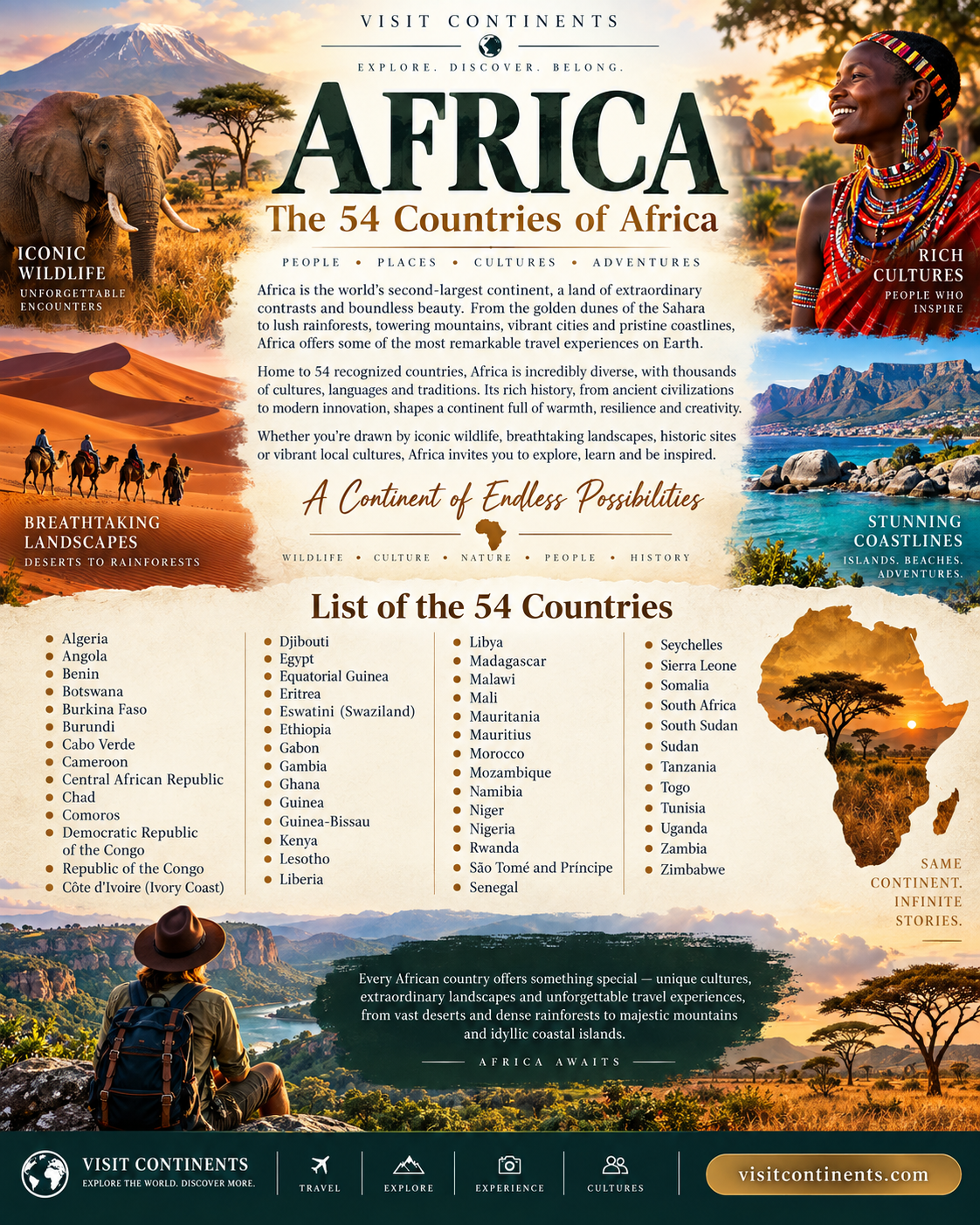
Africa is the world’s second-largest continent by land area and population. It is home to extraordinary geographical diversity, rich cultural traditions, ancient civilizations, modern cities, remarkable wildlife, and some of the most spectacular natural landscapes on Earth.
From the golden sand dunes of the Sahara Desert in the north to the rainforests of Central Africa, the expansive savannas of East Africa, the Atlantic beaches of West Africa, and the dramatic mountains and coastlines of Southern Africa, the continent offers an incredible range of places to discover.
Africa is home to 54 widely recognized sovereign countries that are members of the United Nations. These countries differ greatly in geography, population, languages, history, economic activity, cultural traditions, and tourism opportunities.
The continent is also home to thousands of communities and ethnic groups, and its residents speak a vast range of indigenous and international languages.
Whether you want to experience an African wildlife safari, explore historic cities, visit tropical islands, discover ancient archaeological sites, hike through mountain landscapes, or learn about local cultures, Africa offers opportunities for many different kinds of travel.
In this comprehensive Visit Continents guide, we explore all 54 African countries, their capital cities, geographical regions, major attractions, and some of the experiences that make each destination distinctive.
How many countries are in Africa?
54
UN member countries
5
Major geographical regions
The commonly used count of 54 African countries refers to the continent’s 54 United Nations member states. The African Union has 55 members because it also includes the Sahrawi Arab Democratic Republic, which claims Western Sahara, a territory whose status remains disputed.
Africa is commonly divided into five geographical regions: Northern Africa, Western Africa, Central Africa, Eastern Africa, and Southern Africa. These regions provide a useful framework for understanding the continent’s geography, but they do not encompass every cultural, historical, or economic relationship among African countries.
The Complete List of All 54 African Countries
The following list includes all 54 African countries in alphabetical order, with their capital cities, geographical locations, and notable features.

Political map of the African continent, showing its countries and geographical boundaries.
The country count follows the United Nations membership convention.
AU-UN
+1
Countries 1–10: Algeria to Chad


1. Algeria
Capital: Algiers | Region: Northern Africa
Algeria is the largest country in Africa by land area. Much of its territory lies within the Sahara Desert, while its northern coastline borders the Mediterranean Sea.
The country has a rich history shaped by Amazigh civilizations, Roman settlements, Arab cultural influences, and its modern independence movement.
Travelers can explore the historic Casbah of Algiers, ancient Roman ruins at Timgad, Mediterranean coastal cities, and the remarkable rock formations and prehistoric art of Tassili n’Ajjer.
Its vast desert landscapes offer opportunities for guided exploration and photography, subject to local travel restrictions and safety conditions.
2. Angola
Capital: Luanda | Region: Southern Africa
Angola is located on Africa’s southwestern Atlantic coast. The country features tropical and dry forests, expansive plateaus, waterfalls, mountains, and a long coastline.
Luanda, its capital, is a major urban and economic center with a mixture of historic architecture and modern development.
Notable natural attractions include Kalandula Falls, one of Africa’s remarkable waterfall systems, and the dramatic cliffs and landscapes surrounding the Miradouro da Lua.
Angola’s cultural heritage reflects the traditions of numerous ethnic communities, with Portuguese serving as the official language alongside widely spoken national languages.
3. Benin
Capital: Porto-Novo | Region: Western Africa
Benin is a West African country recognized for its historical kingdoms, cultural traditions, and significant role in the history of the Atlantic slave trade.
Porto-Novo is the official capital, while Cotonou serves as the country’s principal economic center and seat of government.
Travelers can explore the Royal Palaces of Abomey, discover the historic city of Ouidah, and experience the lakeside community of Ganvié.
Benin is also an important center of Vodun religious traditions, which have influenced cultural practices throughout parts of West Africa and the African diaspora.
4. Botswana
Capital: Gaborone | Region: Southern Africa
Botswana is a landlocked country known for its extensive wilderness areas, wildlife conservation efforts, and remarkable natural environments.
The Okavango Delta, a major inland river delta, supports elephants, hippos, crocodiles, antelope, and numerous bird species.
Chobe National Park is another established safari destination, particularly recognized for its large elephant populations.
Visitors may also explore the Makgadikgadi salt pans and the vast landscapes of the Kalahari.
Botswana offers a variety of safari experiences, including guided wildlife drives, boat excursions, and traditional mokoro canoe trips in suitable areas.
5. Burkina Faso
Capital: Ouagadougou | Region: Western Africa
Burkina Faso is a landlocked West African country with a cultural heritage that includes traditional music, dance, storytelling, crafts, and architecture.
Ouagadougou is the country’s capital and a major cultural center. It is associated with FESPACO, the Pan-African Film and Television Festival of Ouagadougou.
The country also has distinctive historic landmarks, including the earthen architecture of the Royal Court of Tiébélé and the archaeological remains of Loropéni.
Burkina Faso’s cultural and natural attractions are significant, but travelers must carefully assess current security conditions before considering a visit.
6. Burundi
Capital: Gitega | Region: Eastern Africa
Burundi is a small, landlocked country in the African Great Lakes region, known for its hills, agricultural landscapes, cultural traditions, and shoreline along Lake Tanganyika.
Gitega is its political capital, while Bujumbura remains a major economic center and the country’s largest city.
Burundi is particularly recognized for its traditional royal drumming, an important part of its cultural heritage.
Visitors interested in nature can explore the areas around Lake Tanganyika and the country’s forested landscapes, subject to local conditions and travel guidance.
7. Cabo Verde
Capital: Praia | Region: Western Africa
Cabo Verde, also known as Cape Verde, is an island nation located in the Atlantic Ocean off the western coast of Africa.
The archipelago consists of volcanic islands with diverse scenery, including sandy beaches, rugged mountains, dry landscapes, and coastal towns.
Sal and Boa Vista are known for their beaches and coastal resorts, while Santo Antão attracts visitors interested in hiking through dramatic mountain valleys.
The island of Fogo is home to Pico do Fogo, an active volcano surrounded by striking volcanic terrain.
Cabo Verde is also internationally recognized for its musical traditions, including morna, which is closely associated with the singer Cesária Évora.
8. Cameroon
Capital: Yaoundé | Region: Central Africa
Cameroon is often described as a country of considerable geographical diversity because its landscapes include coastal plains, tropical forests, mountains, grasslands, and northern savanna environments.
Mount Cameroon, an active volcano near the Atlantic coast, is one of the country’s most distinctive natural landmarks.
The country’s cultural heritage reflects the traditions of many communities, languages, and historical influences.
Visitors may be interested in the country’s mountain landscapes, coastal regions, craft markets, and historical architecture, although security conditions and access vary substantially by region.
9. Central African Republic
Capital: Bangui | Region: Central Africa
The Central African Republic is a landlocked country with extensive forests, savannas, rivers, and important wildlife habitats.
Its ecosystems support forest elephants, gorillas, antelope, and numerous other animal species.
Dzanga-Sangha, in the country’s southwestern forest region, is known for its conservation importance and forest wildlife.
The country also has a rich cultural heritage represented by numerous ethnic communities, traditional music, storytelling, and local crafts.
Despite its natural attractions, ongoing security and infrastructure challenges make tourism difficult. Any proposed visit requires careful consideration of current official travel advice.
10. Chad
Capital: N’Djamena | Region: Central Africa
Chad is a landlocked country whose landscape extends from the Sahara Desert in the north through the Sahel to savanna environments farther south.
The Ennedi Massif is famous for its sandstone formations, natural arches, dramatic cliffs, and ancient rock art.
Zakouma National Park is an important wildlife conservation area supporting elephants, giraffes, lions, and numerous bird species.
Lake Chad, located near the borders of several countries, is an important source of water and livelihoods for surrounding communities.
Travel throughout Chad requires careful preparation because of long distances, limited infrastructure, harsh environmental conditions, and regional security concerns.
Countries 11–20: Comoros to Ethiopia


11. Comoros
Capital: Moroni | Region: Eastern Africa
Comoros is an island country in the Indian Ocean, located between Madagascar and the eastern African mainland.
Its islands contain volcanic mountains, tropical vegetation, beaches, and coastal villages.
Mount Karthala, an active volcano on Grande Comore, is one of the country’s most remarkable natural landmarks.
Comorian culture reflects African, Arab, and other Indian Ocean influences, expressed through its languages, cuisine, music, and architecture.
Visitors can explore historic Moroni, enjoy coastal scenery, and learn about island communities and their traditions.
12. Democratic Republic of the Congo
Capital: Kinshasa | Region: Central Africa
The Democratic Republic of the Congo, commonly called the DRC or DR Congo, is Africa’s second-largest country by land area.
It contains extensive tropical rainforests, major river systems, mountain ranges, and exceptionally rich biodiversity.
The Congo River is one of the world’s great rivers and plays a central role in the country’s geography, transportation, and economic life.
The country’s protected ecosystems are home to remarkable wildlife, including bonobos, forest elephants, and eastern gorillas.
Virunga National Park and Kahuzi-Biega National Park are internationally recognized for their ecological importance, although travel access can be affected by serious security concerns.
Kinshasa is also an important center of African music, particularly Congolese rumba.
13. Republic of the Congo
Capital: Brazzaville | Region: Central Africa
The Republic of the Congo, often called Congo-Brazzaville, is a separate country from the Democratic Republic of the Congo.
It lies west of the DRC and contains tropical forests, rivers, coastal areas, and important wildlife habitats.
Odzala-Kokoua National Park is known for its forest ecosystems, western lowland gorillas, and other wildlife species.
Brazzaville, the capital, stands across the Congo River from Kinshasa, creating one of the world’s notable examples of two national capitals facing one another across a river.
The country’s culture includes musical traditions, local crafts, and diverse communities with longstanding connections to the Congo Basin.
14. Côte d’Ivoire (Ivory Coast)
Capital: Yamoussoukro | Region: Western Africa
Côte d’Ivoire is a West African country with Atlantic beaches, tropical forests, agricultural landscapes, and major urban centers.
Yamoussoukro is the political capital, while Abidjan is the country’s largest city and principal economic center.
One of Yamoussoukro’s most recognizable landmarks is the Basilica of Our Lady of Peace.
Visitors can explore the historic town of Grand-Bassam, experience Abidjan’s cultural and culinary scene, and discover the country’s artistic traditions.
Côte d’Ivoire is also one of the world’s leading cocoa-producing countries, making cocoa agriculture an important part of its economy and cultural landscape.
15. Djibouti
Capital: Djibouti | Region: Eastern Africa
Djibouti is a small country located at the entrance to the Red Sea, where northeastern Africa approaches the Arabian Peninsula.
Its landscape features volcanic formations, dry plains, salt lakes, mountains, and coastal environments.
Lake Assal, an exceptionally saline lake lying below sea level, is one of the country’s most distinctive natural attractions.
Lake Abbe is famous for its unusual limestone chimneys and dramatic desert scenery.
Visitors may also explore coastal areas along the Gulf of Tadjoura, where marine excursions can offer opportunities to observe marine wildlife during suitable seasons.
16. Egypt
Capital: Cairo | Region: Northern Africa
Egypt is one of Africa’s most historically significant travel destinations, famous for its ancient civilization and monumental architecture.
The Pyramids of Giza and the Great Sphinx are among the world’s most recognizable archaeological landmarks.
Travelers can explore the ancient temples of Luxor, the Valley of the Kings, the historic sites of Aswan, and the remarkable temples of Abu Simbel.
The Nile River has shaped Egypt’s agriculture, settlement patterns, transportation, and cultural development for thousands of years.
Beyond its ancient monuments, Egypt offers the Mediterranean coastline, Red Sea beaches, desert oases, traditional markets, and modern urban experiences.
17. Equatorial Guinea
Region: Central Africa
Equatorial Guinea is a Central African country consisting of a mainland territory and several islands in the Gulf of Guinea.
Its environments include tropical forests, coastal landscapes, volcanic mountains, and island ecosystems.
Bioko Island features Mount Cameroon-related volcanic landscapes, while the mainland contains extensive forest habitats.
The country has a distinctive linguistic history, with Spanish, French, and Portuguese recognized as official languages.
Its cultural heritage reflects the traditions of several communities, including Fang and Bubi peoples.
Tourism infrastructure is relatively limited, and travelers should research entry requirements and available transport carefully.
18. Eritrea
Capital: Asmara | Region: Eastern Africa
Eritrea is located along the Red Sea in northeastern Africa and contains coastal lowlands, highland plateaus, mountains, and offshore islands.
Asmara is internationally recognized for its distinctive twentieth-century architecture, particularly buildings associated with Italian modernist design.
The country’s heritage reflects a long history of trade, migration, cultural exchange, and connections between the African interior and Red Sea communities.
The Dahlak Archipelago is known for its marine environments and island landscapes.
Travelers should be aware that movement outside certain areas may require permits and that independent tourism can be subject to significant restrictions.
19. Eswatini (Swaziland)
Capitals: Mbabane and Lobamba | Region: Southern Africa
Eswatini is a small, landlocked country bordered by South Africa and Mozambique.
Mbabane serves as its administrative capital, while Lobamba is the royal and legislative capital.
The country is known for its mountain landscapes, protected wildlife areas, cultural traditions, and traditional arts and crafts.
Hlane Royal National Park offers opportunities for wildlife observation, while Mlilwane Wildlife Sanctuary provides a setting for outdoor recreation and nature activities.
Eswatini is also recognized for major cultural ceremonies, including Umhlanga, during which participants celebrate traditions associated with the country’s monarchy and communities.
20. Ethiopia
Capital: Addis Ababa | Region: Eastern Africa
Ethiopia is one of Africa’s most historically and culturally significant countries.
Its heritage includes ancient kingdoms, important religious traditions, distinctive architecture, and a rich range of languages and cultural practices.
The rock-hewn churches of Lalibela are among Ethiopia’s most remarkable historic landmarks.
Other notable destinations include the Simien Mountains, the ancient city of Aksum, the castles of Gondar, and the dramatic landscapes of the Danakil Depression.
Ethiopia is also widely associated with the historical origins and cultural development of coffee.
The capital, Addis Ababa, is an important continental diplomatic center and hosts the headquarters of the African Union.
Countries 21–30: Gabon to Madagascar


6
21. Gabon
Capital: Libreville | Region: Central Africa
Gabon is a Central African country along the Atlantic coast, recognized for its extensive tropical forests and important biodiversity.
A substantial portion of the country is covered by rainforest, providing habitats for forest elephants, gorillas, chimpanzees, and numerous bird species.
Loango National Park is notable for its combination of coastal landscapes, forests, wetlands, and wildlife habitats.
Visitors interested in nature can explore protected environments through authorized excursions and conservation-focused travel arrangements.
Gabon is also home to a range of cultural traditions expressed through music, masks, storytelling, and local arts.
22. The Gambia
Capital: Banjul | Region: Western Africa
The Gambia is the smallest country on mainland Africa and is geographically shaped by the Gambia River.
Most of its territory lies along the river, which flows westward into the Atlantic Ocean.
The country is known for its beaches, wetlands, mangrove forests, birdlife, and traditional communities.
Travelers can explore the coastal region, visit local markets, and discover the historical significance of Kunta Kinteh Island and related sites.
The Gambia also offers opportunities for river excursions, birdwatching, and cultural experiences.
23. Ghana
Capital: Accra | Region: Western Africa
Ghana is a West African country recognized for its cultural heritage, historic coastal sites, music, arts, and natural attractions.
Accra is a dynamic capital with markets, museums, beaches, restaurants, and a vibrant cultural scene.
Cape Coast Castle and Elmina Castle are important historic sites associated with the transatlantic slave trade.
In the country’s interior, visitors can explore Kumasi, a major center of Asante history and culture.
Kakum National Park offers rainforest environments and a canopy walkway, while Ghana’s coastline provides beaches and coastal communities.
24. Guinea
Capital: Conakry | Region: Western Africa
Guinea is a West African country featuring mountains, waterfalls, forests, rivers, and Atlantic coastal landscapes.
The Fouta Djallon highlands are an important geographical region and the source area of several major West African rivers.
Guinea has a rich musical heritage, including traditions involving the balafon, kora, and djembe.
The country also contains distinctive cultural communities and agricultural landscapes.
Travelers interested in natural scenery may explore the highlands and waterfalls through suitable local arrangements, while Conakry offers urban markets and cultural experiences.
25. Guinea-Bissau
Capital: Bissau | Region: Western Africa
Guinea-Bissau is a small West African country known for its Atlantic coastline, mangrove environments, and offshore islands.
The Bijagós Archipelago is one of its most important natural and cultural regions.
Its islands contain beaches, forests, wetlands, and wildlife habitats, including areas used by sea turtles and other marine animals.
The country’s culture is shaped by numerous communities, local languages, traditional ceremonies, and Portuguese colonial history.
Travelers can explore Bissau, visit coastal communities, and experience the archipelago through appropriate local travel arrangements.
26. Kenya
Capital: Nairobi | Region: Eastern Africa
Kenya is one of Africa’s established wildlife tourism destinations, offering savannas, mountains, lakes, forests, and Indian Ocean beaches.
The Maasai Mara National Reserve is particularly known for its wildlife, including lions, elephants, giraffes, zebras, and wildebeest.
Mount Kenya, the country’s highest mountain, attracts climbers, hikers, and nature enthusiasts.
Kenya’s coastline includes historic Swahili settlements and beach destinations such as Mombasa, Diani, and Lamu.
Nairobi is a major regional center with museums, cultural attractions, restaurants, and Nairobi National Park nearby.
Kenya offers opportunities to experience wildlife, urban life, and cultural traditions during the same journey.
27. Lesotho
Capital: Maseru | Region: Southern Africa
Lesotho is a mountainous, landlocked country entirely surrounded by South Africa.
Its high elevation and dramatic landscapes have earned it the nickname Kingdom in the Sky.
The country is known for its mountain passes, rural villages, traditional Basotho blankets, and outdoor recreation opportunities.
Visitors can explore the Maloti Mountains, see Maletsunyane Falls, and discover cultural traditions associated with the Basotho people.
During winter, higher elevations can experience snowfall, creating a landscape that differs from many commonly imagined African travel destinations.
28. Liberia
Capital: Monrovia | Region: Western Africa
Liberia is located along the Atlantic coast of West Africa and has a distinctive history shaped by indigenous communities and the nineteenth-century settlement of formerly enslaved people from the United States.
Its environment includes tropical forests, rivers, sandy beaches, and coastal wetlands.
Sapo National Park is an important protected rainforest ecosystem with significant biodiversity.
Liberia is also known for coastal destinations such as Robertsport, which attracts visitors interested in surfing and beach activities.
The country’s cultural traditions reflect the heritage of numerous communities, languages, and historical influences.
29. Libya
Capital: Tripoli | Region: Northern Africa
Libya is a North African country with extensive Sahara Desert landscapes and a Mediterranean coastline.
Its historical heritage includes ancient Phoenician, Greek, Roman, and Islamic influences.
Leptis Magna and Sabratha contain remarkable archaeological remains associated with the Roman Empire.
Other notable landmarks include the historic city of Ghadames, known for its traditional desert architecture.
Libya’s desert environments feature dramatic rock formations, ancient settlements, and extensive archaeological heritage.
However, ongoing security and political conditions can make tourism extremely difficult, and travelers should consult current official guidance before considering a visit.
30. Madagascar
Capital: Antananarivo | Region: Eastern Africa
Madagascar is a large island country in the Indian Ocean, located off Africa’s southeastern coast.
Its long geographical isolation has contributed to the development of distinctive plants and animals, many of which are found nowhere else on Earth.
The island is particularly famous for its lemurs, baobab trees, chameleons, and remarkable variety of ecosystems.
Visitors can explore the Avenue of the Baobabs, the limestone formations of Tsingy de Bemaraha, tropical rainforests, and beautiful coastal areas.
Madagascar’s cultural heritage reflects African and Asian historical connections, with distinctive languages, traditions, architecture, and cuisine.
Countries 31–40: Malawi to Rwanda


8
31. Malawi
Capital: Lilongwe | Region: Eastern Africa
Malawi is a landlocked country in southeastern Africa, best known for Lake Malawi, one of Africa’s largest freshwater lakes.
The lake contains remarkable aquatic biodiversity and is particularly recognized for its colorful cichlid fish.
Travelers can explore lakeside villages, enjoy beaches, and participate in authorized boating, kayaking, and nature excursions.
Beyond the lake, Malawi features mountains, forests, tea-growing regions, and wildlife conservation areas.
The Mulanje Massif is a notable destination for hiking and mountain scenery, while Liwonde National Park provides wildlife-viewing opportunities.
32. Mali
Capital: Bamako | Region: Western Africa
Mali is a landlocked West African country with a rich history associated with major medieval empires, trans-Saharan trade, Islamic scholarship, and traditional music.
Timbuktu was historically an important center of trade, education, and manuscript scholarship.
The ancient city of Djenné is recognized for its distinctive earthen architecture, including the Great Mosque of Djenné.
Mali’s cultural heritage also includes the traditions of the Dogon communities and important musical forms involving instruments such as the kora and ngoni.
Although Mali possesses remarkable historical and cultural attractions, serious security challenges affect travel to many parts of the country.
33. Mauritania
Capital: Nouakchott | Region: Western Africa
Mauritania is located on Africa’s northwestern Atlantic coast, with much of its territory extending into the Sahara Desert.
The country is known for its vast desert landscapes, historic trading settlements, and connections to trans-Saharan commerce.
The ancient towns of Chinguetti and Ouadane preserve important examples of Saharan architecture and historical scholarship.
Banc d’Arguin National Park, along the Atlantic coast, provides important habitats for migratory birds and marine wildlife.
Mauritania’s culture reflects Arab, Amazigh, and sub-Saharan African influences, expressed through languages, music, food, and traditional customs.
34. Mauritius
Capital: Port Louis | Region: Eastern Africa
Mauritius is an island nation in the Indian Ocean, east of Madagascar, recognized for its beaches, tropical vegetation, volcanic landscapes, and multicultural society.
The island’s natural attractions include Le Morne Brabant, Black River Gorges National Park, and coastal lagoons.
Travelers can enjoy beach holidays, hiking, marine excursions, botanical gardens, and cultural experiences.
Mauritian society reflects a diverse heritage shaped by African, European, Indian, and Chinese historical influences.
Its cuisine, religious traditions, festivals, and languages provide visitors with opportunities to experience this cultural diversity.
35. Morocco
Capital: Rabat | Region: Northern Africa
Morocco is a North African country known for its historic cities, traditional markets, mountain ranges, Atlantic coastline, and Sahara Desert landscapes.
Marrakech is famous for its medina, traditional architecture, gardens, and bustling markets.
Fes is internationally recognized for its historic urban heritage, while Chefchaouen attracts visitors with its blue-painted streets and mountain setting.
Travelers can also explore the Atlas Mountains, visit coastal cities such as Essaouira, and experience guided desert excursions near Merzouga.
Morocco’s cultural heritage reflects Amazigh, Arab, African, Mediterranean, and other historical influences.
36. Mozambique
Capital: Maputo | Region: Eastern Africa
Mozambique is located along Africa’s southeastern Indian Ocean coast and is known for its beaches, offshore islands, marine ecosystems, and cultural heritage.
The Bazaruto Archipelago is particularly recognized for its sandy beaches, coral reefs, and marine biodiversity.
The country’s coastal regions provide opportunities for snorkeling, diving, boating, and beach recreation when conditions are suitable.
Gorongosa National Park is an important conservation landscape supporting diverse wildlife.
Mozambique’s cultural traditions reflect African and Indian Ocean connections, with Portuguese serving as the official language alongside many local languages.
37. Namibia
Capital: Windhoek | Region: Southern Africa
Namibia is a country of striking natural contrasts, featuring ancient deserts, coastal landscapes, mountains, savannas, and extensive wilderness.
The Namib Desert is one of the world’s oldest deserts and is home to the remarkable red dunes of Sossusvlei.
Etosha National Park is a major wildlife destination where visitors may observe elephants, lions, giraffes, antelope, and numerous other species.
The coastal town of Swakopmund is known for its German colonial-era architecture and access to desert and marine activities.
Namibia also offers opportunities to learn about the cultural traditions of its diverse communities through respectful, locally organized experiences.
38. Niger
Capital: Niamey | Region: Western Africa
Niger is a large, landlocked country in the Sahel and Sahara regions of West Africa.
Its landscapes include desert plains, rocky mountains, river valleys, and agricultural areas along the Niger River.
The Aïr Mountains and Ténéré Desert contain remarkable geological formations, ancient rock art, and historic caravan routes.
Niger’s cultural heritage reflects the traditions of communities including Hausa, Zarma, Tuareg, and other peoples.
However, security concerns, challenging environmental conditions, and limited infrastructure can severely restrict tourism.
39. Nigeria
Capital: Abuja | Region: Western Africa
Nigeria is Africa’s most populous country and one of the continent’s major cultural and economic centers.
Its enormous cultural diversity is reflected in numerous languages, ethnic communities, musical traditions, cuisines, and artistic expressions.
Lagos is an important commercial and cultural metropolis associated with music, entertainment, business, fashion, and contemporary African creativity.
Visitors interested in history and cultural heritage can explore museums, traditional markets, historic settlements, and festivals.
Nigeria’s landscapes range from coastal wetlands and tropical forests to northern savanna environments and highland regions.
Its influence on contemporary African music and film is particularly notable through Afrobeats and the Nigerian film industry, commonly known as Nollywood.
40. Rwanda
Capital: Kigali | Region: Eastern Africa
Rwanda is a landlocked country in the African Great Lakes region, recognized for its rolling hills, mountainous landscapes, forests, and wildlife conservation areas.
Volcanoes National Park is internationally known for its mountain gorillas, which visitors may observe through regulated trekking experiences.
Nyungwe Forest National Park contains extensive montane forest habitats and opportunities for guided nature walks and birdwatching.
Lake Kivu provides scenic lakeside environments, while Kigali offers museums, cultural institutions, restaurants, and contemporary urban experiences.
The Kigali Genocide Memorial is an important place of remembrance and education concerning the 1994 genocide against the Tutsi.
Countries 41–50: São Tomé and Príncipe to Tanzania


9
41. São Tomé and Príncipe
Capital: São Tomé | Region: Central Africa
São Tomé and Príncipe is a small island nation in the Gulf of Guinea, located off the western coast of Central Africa.
Its volcanic islands feature tropical rainforests, mountain peaks, sandy beaches, and rich marine environments.
The country has a distinctive history associated with Portuguese settlement and the cultivation of cocoa and coffee.
Travelers can explore historic plantation estates, visit coastal communities, and enjoy guided forest excursions.
The islands also provide opportunities for birdwatching, snorkeling, and experiencing a relatively quiet tropical setting.
42. Senegal
Capital: Dakar | Region: Western Africa
Senegal is a West African country with a rich cultural heritage, Atlantic coastline, historic towns, and diverse natural landscapes.
Dakar is an important center of art, music, fashion, and contemporary West African culture.
Gorée Island is recognized for its historical connections to the Atlantic slave trade and serves as an important place of remembrance.
Visitors can also explore Saint-Louis, a historic city known for its architecture and cultural traditions.
The Saloum Delta offers coastal wetlands, mangrove forests, fishing communities, and birdwatching opportunities.
Senegal is particularly associated with the musical tradition of mbalax, as well as its distinctive cuisine and hospitality customs.
43. Seychelles
Capital: Victoria | Region: Eastern Africa
Seychelles is an island nation in the Indian Ocean, northeast of Madagascar.
The country is internationally known for its tropical beaches, clear waters, granite rock formations, coral reefs, and protected natural environments.
Mahé, Praslin, and La Digue are among its principal islands for tourism.
Visitors can explore beaches such as Anse Source d’Argent, discover the Vallée de Mai nature reserve, and participate in marine activities.
Seychelles is also home to unique plants and wildlife, including the coco de mer palm and giant tortoises on certain islands.
44. Sierra Leone
Capital: Freetown | Region: Western Africa
Sierra Leone is located along the Atlantic coast of West Africa and features beaches, hills, forests, islands, and river systems.
Freetown, the capital, has an important history associated with the settlement of formerly enslaved people.
The country is known for coastal attractions such as the beaches of the Western Area Peninsula.
Tiwai Island is an important biodiversity area with forest habitats, primates, and numerous bird species.
Sierra Leone’s cultural traditions include music, dance, storytelling, local crafts, and the heritage of many communities.
45. Somalia
Capital: Mogadishu | Region: Eastern Africa
Somalia is located in the Horn of Africa and possesses one of the longest coastlines on the African mainland.
Its geographical setting along the Indian Ocean and Gulf of Aden has historically connected the region to important maritime trade routes.
Somalia’s cultural heritage includes a rich tradition of poetry, storytelling, music, pastoral life, and historic coastal settlements.
The country contains beaches, dry landscapes, mountains, and important archaeological sites.
However, serious security concerns and limited tourism infrastructure create significant challenges for international visitors.
46. South Africa
Capitals: Pretoria, Cape Town, and Bloemfontein | Region: Southern Africa
South Africa is a geographically and culturally diverse country known for its mountains, coastlines, wildlife reserves, historic landmarks, and major cities.
It has three capitals: Pretoria serves as the administrative capital, Cape Town is the legislative capital, and Bloemfontein is traditionally recognized as the judicial capital.
Cape Town is famous for Table Mountain, its scenic coastline, and the Cape Peninsula.
Kruger National Park is one of Africa’s established safari destinations, supporting elephants, lions, leopards, rhinoceroses, buffalo, and many other wildlife species.
Johannesburg offers museums and historical sites associated with South Africa’s political and social history, including the struggle against apartheid.
Other notable destinations include the Garden Route, the Drakensberg Mountains, and the Winelands.
47. South Sudan
Capital: Juba | Region: Eastern Africa
South Sudan became an independent country on July 9, 2011, making it Africa’s newest internationally recognized sovereign state.
The country features extensive wetlands, savannas, river systems, and important wildlife habitats.
The Sudd, one of the world’s largest tropical wetlands, plays a significant role in the region’s ecology and local livelihoods.
South Sudan is home to many cultural communities with distinctive languages, customs, musical traditions, and ways of life.
Its natural environments have considerable conservation significance, but armed conflict, insecurity, and limited infrastructure create major obstacles to tourism.
48. Sudan
Capital: Khartoum | Region: Northern Africa
Sudan is a northeastern African country with a long history associated with the Nile Valley and ancient Nubian civilizations.
The archaeological sites of Meroë contain impressive pyramids and remains of the ancient Kingdom of Kush.
Sudan’s landscape includes deserts, river valleys, mountains, and agricultural regions along the Nile.
Its cultural heritage reflects diverse communities and historic connections between northeastern Africa, the Sahara, and the Red Sea region.
The ongoing armed conflict has caused a major humanitarian crisis and severely disrupted ordinary travel. Sudan’s archaeological and cultural heritage should not be interpreted as indicating that its tourism destinations are currently accessible or safe.
49. Tanzania
Capital: Dodoma | Region: Eastern Africa
Tanzania is one of Africa’s major wildlife and nature tourism destinations, offering national parks, mountain landscapes, lakes, historic settlements, and Indian Ocean beaches.
Serengeti National Park is internationally known for its savanna wildlife and the Great Migration.
Mount Kilimanjaro, Africa’s highest mountain, attracts trekkers from around the world.
The Ngorongoro Conservation Area supports diverse wildlife and contains important archaeological and geological sites.
Travelers can also explore Zanzibar, an island destination known for Stone Town, Swahili cultural heritage, beaches, and historic Indian Ocean trade connections.
Tanzania provides opportunities to combine safari adventures, mountain trekking, cultural exploration, and coastal relaxation.
50. Togo
Capital: Lomé | Region: Western Africa
Togo is a narrow West African country stretching from the Gulf of Guinea inland through forested hills and savanna landscapes.
Lomé, the capital, is known for its markets, coastal location, and cultural activity.
The Koutammakou cultural landscape is recognized for its distinctive traditional earthen architecture and the traditions of the Batammariba people.
Visitors interested in nature may explore the highland region around Kpalimé, known for its forests, waterfalls, and agricultural landscapes.
Togo’s cultural heritage includes diverse languages, music, traditional crafts, and local religious practices.
Countries 51–54: Tunisia to Zimbabwe


7
51. Tunisia
Capital: Tunis | Region: Northern Africa
Tunisia is a North African country with Mediterranean beaches, ancient archaeological sites, historic cities, and desert landscapes.
The archaeological site of Carthage preserves evidence of one of the Mediterranean world’s important ancient civilizations.
Visitors can explore the historic medina of Tunis, the blue-and-white village of Sidi Bou Said, and the Roman amphitheater of El Jem.
Southern Tunisia offers desert landscapes, traditional settlements, and distinctive architecture.
The country’s cultural heritage reflects Amazigh, Phoenician, Roman, Arab, Ottoman, and Mediterranean influences.
52. Uganda
Capital: Kampala | Region: Eastern Africa
Uganda is a landlocked East African country known for its forests, mountains, lakes, rivers, and remarkable wildlife.
Bwindi Impenetrable National Park is internationally recognized for its mountain gorilla conservation and regulated gorilla trekking experiences.
Queen Elizabeth National Park supports diverse wildlife, including elephants, buffalo, hippos, and numerous bird species.
The country also includes parts of Lake Victoria and the Rwenzori Mountains, which provide opportunities for nature exploration and mountain trekking.
Uganda’s cultural heritage reflects the traditions of many communities, expressed through languages, music, dance, cuisine, and local arts.
53. Zambia
Capital: Lusaka | Region: Southern Africa
Zambia is a landlocked country in Southern Africa, known for its rivers, waterfalls, national parks, and wildlife conservation areas.
Victoria Falls, located along the border between Zambia and Zimbabwe, is one of Africa’s most spectacular natural landmarks.
The falls are known locally as Mosi-oa-Tunya, commonly translated as The Smoke That Thunders.
South Luangwa National Park is recognized for its wildlife-viewing opportunities and walking safari experiences.
The Lower Zambezi region offers river scenery and wildlife habitats, while Kafue National Park contains extensive savanna and wetland ecosystems.
Zambia’s diverse landscapes provide opportunities for wildlife tourism, outdoor recreation, and cultural exploration.
54. Zimbabwe
Capital: Harare | Region: Southern Africa
Zimbabwe is a Southern African country known for its wildlife reserves, historical sites, dramatic landscapes, and remarkable archaeological heritage.
Victoria Falls is one of its most famous attractions, shared with neighboring Zambia.
The Great Zimbabwe National Monument preserves the stone ruins of an important medieval African urban center.
Hwange National Park is a major wildlife destination known for its elephants and other savanna species.
Mana Pools National Park offers distinctive riverine wilderness environments along the Zambezi River.
Zimbabwe also contains the Eastern Highlands and the Matobo Hills, known for their dramatic rock formations, cultural heritage, and wildlife habitats.
Exploring Africa’s Five Major Regions

Africa’s five major geographical regions provide a useful way to organize the continent’s 54 countries. Each region contains distinct landscapes, cultural traditions, historical connections, and travel experiences.
For this guide, the regional grouping follows the commonly used United Nations geographical classification, which may differ from cultural or political definitions of the regions.
Northern Africa

1. Northern Africa — 6 countries
Northern Africa is known for its Mediterranean coastlines, Sahara Desert landscapes, ancient civilizations, and important historical trading centers.
Countries: Algeria, Egypt, Libya, Morocco, Sudan, and Tunisia.
Major natural and historical landmarks include the Pyramids of Giza, the Sahara Desert, the Nile Valley, ancient Roman ruins, and historic cities such as Marrakech and Tunis.
Western Africa

2. Western Africa — 16 countries
Western Africa features Atlantic coastlines, tropical forests, savannas, Sahelian environments, historic trading cities, and rich artistic and musical traditions.
Countries: Benin, Burkina Faso, Cabo Verde, Côte d’Ivoire, The Gambia, Ghana, Guinea, Guinea-Bissau, Liberia, Mali, Mauritania, Niger, Nigeria, Senegal, Sierra Leone, and Togo.
Important travel and cultural attractions include Ghana’s historic coastal castles, Senegal’s Gorée Island, the ancient towns of Mali, and the beaches of Cabo Verde.
Central Africa

3. Central Africa — 9 countries
Central Africa contains some of the world’s largest tropical rainforest ecosystems, major rivers, diverse wildlife habitats, and important conservation areas.
Countries: Angola, Cameroon, Central African Republic, Chad, Democratic Republic of the Congo, Republic of the Congo, Equatorial Guinea, Gabon, and São Tomé and Príncipe.
The Congo Basin, Odzala-Kokoua National Park, the forests of Gabon, and the volcanic islands of São Tomé and Príncipe illustrate the region’s environmental diversity.
Eastern Africa — 18 countries

4. Eastern Africa — 18 countries
Eastern Africa is known for mountain ranges, the Great Rift Valley, savanna wildlife, large freshwater lakes, ancient cultural heritage, and Indian Ocean islands.
Countries: Burundi, Comoros, Djibouti, Eritrea, Ethiopia, Kenya, Madagascar, Malawi, Mauritius, Mozambique, Rwanda, Seychelles, Somalia, South Sudan, Tanzania, Uganda, Zambia, and Zimbabwe.
Major attractions include Mount Kilimanjaro, the Serengeti, the ancient churches of Ethiopia, Madagascar’s distinctive wildlife, and the tropical islands of Mauritius and Seychelles.
Southern Africa — 5 countries

5. Southern Africa — 5 countries
In the United Nations geographical classification, Southern Africa consists of five countries featuring desert environments, mountains, extensive wildlife habitats, and major urban centers.
Countries: Botswana, Eswatini, Lesotho, Namibia, and South Africa.
Well-known attractions include Botswana’s Okavango Delta, Namibia’s Namib Desert, South Africa’s Table Mountain, and Lesotho’s mountain landscapes.
Note: The geographical definition of Southern Africa is narrower than the broader regional use of the term, which often also includes countries such as Angola, Mozambique, Zambia, and Zimbabwe.
Africa’s Most Remarkable Natural Attractions
Africa’s extraordinary geographical diversity includes deserts, tropical rainforests, mountain ranges, vast savannas, lakes, rivers, waterfalls, and extensive coastlines.
The following destinations illustrate the range of natural experiences available throughout the continent.

Mount Kilimanjaro, Tanzania
Africa’s highest mountain rises to approximately 5,895 meters above sea level. Its trekking routes pass through several ecological zones before reaching the mountain’s high-altitude summit region.

Victoria Falls, Zambia and Zimbabwe
One of the world’s most spectacular waterfalls, Victoria Falls stretches across the Zambezi River and creates immense clouds of mist during periods of high water flow.

The Sahara Desert, Northern Africa
The Sahara is the world’s largest hot desert and extends across much of North Africa. Its landscapes range from towering sand dunes to rocky plateaus, mountains, and historic oasis settlements.

Okavango Delta, Botswana
This remarkable inland delta creates a network of seasonal waterways, wetlands, and islands that support an exceptional variety of wildlife.

The Namib Desert, Namibia
The Namib is famous for its ancient desert environment, immense red sand dunes, and dramatic landscapes such as Sossusvlei and Deadvlei.

Avenue of the Baobabs, Madagascar
This remarkable landscape features towering baobab trees, some of which are centuries old, creating one of Madagascar’s most recognizable natural scenes.
The People, Cultures, and Languages of Africa


6
Africa’s cultural diversity is one of its most distinctive characteristics.
The continent is home to thousands of ethnic and linguistic communities with different traditions, histories, artistic expressions, social structures, and religious practices.
African cultures cannot be represented by a single language, cuisine, clothing style, or way of life. Each country contains its own combinations of local traditions and contemporary cultural influences.
Languages across Africa
Thousands of languages are spoken across the continent. They belong to several major language families, including Niger-Congo, Afroasiatic, Nilo-Saharan, and Khoisan groupings, although the precise classification of some language families remains a subject of linguistic study.
Widely spoken African languages include Swahili, Hausa, Yoruba, Igbo, Amharic, Somali, Zulu, Xhosa, and many others.
Arabic is widely spoken in parts of Northern and northeastern Africa.
English, French, Portuguese, and Spanish are also used in various African countries, reflecting different colonial histories and contemporary administrative practices.
Many Africans speak multiple languages, using different languages in their homes, communities, workplaces, educational institutions, and international communication.
African music and artistic traditions
African music includes an extraordinary range of traditional and contemporary styles.
West Africa is associated with musical traditions involving the kora, balafon, and djembe, while Central Africa has contributed influential forms of rumba and soukous.
Southern Africa is home to musical styles such as amapiano, while contemporary Afrobeats has gained international audiences.
Traditional music and dance continue to play important roles in ceremonies, celebrations, storytelling, religious practices, and community gatherings.
African artistic traditions also include sculpture, textiles, beadwork, pottery, metalwork, painting, and contemporary digital art.
African cuisine


4
Food is an important part of the travel experience, and African cuisine offers remarkable variety.
In West Africa, travelers may encounter jollof rice, fufu, egusi soup, and numerous regional rice and stew dishes.
Ethiopian and Eritrean cuisines feature injera, a fermented flatbread traditionally served with vegetables, legumes, and various stews.
North African cuisines include couscous, tagines, grilled meats, and dishes influenced by Mediterranean and Saharan culinary traditions.
East African food traditions include ugali, nyama choma, pilau, and regional coastal dishes influenced by Indian Ocean trade.
Southern African cuisines feature a wide variety of dishes, including braai, pap, stews, and locally prepared vegetables and grains.
Each country’s food reflects its agricultural environment, historical connections, cultural practices, and regional ingredients.
How to Plan a Trip Across Africa’s 54 Countries

Traveling to every African country is a significant undertaking that requires careful financial, logistical, and personal preparation.
Africa covers more than 30 million square kilometers, and distances between destinations can be enormous.
A traveler visiting Morocco, Egypt, Kenya, South Africa, and Madagascar during the same journey may need several long-distance flights, different entry authorizations, and substantial time to explore each location.
There is no single route suitable for every traveler. The most appropriate itinerary depends on nationality, departure location, budget, available time, personal interests, and current conditions in the countries being considered.
Choose your preferred travel style
Different travelers may approach an African journey in different ways.
Some prefer guided wildlife safaris and nature-based experiences, while others focus on historical landmarks, museums, cultural festivals, beaches, hiking, or urban exploration.
Travelers who want to visit all 54 countries may find it more practical to divide their journey into several regional trips rather than attempting to visit every country during one continuous adventure.
For example, a traveler might begin with selected destinations in Northern Africa before organizing separate journeys to Western, Central, Eastern, and Southern Africa.
However, geographical proximity does not always mean that international connections, border crossings, or travel conditions are straightforward.
Check passport and visa requirements
African countries have different entry requirements, and these may vary according to the traveler’s nationality, passport, length of stay, and purpose of travel.
Some destinations offer electronic visa systems or visa-free entry for eligible visitors, while others require advance applications through embassies or consulates.
Before departure, travelers should verify passport validity requirements, visa rules, required vaccinations, onward-travel documentation, and any restrictions affecting their itinerary.
Research health and safety conditions
Travel conditions vary considerably across Africa and can change within individual countries.
Some regions have established tourism infrastructure and extensive visitor services, while others face serious security, public-health, transportation, or infrastructure challenges.
A country’s natural beauty or historical significance does not necessarily mean that its attractions are currently accessible.
Before booking, consult current official travel advisories and destination-specific health guidance, and review insurance coverage for medical treatment, evacuation, and planned activities.
Travelers should also consider seasonal weather, road conditions, access to drinking water, and local transportation arrangements.
Travel responsibly
Responsible tourism involves respecting local customs, following conservation regulations, supporting local communities, and protecting cultural and natural heritage.
When visiting national parks, travelers should follow wildlife-viewing guidelines and avoid disturbing animals.
When exploring cultural or religious sites, visitors should observe local etiquette and obtain permission before photographing people or restricted locations.
Choosing reputable local guides, accommodations, and tour operators can also help support the communities and conservation initiatives associated with a destination.
Frequently Asked Questions About Africa’s 54 Countries
1. How many countries are there in Africa?
Africa has 54 countries that are members of the United Nations. The African Union has 55 member states because it also includes the Sahrawi Arab Democratic Republic, which claims the disputed territory of Western Sahara.
AU-UN
+1
2. What is the largest country in Africa?
Algeria is Africa’s largest country by land area, covering approximately 2.38 million square kilometers.
3. What is the smallest country in Africa?
Seychelles is the smallest African sovereign country by land area. The Gambia is the smallest country on the African mainland.
4. Which African country has the largest population?
Nigeria has the largest population of any African country.
5. What is Africa’s newest country?
South Sudan became independent on July 9, 2011.
6. How many countries are in North Africa?
Northern Africa contains six UN member countries under the geographical classification used in this article: Algeria, Egypt, Libya, Morocco, Sudan, and Tunisia.
7. Which African countries are island nations?
Africa’s sovereign island countries include Cabo Verde, Comoros, Madagascar, Mauritius, São Tomé and Príncipe, and Seychelles.
8. What is the highest mountain in Africa?
Mount Kilimanjaro in Tanzania is Africa’s highest mountain, reaching approximately 5,895 meters above sea level.
9. Can you visit all 54 African countries?
Visiting all 54 countries is a possible long-term travel goal, but access is not always feasible. Entry restrictions, conflicts, border closures, infrastructure limitations, and personal safety considerations may make certain destinations inaccessible at particular times.
10. How long would it take to visit all 54 African countries?
The total duration depends on travel style, transportation, border requirements, and the amount of time spent in each country. A journey involving meaningful exploration would generally require many months or multiple years, and some destinations may need to be postponed until travel conditions permit.
Conclusion: 54 Countries, One Extraordinary Continent

Africa’s 54 countries offer an extraordinary range of natural landscapes, historic landmarks, cultural traditions, languages, cuisines, and travel experiences.
From the ancient pyramids of Egypt and the vast dunes of the Sahara Desert to the rainforests of Central Africa, the wildlife-rich savannas of East Africa, the Atlantic coastlines of West Africa, and the remarkable mountains and natural environments of Southern Africa, the continent contains countless places worth learning about and exploring.
Every African country has its own history, geography, people, and cultural identity. Understanding these differences is essential to appreciating Africa as a continent of distinct nations rather than a single destination.
For travelers, discovering Africa can mean experiencing a wildlife safari, visiting an archaeological site, exploring a modern city, learning about traditional arts, enjoying regional cuisine, or spending time in a protected natural environment.
There is no need to visit all 54 countries at once. A journey across Africa can begin with one destination, one region, or a carefully planned itinerary that gradually expands over time.
The most meaningful travel experiences come from learning about the places you visit, respecting the people and environments you encounter, and developing a deeper understanding of the world.
Africa’s 54 countries offer a wealth of opportunities for discovery, education, cultural exchange, and adventure.
VISIT CONTINENTS
Explore Africa. Discover All 54 Countries.
Discover remarkable destinations, explore different cultures, and find inspiration for your next journey across Africa and beyond.
Explore the World. Discover Every Continent.
visitcontinents.com