VISIT CONTINENTS
Explore the World. Discover Every Continent.


TRAVEL GUIDES • WORLD EXPLORATION • SEVEN CONTINENTS
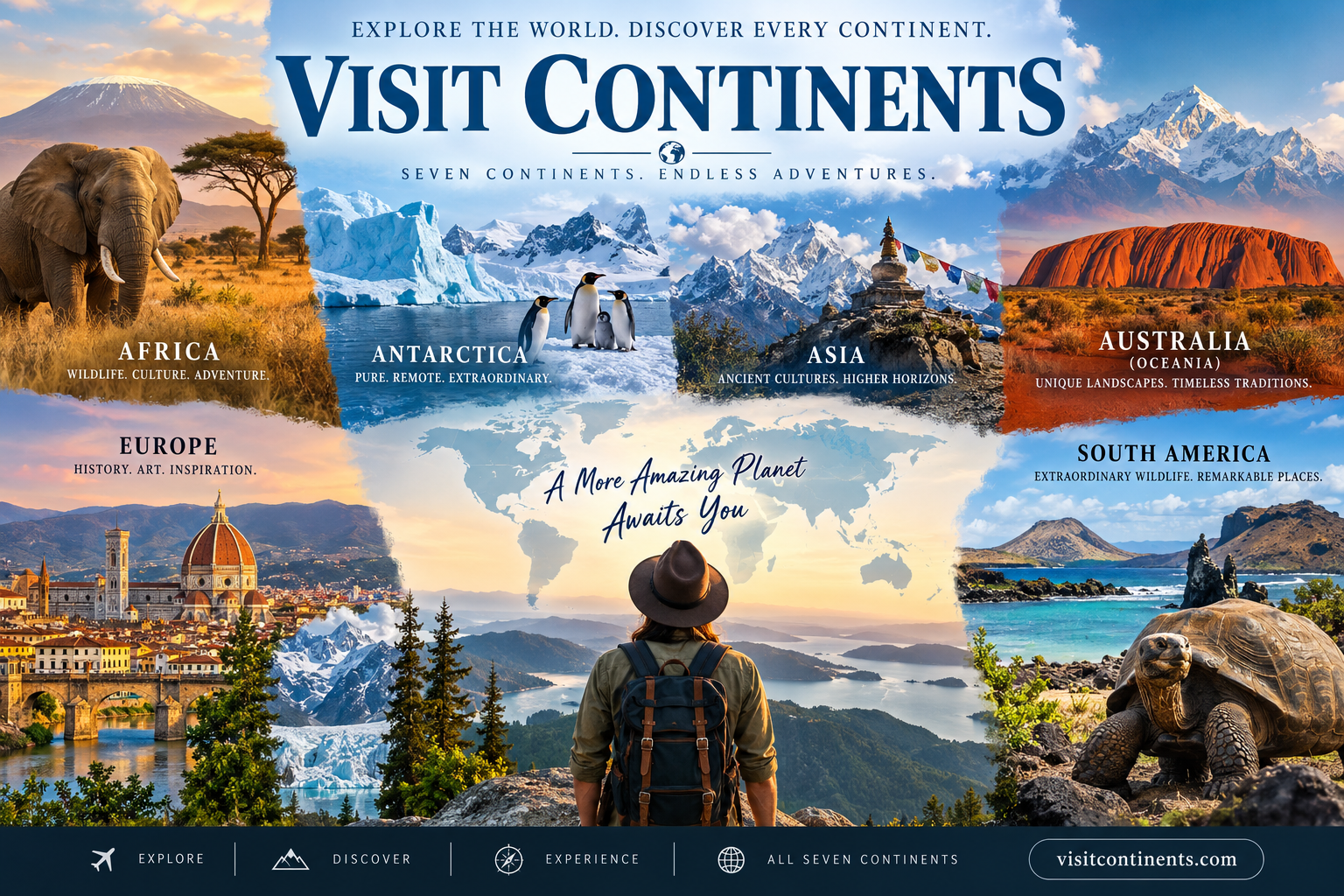
Visiting all seven continents is one of the most extraordinary travel experiences a person can undertake. From the wildlife-rich plains of Africa and the historic cities of Europe to the towering mountains of Asia and the frozen wilderness of Antarctica, each continent offers unique landscapes, cultures, natural wonders, and unforgettable adventures.
For many travelers, visiting every continent represents a lifelong dream. It is an opportunity to explore the diversity of our planet, experience different ways of life, encounter extraordinary wildlife, and discover destinations that may be completely different from home.
However, traveling to all seven continents requires careful planning, a flexible budget, and an efficient route that groups nearby regions together. Travelers must consider international flights, visa requirements, accommodation, seasonal weather, transportation, travel insurance, and the amount of time they want to spend exploring each destination.
Some people complete their seven-continent journey in one extended trip, while others travel across several years, visiting one or two continents at a time.
Whether you are planning a global adventure or looking for inspiration for your next vacation, this Visit Continents guide explores seven remarkable destinations, explains what makes each continent special, and offers practical advice to help you prepare for a journey around the world.
1. Africa: Experience Wildlife Safaris and the Sahara Desert


6
Africa is a continent of extraordinary natural beauty, rich cultural heritage, diverse wildlife, and remarkable landscapes. From tropical rainforests and extensive grasslands to mountain ranges and immense deserts, Africa provides opportunities for adventure, discovery, and cultural exploration.
Two of its most memorable travel experiences are wildlife safaris in Tanzania and desert expeditions in the Sahara.
Explore the wildlife of Tanzania
Tanzania is one of Africa’s renowned safari destinations, attracting travelers who want to observe wild animals in their natural habitats.
The country’s Serengeti National Park is famous for its vast grasslands, abundant wildlife, and the Great Migration, during which large herds of wildebeest and zebras move through the Serengeti-Mara ecosystem in search of grazing land and water.
Visitors can explore the park through guided safari drives, observing animals such as lions, elephants, giraffes, cheetahs, zebras, and numerous bird species.
A safari provides an opportunity to witness the relationships between predators, prey, vegetation, and seasonal changes in the African savanna.
Many travelers choose to stay in safari lodges or tented camps, where they can enjoy the surrounding wilderness while participating in organized wildlife excursions.
The dry season, generally from June through October, is popular for wildlife viewing in many parts of Tanzania. However, the timing and location of animal movements vary from year to year.
Discover the Sahara Desert

For a completely different African adventure, the Sahara Desert offers an experience unlike almost anywhere else on Earth.
Stretching across much of North Africa, the Sahara is the world’s largest hot desert. Its landscape includes towering sand dunes, rocky plateaus, mountains, and scattered oases.
Travelers visiting Morocco can explore the spectacular dunes near Merzouga, participate in guided camel excursions, and spend the night in a desert camp.
As the sun sets, the surrounding dunes appear in different shades of gold, orange, and red. At night, areas far from major cities can offer remarkable views of the stars when skies are clear.
Desert excursions also provide opportunities to learn about Amazigh culture, traditional hospitality, regional cuisine, and the ways communities have adapted to the challenging desert environment.
Africa travel highlights
Suggested duration: 7–14 days for a Tanzania safari or Moroccan desert adventure.
Best time to visit: June–October for many Tanzania safari itineraries; spring and autumn for more comfortable desert temperatures in Morocco.
Recommended experiences: Guided wildlife safari, desert camping, cultural tours, photography, and nature exploration.
2. Antarctica: Discover the World’s Frozen Wilderness


6
Antarctica is one of the most remote and extraordinary travel destinations on Earth. Located around the South Pole, it is known for its immense ice sheet, enormous glaciers, floating icebergs, dramatic mountain landscapes, and wildlife adapted to extreme conditions.
Unlike the other continents, Antarctica has no permanent cities or conventional tourism infrastructure. Most leisure travelers visit aboard specialized expedition vessels accompanied by experienced guides and crew members.
For those seeking a truly distinctive travel experience, Antarctica provides an opportunity to explore an environment largely untouched by urban development.
Explore the Antarctic Peninsula
The Antarctic Peninsula extends toward South America and is one of the most accessible regions of Antarctica for expedition tourism.
Many travelers begin their journey in Ushuaia, Argentina, where they board an expedition ship and sail across the Drake Passage.
After reaching Antarctic waters, passengers may explore locations along the peninsula and nearby islands, depending on weather conditions, sea ice, and their expedition itinerary.
Visitors can observe penguin colonies, watch seals resting on ice, and potentially see whales swimming through the surrounding waters.
The landscape is dominated by enormous glaciers, snow-covered mountains, and blue icebergs with distinctive shapes created by natural ice movement and melting.
Kayak among icebergs and glaciers
One of the most memorable ways to experience Antarctica is through guided kayaking excursions.
Travelers can paddle through sheltered waters while observing floating ice, dramatic glaciers, and spectacular coastal scenery.
These activities are available only through certain expedition operators and depend on suitable weather, sea, and ice conditions.
Participants must follow safety instructions, maintain appropriate distances from wildlife and unstable ice, and use the protective equipment provided by their guides.
Antarctica is an environmentally sensitive region, and visitors must follow conservation guidelines to protect wildlife and minimize human disturbance.
Antarctica travel highlights
Suggested duration: 10–14 days for a typical Antarctic Peninsula expedition from Ushuaia.
Best time to visit: November–March, during the Antarctic summer.
Recommended experiences: Expedition cruising, guided kayaking, wildlife observation, iceberg photography, and educational excursions.
3. Asia: Trek Through the Majestic Himalayas


6
Asia is the largest continent on Earth and offers an incredible diversity of travel experiences. Its destinations include ancient temples, bustling modern cities, tropical beaches, expansive deserts, rainforests, and some of the world’s highest mountains.
From the cultural landmarks of China and India to the island destinations of Southeast Asia, Asia offers countless opportunities for exploration.
For travelers seeking an unforgettable outdoor adventure, the Himalayas provide one of the continent’s most impressive natural experiences.
Explore the Himalayan mountain range
The Himalayas stretch across several Asian countries and contain the world’s highest mountain, Mount Everest.
Nepal is one of the most popular destinations for visitors who want to experience Himalayan scenery through organized trekking adventures.
The Everest and Annapurna regions are particularly well known for their mountain landscapes, established trekking routes, traditional villages, and cultural significance.
Depending on the chosen route, trekkers may travel through forested valleys, cross suspension bridges, pass traditional mountain settlements, and enjoy spectacular views of snow-covered peaks.
Many established trekking routes include local lodges where travelers can rest, enjoy regional food, and learn about mountain communities.
Experience local cultures and traditions

The Himalayan region is home to communities with distinct languages, traditions, religious practices, and ways of life.
Travelers may encounter Buddhist monasteries, colorful prayer flags, traditional architecture, and local markets.
Guided trekking experiences can provide opportunities to learn about regional history, mountain agriculture, and the cultural significance of the surrounding landscape.
Supporting local guides, porters, restaurants, and accommodations can also contribute to the communities that make Himalayan tourism possible.
However, high-altitude trekking requires preparation. Travelers should choose routes appropriate to their fitness and experience, allow sufficient time for acclimatization, and understand the warning signs of altitude sickness.
Asia travel highlights
Suggested duration: 10–21 days, depending on the trekking route.
Best time to visit: March–May and September–November for many popular Nepal trekking routes.
Recommended experiences: Mountain trekking, village visits, cultural tours, photography, and guided nature exploration.
4. Australia and Oceania: Explore the Natural Wonder of Uluru


6
Australia and the wider Oceania region offer remarkable geographical diversity, from the Australian Outback and New Zealand’s mountain landscapes to the tropical islands and coral reefs of the Pacific Ocean.
Australia is recognized as a continent in the commonly used seven-continent model, while Oceania is a broader geographical region that also encompasses New Zealand and numerous Pacific island nations and territories.
One of Australia’s most recognizable landmarks is Uluru, an immense sandstone formation rising above the desert landscape of the Northern Territory.
Witness the beauty of Uluru
Uluru is located within Uluru-Kata Tjuta National Park in Australia’s Red Centre.
The enormous sandstone formation is famous for its striking appearance, particularly during sunrise and sunset, when changing sunlight creates beautiful variations in color.
Visitors can explore designated walking trails, admire the surrounding desert, and learn about the area’s geology, natural environment, and cultural significance.
Uluru holds deep spiritual and cultural importance for the Anangu, the Traditional Owners of the land.
Travelers are encouraged to respect local customs and learn about the relationship between Indigenous communities and the surrounding landscape.
Climbing Uluru is prohibited. Visitors can instead enjoy designated walking routes and culturally appropriate guided experiences.
Discover the Australian Outback

The surrounding Australian Outback provides opportunities to explore striking desert scenery, unusual geological formations, and plants and animals adapted to dry conditions.
Nearby Kata Tjuta features a collection of large rock domes and designated walking trails.
Travelers can participate in guided cultural experiences, explore scenic viewpoints, and learn how Indigenous communities have maintained connections with the region over generations.
Because temperatures in the Australian Outback can become extremely high, visitors should plan outdoor activities carefully, carry sufficient drinking water, and follow park safety guidance.
Australia and Oceania travel highlights
Suggested duration: 3–5 days for Uluru and Kata Tjuta, or 10–14 days for a broader Australian adventure.
Best time to visit: April–September for generally milder conditions in the Red Centre.
Recommended experiences: Uluru sunrise and sunset viewing, designated walking trails, Indigenous cultural experiences, desert photography, and nature exploration.
5. Europe: Discover the Art, Architecture, and History of Florence


6
Europe is celebrated for its rich history, remarkable architecture, diverse cultures, famous museums, and historic cities.
Its extensive transportation networks make it possible to visit several countries during a single journey, allowing travelers to experience different languages, traditions, cuisines, and landscapes.
For visitors interested in Renaissance art, architecture, and Italian culture, Florence is an extraordinary destination.
Walk through the historic streets of Florence
Located in Italy’s Tuscany region, Florence was an important center of the Renaissance and remains internationally recognized for its artistic and architectural heritage.
The city’s historic center contains centuries-old buildings, beautiful public squares, traditional markets, museums, churches, and narrow streets filled with history.
One of Florence’s most famous landmarks is the Cathedral of Santa Maria del Fiore, commonly known as the Duomo.
Its magnificent dome, designed by Filippo Brunelleschi, dominates the city’s skyline and represents an important achievement in Renaissance architecture.
Visitors can also explore the historic Ponte Vecchio, a bridge spanning the Arno River, and enjoy panoramic views of the city from Piazzale Michelangelo.
Explore Florence’s world-famous museums

Florence is home to some of the world’s most celebrated collections of Renaissance art.
The Uffizi Gallery houses important paintings by artists including Sandro Botticelli, Leonardo da Vinci, and Michelangelo.
The Accademia Gallery is particularly famous for Michelangelo’s marble sculpture of David.
Travelers can also visit the Pitti Palace, explore the Boboli Gardens, and admire the artwork and architecture found throughout Florence’s historic churches.
Beyond its cultural landmarks, Florence offers traditional Tuscan cuisine, artisan workshops, lively markets, and welcoming public squares.
Travelers planning to visit major museums should consider reserving admission in advance, especially during popular tourist seasons.
Europe travel highlights
Suggested duration: 3–5 days in Florence, or 10–14 days for a broader Italian itinerary.
Best time to visit: April–June and September–October.
Recommended experiences: Historic walking tours, Renaissance art museums, Italian cuisine, architectural photography, and cultural exploration.
6. North America: Experience the Wilderness of Alaska


6
North America offers an extraordinary variety of natural environments, including tropical rainforests, deserts, mountains, lakes, glaciers, and Arctic wilderness.
Travelers can explore vibrant cities, ancient archaeological sites, coastal landscapes, and some of the world’s most impressive national parks.
For those seeking a remote wilderness experience, Wrangell-St. Elias National Park and Preserve in Alaska is an unforgettable destination.
Explore America’s largest national park
Located in southeastern Alaska, Wrangell-St. Elias National Park and Preserve encompasses approximately 13.2 million acres, making it the largest national park in the United States.
The park contains enormous glaciers, rugged mountain ranges, alpine valleys, rivers, and extensive wilderness.
Its dramatic landscape provides opportunities for travelers to experience the scale and beauty of Alaska’s natural environment.
Unlike parks with extensive paved road networks, much of Wrangell-St. Elias is remote and can be difficult to access.
Visitors should plan transportation, accommodation, activities, and supplies carefully before entering the park.
Discover glaciers and historic mining communities
One of the park’s notable destinations is the historic Kennecott mining district, which preserves buildings and structures associated with Alaska’s early twentieth-century copper mining industry.
Nearby, travelers can enjoy views of the Root Glacier and surrounding mountain scenery.
Depending on their experience and travel arrangements, visitors can participate in guided glacier walks, wilderness hiking, scenic flights, and photography excursions.
The park is also home to wildlife such as bears, moose, mountain goats, and Dall sheep.
Wildlife encounters are unpredictable, and visitors should follow established safety procedures when traveling in bear country or exploring remote areas.
North America travel highlights
Suggested duration: 5–10 days for an Alaska wilderness adventure.
Best time to visit: June–early September for access to many summer visitor services and activities.
Recommended experiences: Guided glacier walks, wilderness hiking, scenic flights, wildlife observation, and visits to historic Kennecott.
7. South America: Discover the Extraordinary Wildlife of the Galápagos Islands


6
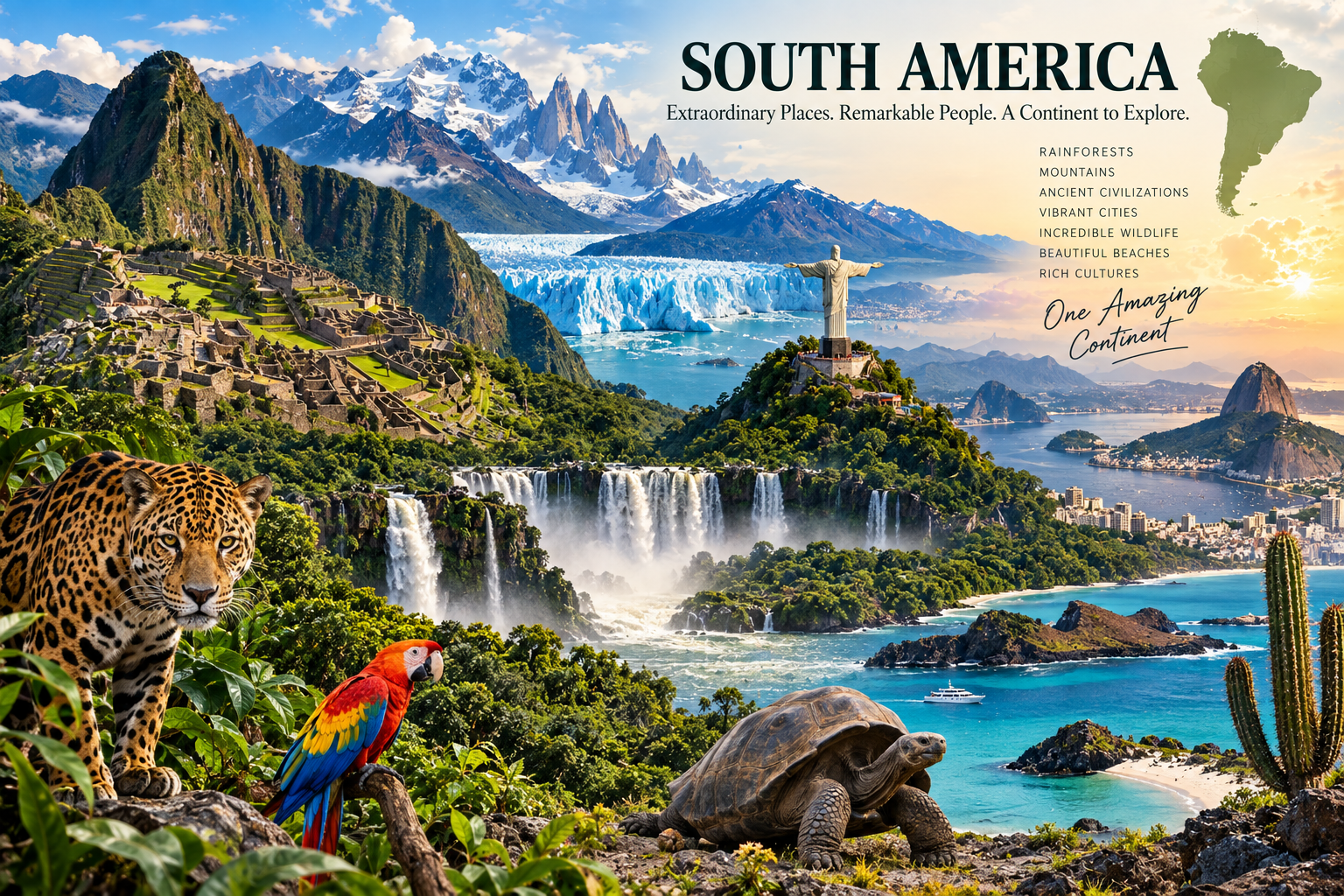
South America is a continent of extraordinary geographical and cultural diversity.
Its natural landscapes include the Amazon rainforest, the Andes Mountains, Patagonia, tropical coastlines, and remarkable volcanic islands.
Travelers can explore ancient civilizations, vibrant cities, traditional communities, and some of the world’s most distinctive ecosystems.
Among the continent’s most fascinating destinations are the Galápagos Islands, an archipelago located in the Pacific Ocean off the coast of Ecuador.
Encounter the unique wildlife of the Galápagos Islands
The Galápagos Islands are famous for their unusual wildlife, remarkable volcanic landscapes, and important role in the history of evolutionary science.
The archipelago is home to numerous animal species, including several found nowhere else on Earth.
Travelers may encounter giant tortoises, marine iguanas, Galápagos sea lions, blue-footed boobies, and Darwin’s finches.
The islands became internationally significant after Charles Darwin visited them in 1835. His observations of their plants and animals contributed to the development of his ideas about evolution by natural selection.
Today, the islands provide visitors with opportunities to observe wildlife and learn about the natural processes that shape isolated ecosystems.
Explore volcanic islands and marine ecosystems

The Galápagos Islands offer far more than land-based wildlife encounters.
Their surrounding waters contain fascinating marine ecosystems where travelers may have opportunities to observe sea turtles, rays, reef fish, and other marine animals.
Depending on their itinerary, visitors can explore the islands through organized cruises, guided day trips, snorkeling excursions, and designated walking trails.
Different islands feature distinct landscapes and wildlife populations, so travelers should select tours based on their interests and the experiences they hope to enjoy.
Because the Galápagos Islands are an environmentally sensitive destination, visitors must follow conservation regulations, maintain appropriate distances from wildlife, and avoid disturbing animals or their habitats.
South America travel highlights
Suggested duration: 5–8 days in the Galápagos Islands, with additional time for mainland Ecuador.
Best time to visit: Year-round, although weather, sea conditions, and wildlife activity vary by season.
Recommended experiences: Wildlife observation, snorkeling, guided nature walks, volcanic landscape photography, and educational marine excursions.
How to Plan a Trip to All Seven Continents

Traveling to every continent requires more than simply choosing seven destinations and booking international flights.
A well-organized itinerary should consider geographical distance, seasonal weather, available transportation, accommodation, entry requirements, personal interests, and the overall travel budget.
One of the most effective planning strategies is to group nearby regions together whenever possible.
For example, travelers visiting Antarctica commonly begin their expedition in South America, making Argentina and other South American destinations natural additions to the same journey.
Similarly, Europe and North Africa can be combined relatively easily through regional flights.
However, an itinerary that minimizes geographical distance may not always provide the most favorable seasonal conditions. Travelers should balance transportation efficiency with their preferred activities and destinations.
A Suggested Seven-Continent Travel Route
The following itinerary provides an example of how travelers might organize a journey beginning in North America.

Stop 1 · North America
Alaska, United States
Begin your adventure by exploring Wrangell-St. Elias National Park and experiencing Alaska’s spectacular glaciers, mountain landscapes, and wilderness.

Stop 2 · South America
Ecuador and Argentina
Discover the wildlife of the Galápagos Islands before traveling to Argentina to prepare for an Antarctic expedition.

Stop 3 · Antarctica
Antarctic Peninsula
Depart from Ushuaia on an expedition cruise to explore glaciers, observe wildlife, and experience Antarctica’s frozen wilderness.

Stop 4 · Africa
Tanzania or Morocco
Experience an African wildlife safari or explore the Sahara Desert through guided excursions and desert camping.

Stop 5 · Europe
Florence, Italy
Discover Renaissance art, historic architecture, Italian cuisine, and the cultural heritage of Tuscany.

Stop 6 · Asia
Nepal
Explore the Himalayas through guided trekking adventures and learn about the cultures of traditional mountain communities.

Stop 7 · Australia and Oceania
Uluru, Australia
Complete your journey by exploring Australia’s Red Centre and discovering the natural and cultural significance of Uluru.
This route is an illustrative planning framework rather than a fixed flight itinerary. Alaska’s summer season and Antarctica’s expedition season occur during different parts of the year, so completing these exact destinations in one continuous journey may require several months of additional travel, adjustments to the order, or a return visit.
Travelers should customize the route according to their departure location, available time, preferred activities, and travel season.
How Much Does It Cost to Visit All Seven Continents?
The cost of visiting all seven continents depends on travel style, destination choices, trip duration, transportation, accommodation, and planned activities.
A budget-conscious traveler may choose hostels, economical accommodation, public transportation, and affordable regional flights.
A luxury traveler may prefer premium hotels, private transportation, personalized guides, and exclusive excursions.
However, some experiences require substantial spending regardless of travel style. Antarctic expedition cruises, African safaris, remote wilderness transportation, and certain guided trekking adventures can significantly increase the overall budget.
Major expenses to consider
| Travel expense | What to include |
|---|---|
| International flights | Long-distance flights, regional connections, and airport transfers |
| Accommodation | Hotels, hostels, guesthouses, safari lodges, and expedition vessels |
| Food and daily expenses | Meals, drinking water, local transportation, and personal purchases |
| Activities and excursions | Safari tours, trekking guides, museum visits, cruises, and organized excursions |
| Travel documentation | Passports, visas, permits, and required entry authorizations |
| Travel insurance | Medical coverage, emergency evacuation, and trip disruptions |
| Emergency reserve | Unexpected transportation changes, medical expenses, and other unforeseen costs |
Travelers should request current prices from airlines, accommodation providers, expedition operators, and local tour companies before establishing a final budget.
An emergency reserve can help protect against unexpected expenses, especially when visiting destinations with limited transportation or medical facilities.
For travelers who cannot finance every destination during one extended trip, completing the journey over several years may be a practical alternative.
When Is the Best Time to Visit All Seven Continents?
One of the biggest challenges of visiting all seven continents is that the most favorable travel seasons do not occur simultaneously.
Northern and Southern Hemisphere destinations experience opposite seasons, while tropical regions may have distinctive wet and dry periods.
Travelers planning a worldwide itinerary should research the seasonal conditions of every destination before booking flights and activities.
| Continent | Destination | General travel window |
|---|---|---|
| Africa | Tanzania safari | June–October |
| Antarctica | Antarctic Peninsula | November–March |
| Asia | Himalayas, Nepal | March–May and September–November |
| Australia/Oceania | Uluru | April–September |
| Europe | Florence, Italy | April–June and September–October |
| North America | Alaska wilderness | June–early September |
| South America | Galápagos Islands | Year-round |
These travel windows are general guidelines. Weather, wildlife activity, tour availability, and individual preferences may affect the most suitable dates for a particular itinerary.
Travelers with flexible schedules can organize their destinations around favorable seasonal conditions.
Those with limited time may need to prioritize specific activities, adjust their destination choices, or divide their journey into separate trips.
Essential Tips for Traveling to All Seven Continents

Preparing for a worldwide journey involves important decisions about transportation, health, safety, accommodation, and travel documentation.
The following considerations can help travelers organize their adventure more effectively.
1. Check passport and visa requirements
Before booking international flights, verify that your passport meets the entry requirements of every country you plan to visit.
Visa requirements vary according to nationality, destination, and length of stay.
Some countries require advance visa approval, electronic travel authorizations, proof of onward travel, or evidence of sufficient funds.
Travelers should also check transit requirements for countries where they will change flights.
2. Purchase suitable travel insurance
International travel can involve unexpected medical expenses, canceled flights, lost luggage, and other disruptions.
Travel insurance can provide financial protection, depending on the policy and coverage selected.
Travelers participating in high-altitude trekking, expedition cruising, glacier walking, or other specialized activities should confirm that their insurance covers the specific activities and emergency evacuation needs.
3. Research health and safety requirements
Different destinations present different health and safety considerations.
Before departure, consult a qualified travel-health professional about destination-specific vaccinations, medications, and personal health needs.
Travelers should also research local emergency services, climate conditions, transportation safety, and any restrictions affecting their planned activities.
4. Allow flexibility in your itinerary
An international journey involving multiple continents may be affected by weather conditions, transportation disruptions, changes in entry requirements, or unexpected circumstances.
Avoid scheduling every activity without sufficient time between destinations.
Additional travel days can be particularly important before Antarctic expeditions, remote wilderness tours, and other expensive activities with limited departure schedules.
5. Respect local cultures and environments
Traveling across seven continents creates opportunities to encounter different languages, traditions, customs, and ways of life.
Respectful travel involves following local laws, observing cultural etiquette, supporting local communities, and respecting important heritage sites.
When visiting national parks and protected environments, travelers should stay on designated trails, follow wildlife-viewing rules, and avoid leaving waste behind.
Responsible travel helps preserve the destinations that make worldwide exploration possible.
Frequently Asked Questions About Visiting All Seven Continents
How long does it take to visit all seven continents?
A short trip can technically include a visit to every continent, but meaningful exploration takes considerably longer. Travelers who want to experience the destinations featured in this guide should consider allowing several months or dividing the journey into multiple trips over several years.
Which continent is the most difficult to visit?
Antarctica presents distinctive logistical challenges because of its remoteness, extreme environmental conditions, limited transportation options, and dependence on specialized expedition operators.
Can you visit all seven continents on a budget?
Yes, although the total cost depends on your destinations and travel style. Affordable accommodation, public transportation, strategic flight bookings, and careful budgeting can reduce many expenses. Antarctica and certain remote destinations may still require substantial funding.
Do you need to visit every country to complete a seven-continent journey?
No. Under the commonly used seven-continent model, visiting at least one destination on each continent allows travelers to complete a journey across all seven continents.
Can families with children visit all seven continents?
Families can organize worldwide journeys by selecting age-appropriate destinations and activities. However, some expedition operators, trekking routes, and remote excursions have minimum-age requirements or other restrictions that should be checked before booking.
Is it better to visit all seven continents in one trip or over several years?
Both approaches offer advantages. A continuous trip can provide an immersive travel experience, while visiting continents over several years allows more time for financial preparation, seasonal planning, and exploring individual destinations in greater depth.
Conclusion: Seven Continents, Endless Adventures

Visiting all seven continents is more than a travel achievement. It is an opportunity to discover the extraordinary diversity of our planet and experience destinations that offer completely different landscapes, cultures, histories, and natural environments.
From watching elephants roam the African savanna and kayaking through Antarctic waters to trekking through the Himalayas, exploring Australia’s Red Centre, admiring Renaissance masterpieces in Florence, discovering Alaska’s immense wilderness, and encountering the remarkable wildlife of the Galápagos Islands, every continent offers experiences worth exploring.
Completing a worldwide journey requires thoughtful planning, financial preparation, and a willingness to adapt to different environments and cultures.
Some travelers may choose to visit all seven continents during one extended adventure, while others will explore the world gradually over many years.
Regardless of the route or travel style, the true value of global exploration lies in the knowledge gained, people encountered, places discovered, and memories created along the way.
With curiosity, preparation, and a passion for discovery, the dream of visiting all seven continents can become a meaningful and achievable travel goal.
VISIT CONTINENTS
Your Journey Around the World Starts Here
Discover remarkable destinations, explore different cultures, and find inspiration for your next adventure across all seven continents.
Explore the World. Discover Every Continent.
visitcontinents.com