VISIT CONTINENTS


5
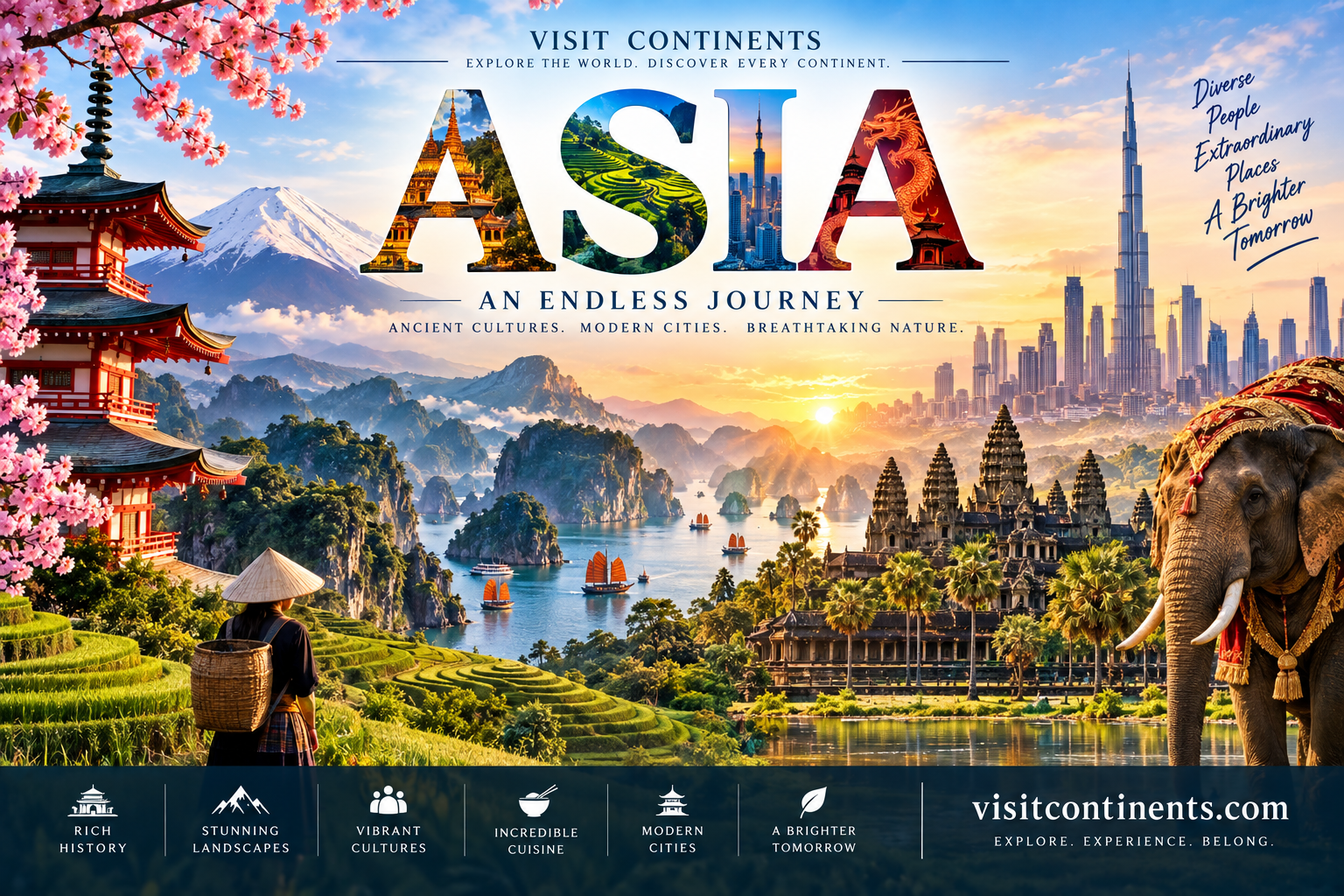
Asia is a continent of extraordinary diversity, ancient civilizations, breathtaking landscapes, and remarkable cultural traditions. Stretching from the Mediterranean region in the west to the Pacific Ocean in the east, Asia is the largest and most populous continent on Earth. It is home to towering mountains, vast deserts, tropical rainforests, beautiful islands, enormous cities, and some of the world’s oldest civilizations.
From the snow-covered peaks of the Himalayas to the tropical beaches of Southeast Asia, Asia offers an incredible variety of natural wonders and travel experiences. Visitors can explore ancient temples, historic palaces, bustling markets, modern skyscrapers, and traditional villages, all within the same continent.
Asia is also a center of global economic activity, scientific development, technological innovation, and international trade. Its countries have influenced world history through their contributions to mathematics, medicine, literature, philosophy, religion, architecture, and the arts.
Whether you are interested in discovering ancient history, experiencing diverse cultures, tasting delicious cuisine, or exploring spectacular natural environments, Asia offers countless opportunities for learning, adventure, and discovery.
1. Geography and Location of Asia


7
Asia covers approximately 44.6 million square kilometers (17.2 million square miles), representing nearly one-third of Earth’s land area. It extends across the Northern and Eastern Hemispheres, although parts of Southeast Asia lie south of the Equator.
Asia shares a continuous landmass with Europe, together forming the vast region known as Eurasia. The conventional boundary between the continents generally follows the Ural Mountains, Ural River, Caspian Sea, Caucasus region, Black Sea, and Turkish Straits, although geographical definitions differ.
Asia is bordered by the Arctic Ocean to the north, the Pacific Ocean to the east, and the Indian Ocean to the south. To the southwest, the Red Sea and the Suez Canal help separate Asia from Africa.
The continent contains many geographical extremes. Mount Everest, situated on the border between Nepal and China, is the highest mountain above sea level on Earth, reaching approximately 8,849 meters (29,032 feet). The Dead Sea shoreline, between Israel and Jordan and adjoining the West Bank, is one of the lowest exposed land areas on Earth.
Asia’s remarkable size creates enormous differences in climate, ecosystems, and natural resources. Northern Siberia experiences extremely cold winters, while equatorial parts of Indonesia and Malaysia have warm, humid conditions throughout the year.
The continent is also home to some of the world’s major river systems, including the Yangtze, Yellow, Mekong, Ganges, Indus, and Tigris–Euphrates rivers. For thousands of years, these waterways have supported agriculture, transportation, commerce, and the development of human settlements.
2. How Many Countries Are in Asia?
Asia is commonly described as having 48 countries under a widely used geographical classification, although totals vary depending on whether transcontinental countries and territories with disputed or limited recognition are included.
The following list presents 48 countries grouped by geographical region. Regional classifications can differ among geographical organizations and reference sources.
East Asia

East Asia is known for its ancient civilizations, technological development, influential cultural traditions, and major economic centers.
- China
- Japan
- Mongolia
- North Korea
- South Korea
Southeast Asia

Southeast Asia is famous for tropical islands, historic temples, rich biodiversity, tropical forests, and diverse cultural traditions.
- Brunei
- Cambodia
- Indonesia
- Laos
- Malaysia
- Myanmar
- Philippines
- Singapore
- Thailand
- Timor-Leste
- Vietnam
South Asia

South Asia is home to the Himalayan mountain range, ancient historical sites, major religious traditions, and some of the world’s most populous countries.
- Afghanistan
- Bangladesh
- Bhutan
- India
- Maldives
- Nepal
- Pakistan
- Sri Lanka
Central Asia

Central Asia is characterized by vast grasslands, towering mountain ranges, historic Silk Road cities, and nomadic cultural traditions.
- Kazakhstan
- Kyrgyzstan
- Tajikistan
- Turkmenistan
- Uzbekistan
Western Asia

Western Asia contains some of the world’s oldest urban civilizations, important archaeological sites, diverse landscapes, and major religious and cultural centers.
- Armenia
- Azerbaijan
- Bahrain
- Cyprus
- Georgia
- Iran
- Iraq
- Israel
- Jordan
- Kuwait
- Lebanon
- Oman
- Palestine
- Qatar
- Saudi Arabia
- Syria
- Türkiye (Turkey)
- United Arab Emirates
- Yemen
A note on geographical classifications: Russia spans both Europe and Asia and is geographically the largest country in Asia by land area, but it is not included in the 48-country list above. Taiwan is geographically part of East Asia and is self-governing; its political status is disputed. The placement of countries such as Cyprus, Georgia, Armenia, Azerbaijan, and Türkiye also differs among geographical classifications.
3. The Population and People of Asia


7
Asia is home to approximately 4.8 billion people, accounting for nearly 60% of the world’s population. Its inhabitants represent thousands of ethnic communities, cultures, languages, and religious traditions.
China and India are among the world’s most populous countries, with each having more than one billion residents. Other countries with large populations include Indonesia, Pakistan, Bangladesh, Japan, and the Philippines.
Asia contains some of the largest metropolitan areas in the world, including Tokyo, Delhi, Shanghai, Beijing, Mumbai, Dhaka, and Jakarta. These cities are major centers of business, education, transportation, technology, and cultural exchange.
However, life in Asia extends far beyond its major cities. Millions of people live in farming communities, mountain villages, coastal settlements, desert regions, and islands, where traditional lifestyles often exist alongside modern technology.
Languages of Asia
Asia is one of the most linguistically diverse continents. Thousands of languages and dialects are spoken across its countries.
Some widely spoken languages include Mandarin Chinese, Hindi, Arabic, Bengali, Japanese, Korean, Indonesian, Urdu, Vietnamese, Tamil, Turkish, and Persian.
English is also used extensively in international business, education, tourism, and communication in many Asian countries.
Language is an important part of Asian cultural identity. Each language carries unique expressions, literary traditions, historical experiences, and ways of understanding the world.
Religions and spiritual traditions
Asia is the birthplace of several major world religions, including Christianity, Islam, Hinduism, Buddhism, Judaism, Sikhism, Jainism, and many other religious and philosophical traditions.
Sacred temples, mosques, churches, monasteries, shrines, and pilgrimage destinations can be found throughout the continent.
Religious practices and spiritual traditions have shaped Asian architecture, festivals, literature, philosophy, family life, and social customs for thousands of years.
4. The History of Asia: Ancient Civilizations and Great Empires


5
Asia played a central role in the development of human civilization. Some of the earliest known cities, agricultural communities, writing systems, and organized societies emerged on the continent.
Mesopotamia, located primarily in present-day Iraq, is often described as one of the cradles of civilization. Ancient societies developed systems of writing, mathematics, irrigation, law, and organized government in this region.
The Indus Valley civilization developed sophisticated cities in parts of present-day Pakistan and northwestern India. Settlements such as Mohenjo-daro and Harappa featured planned streets, drainage systems, and impressive urban infrastructure.
Ancient Chinese civilization emerged along the Yellow River and other major waterways. Over many centuries, successive dynasties contributed to developments in agriculture, philosophy, manufacturing, architecture, and governance.
Other influential historical civilizations and empires included the Persian, Maurya, Gupta, Mongol, Ottoman, Khmer, and various Islamic empires.
The Silk Road

The Silk Road was an extensive network of trade routes connecting East Asia, Central Asia, South Asia, the Middle East, and Europe.
Merchants traveled thousands of miles carrying silk, spices, precious stones, ceramics, textiles, and other valuable products. These trade networks also facilitated the exchange of religions, languages, scientific knowledge, artistic styles, and technological innovations.
Historic trading cities such as Samarkand and Bukhara in present-day Uzbekistan became important centers of commerce and cultural exchange.
The Silk Road demonstrates how Asia’s civilizations influenced one another and helped connect distant regions of the world.
5. The Natural Wonders of Asia
Asia offers some of the most spectacular natural landscapes on Earth. Its geographical diversity includes mountain ranges, deserts, tropical rainforests, volcanoes, rivers, lakes, islands, and coral reefs.
The Himalayas

The Himalayas extend across parts of Nepal, India, Bhutan, China, and Pakistan’s wider mountain region. This enormous mountain system contains many of the world’s highest peaks, including Mount Everest.
The Himalayas are an important source of freshwater for millions of people. Their glaciers, snowfields, and mountain rivers support major river systems throughout South and East Asia.
Visitors travel to the region for trekking, mountaineering, wildlife observation, photography, and cultural experiences in Himalayan communities.
Nepal’s Everest region and Annapurna region are internationally known trekking destinations, while Bhutan offers beautiful mountain scenery, historic monasteries, and traditional architecture.
The Gobi Desert

The Gobi Desert stretches across southern Mongolia and northern China. Unlike the popular image of a desert covered entirely in sand, much of the Gobi consists of rocky plains, gravel landscapes, and mountains.
The region experiences extreme seasonal temperature changes, with hot summers and freezing winters.
The Gobi is also scientifically important because it contains significant fossil deposits, including discoveries of dinosaur eggs and skeletons.
Travelers can explore desert landscapes, learn about traditional Mongolian nomadic life, and experience the remarkable quiet and open skies of this vast region.
Mount Fuji, Japan

Mount Fuji is one of Japan’s most recognizable natural landmarks. Standing approximately 3,776 meters above sea level, this volcanic mountain is celebrated for its symmetrical appearance and cultural significance.
It has inspired Japanese art, literature, photography, and religious traditions for centuries.
Visitors can admire Mount Fuji from nearby lakes, traditional villages, and scenic viewpoints. During the designated climbing season, suitably prepared travelers can also attempt to reach its summit.
The mountain is particularly beautiful when framed by cherry blossoms in spring or colorful autumn leaves.
The Mekong River

The Mekong is one of Asia’s major rivers. It flows from the Tibetan Plateau through China and mainland Southeast Asia before reaching the South China Sea through Vietnam’s Mekong Delta.
The river supports agriculture, fisheries, transportation, and local communities.
Visitors can explore riverside villages, floating markets, traditional fishing communities, and beautiful landscapes in countries such as Laos, Cambodia, Thailand, and Vietnam.
The Mekong Delta is especially known for its network of waterways, fertile agricultural land, and distinctive river-based communities.
The Islands and Coral Reefs of Southeast Asia


7
Southeast Asia contains thousands of islands surrounded by warm tropical waters.
Indonesia is the world’s largest archipelagic country and is known for its volcanic landscapes, tropical forests, marine ecosystems, and diverse island cultures.
The Philippines is famous for its white-sand beaches, coral reefs, limestone cliffs, and clear turquoise lagoons.
Raja Ampat in Indonesia is especially celebrated for its rich marine biodiversity, while Palawan in the Philippines attracts travelers interested in snorkeling, island exploration, and coastal scenery.
The Maldives, located in South Asia, offers another remarkable island environment, featuring coral atolls, lagoons, and tropical marine life.
These destinations are important centers for tourism, marine research, and conservation.
6. Famous Landmarks and Tourist Attractions in Asia
Asia contains countless historical monuments, architectural masterpieces, religious sites, and modern attractions. Many of these destinations are recognized internationally for their cultural, historical, and artistic importance.

The Great Wall of China
China
The Great Wall is a vast network of defensive walls and fortifications built and rebuilt over many centuries. It stretches across mountainous and desert regions of northern China and offers visitors an opportunity to explore ancient engineering, military history, and spectacular scenery.

Angkor Wat
Cambodia
Angkor Wat is an enormous temple complex built during the Khmer Empire in the 12th century. Originally dedicated to the Hindu god Vishnu, it later became an important Buddhist site. Its intricate stone carvings, monumental towers, and surrounding archaeological landscape attract visitors from around the world.

The Taj Mahal
India
Located in Agra, the Taj Mahal is a magnificent white-marble mausoleum commissioned by the Mughal emperor Shah Jahan in memory of his wife Mumtaz Mahal. Its beautiful gardens, symmetrical architecture, and decorative stonework make it one of India’s most recognizable monuments.

Petra
Jordan
Petra is an ancient city famous for its impressive buildings carved directly into rose-colored sandstone cliffs. Once an important trading center of the Nabataean kingdom, Petra features tombs, temples, and remarkable archaeological remains.

Burj Khalifa
United Arab Emirates
Standing approximately 828 meters tall, Burj Khalifa in Dubai is the world’s tallest completed building. Its observation decks provide expansive views of Dubai’s skyline, coastline, and surrounding desert landscape.

Borobudur Temple
Indonesia
Borobudur is a magnificent Buddhist monument located on the island of Java. Constructed around the eighth and ninth centuries, it features multiple terraces, carved stone reliefs, and hundreds of Buddha statues. The surrounding volcanic mountains contribute to its extraordinary setting.

Hagia Sophia
Türkiye
Located in Istanbul, Hagia Sophia is an architectural landmark originally constructed as a Byzantine cathedral in the sixth century. It has served different religious and cultural functions over its long history and is celebrated for its monumental dome and intricate interior decoration.
7. Asian Culture and Traditions


7
Asia’s cultural richness reflects thousands of years of history, migration, trade, religious development, and interaction among different societies.
Its countries have distinctive traditions involving family life, music, dance, literature, architecture, clothing, food, and celebrations.
Traditional customs continue to play important roles in many communities, even as modern lifestyles and technological developments transform everyday life.
Festivals and celebrations
Festivals are among the most colorful expressions of Asian culture. They often bring families and communities together through music, dancing, traditional clothing, decorations, special meals, and religious or cultural ceremonies.
Some notable celebrations include:
- Lunar New Year, celebrated in China, Vietnam, South Korea, and several other Asian communities.
- Diwali, the festival of lights celebrated by Hindus, Jains, Sikhs, and some Buddhists.
- Eid al-Fitr, celebrated by Muslim communities throughout Asia at the conclusion of Ramadan.
- Songkran, Thailand’s traditional New Year celebration, famous for its water festivities.
- Holi, a spring festival associated with colorful powders, music, and community celebrations in India and Nepal.
- Nowruz, a traditional New Year celebration observed in Iran, Central Asia, and other regions.
Each festival carries its own history, symbolism, and cultural significance.
Traditional clothing


8
Traditional Asian clothing reflects the geography, history, climate, and artistic traditions of different societies.
Japan is known for the kimono, a traditional garment associated with formal occasions, ceremonies, and cultural celebrations.
India is famous for the sari, a garment worn in numerous styles, fabrics, colors, and regional variations.
In South Korea, the hanbok is recognized for its elegant silhouettes and vibrant colors, while Vietnam’s áo dài is known for its fitted tunic and flowing panels.
Across Western and Central Asia, traditional garments include a wide variety of robes, embroidered dresses, head coverings, and regional textiles.
These clothing traditions remain important expressions of cultural identity and craftsmanship.
8. Asian Food and Cuisine


6
Asian cuisine is celebrated worldwide for its variety of ingredients, cooking methods, aromatic spices, and distinctive flavors.
Food traditions differ enormously across the continent. In some regions, rice is a major staple, while wheat, barley, millet, noodles, flatbreads, and other grains are central to everyday meals elsewhere.
Local climates, agricultural practices, religious traditions, and historical trade routes have influenced how different cuisines developed.
Here are several well-known dishes from Asia:

Sushi — Japan
Sushi combines seasoned rice with ingredients such as seafood, vegetables, and seaweed. It is prepared in numerous styles, including nigiri, maki, and chirashi.

Biryani — South Asia
Biryani is an aromatic rice dish commonly prepared with spices, vegetables, meat, or seafood. Numerous regional varieties are enjoyed across India, Pakistan, Bangladesh, and neighboring countries.

Pho — Vietnam
Pho is a popular Vietnamese noodle soup traditionally prepared with a flavorful broth, rice noodles, herbs, and meat or other ingredients.

Bibimbap — South Korea
Bibimbap is a Korean rice dish served with an assortment of vegetables and other toppings. It is often accompanied by a flavorful chili-based sauce.

Hummus — Western Asia
Hummus is a creamy preparation made from chickpeas, tahini, lemon juice, and garlic. It is widely enjoyed in the Levant and surrounding regions.

Dumplings — China
Chinese dumplings are made with wrappers filled with ingredients such as vegetables, meat, or seafood. They may be steamed, boiled, or pan-fried.
Exploring local cuisine is one of the most enjoyable ways to discover Asia. Travelers can visit traditional restaurants, street markets, family-owned food stalls, and regional food festivals to experience the continent’s culinary diversity.
9. Wildlife and Biodiversity in Asia


7
Asia is home to extraordinary biodiversity, including many rare, endangered, and geographically unique animals.
The continent contains tropical rainforests, temperate forests, grasslands, wetlands, coral reefs, deserts, and mountain ecosystems that support an enormous variety of plant and animal species.
Among Asia’s most recognizable animals are the Bengal tiger, giant panda, Asian elephant, snow leopard, orangutan, red panda, and Komodo dragon.
The Bengal tiger lives in parts of South Asia, including India, Bangladesh, Nepal, and Bhutan. It is an important predator that helps maintain ecological balance in its natural environment.
The giant panda is native to China and is known for its distinctive black-and-white fur and bamboo-based diet.
Orangutans live in the tropical forests of Borneo and Sumatra, where they spend much of their lives in trees.
The snow leopard inhabits mountainous regions of Central and South Asia, while the Komodo dragon is a large monitor lizard native to several Indonesian islands.
Many Asian species face threats from habitat destruction, illegal wildlife trade, pollution, and climate change.
National parks, protected areas, wildlife reserves, and conservation programs play essential roles in preserving the continent’s biodiversity.
10. The Climate and Seasons of Asia


6
Because Asia stretches across such a large geographical area, it experiences nearly every major climate type on Earth.
Northern Asia has subarctic and Arctic climates, with long, cold winters and relatively short summers. Siberia is especially known for its extensive forests, frozen landscapes, and extremely low winter temperatures.
Central Asia has largely continental and arid climates. Its deserts and grasslands experience considerable seasonal temperature differences, with hot summers and cold winters in many areas.
South and Southeast Asia include tropical and subtropical regions characterized by warm temperatures, seasonal rainfall, and monsoon weather patterns.
The Arabian Peninsula and parts of Western Asia have hot, dry desert climates, while coastal and mountainous regions may experience milder conditions.
East Asia includes temperate regions with distinct seasons, creating dramatic seasonal changes in countries such as Japan, China, and South Korea.
When is the best time to visit Asia?
The ideal time to visit depends on the country, region, and activities you want to experience.
Spring is a popular season for visiting parts of Japan and South Korea, especially during cherry blossom season.
Autumn offers colorful foliage and generally comfortable conditions in many temperate regions.
For Himalayan trekking, certain spring and autumn periods are popular because they can offer relatively favorable mountain conditions.
Many tropical destinations have distinct wet and dry seasons, although their timing varies by location.
Travelers should research local weather patterns, seasonal temperatures, monsoon conditions, and regional travel advisories before planning their journeys.
11. Major Cities of Asia
Asia contains some of the world’s most dynamic urban centers. Its cities combine historical landmarks, modern architecture, business districts, cultural attractions, transportation networks, and diverse communities.

Tokyo, Japan
Tokyo is famous for its modern transportation system, shopping districts, traditional shrines, museums, technology centers, and diverse food culture. Visitors can explore historic neighborhoods, peaceful gardens, and vibrant commercial districts.

Singapore
Singapore is a city-state known for its modern skyline, multicultural communities, gardens, shopping centers, and international business environment. Popular attractions include Marina Bay, Gardens by the Bay, and its diverse cultural neighborhoods.

Dubai, United Arab Emirates
Dubai is internationally recognized for its distinctive skyscrapers, shopping destinations, luxury hotels, desert landscapes, and modern architectural developments. Visitors can explore both historic trading districts and contemporary attractions.

Seoul, South Korea
Seoul combines modern urban development with historic palaces, traditional neighborhoods, museums, shopping streets, and vibrant entertainment districts. It is also an important international center for Korean music, fashion, film, and technology.

Bangkok, Thailand
Bangkok is celebrated for its ornate Buddhist temples, traditional markets, riverside attractions, distinctive cuisine, and lively urban atmosphere. The Grand Palace and Wat Arun are among its most recognizable landmarks.

Istanbul, Türkiye
Istanbul is a historic city spanning Europe and Asia. It is famous for its magnificent mosques, historic palaces, traditional bazaars, and strategic location along the Bosphorus Strait.
12. The Economy and Technology of Asia


5
Asia plays a major role in the global economy. Its countries participate in industries ranging from agriculture and manufacturing to finance, transportation, energy, information technology, and scientific research.
China is a major global manufacturing and trading center, producing a wide range of consumer goods, machinery, electronics, and industrial products.
Japan has a long history of technological and industrial development, particularly in automobiles, electronics, robotics, and advanced manufacturing.
South Korea is internationally recognized for its semiconductor industry, electronics, automobiles, shipbuilding, and digital entertainment.
India has a substantial information technology and services industry, with major business and technology centers in cities such as Bengaluru, Hyderabad, and Mumbai.
Singapore is an important international financial, transportation, and logistics hub, while countries in Western Asia play significant roles in global energy markets, aviation, commerce, and infrastructure development.
Asian countries also contribute extensively to scientific research, renewable energy, medical technology, telecommunications, and space exploration.
The continent’s economic diversity demonstrates the importance of international cooperation, education, infrastructure, and technological innovation in shaping its future.
13. Travel and Tourism in Asia


6
Asia attracts travelers interested in history, nature, culture, adventure, relaxation, education, and spiritual experiences.
The continent offers an extraordinary range of activities, from visiting ancient cities and exploring tropical islands to hiking through mountains and discovering traditional villages.
Travel experiences vary significantly from country to country. Some destinations feature extensive modern transportation systems and major international tourism infrastructure, while others require more specialized planning and local guidance.
Popular travel experiences

Beach and island vacations
Discover the tropical islands of Indonesia, Thailand, the Philippines, Sri Lanka, and the Maldives, where visitors can enjoy swimming, snorkeling, diving, and coastal exploration.

Mountain adventures
Explore the Himalayas, the Japanese Alps, the mountains of Central Asia, and other scenic regions offering hiking, trekking, skiing, and outdoor activities.

Historical and cultural tourism
Visit ancient temples, archaeological sites, historic cities, museums, palaces, and cultural heritage destinations across the continent.

Modern city exploration
Experience the architecture, entertainment, shopping, technology, and diverse neighborhoods of cities such as Tokyo, Singapore, Seoul, Dubai, and Shanghai.
Important travel tips
Before visiting Asia, travelers should check the passport and visa requirements of their destination, including any transit countries. Entry rules vary considerably between countries and may depend on nationality, travel purpose, and length of stay.
Visitors should also review recommended vaccinations and other health precautions, purchase suitable travel insurance, research transportation options, and familiarize themselves with local laws and customs.
Respecting religious traditions, dressing appropriately at sacred sites, learning basic local greetings, and following environmental guidelines can help create a positive travel experience.
Travelers should consult current official travel advisories and local authorities, particularly when visiting destinations experiencing natural disasters, severe weather, political instability, or other safety concerns.
14. Fascinating Facts About Asia
Asia is the world’s largest continent.
It covers approximately 44.6 million square kilometers, or about 30% of Earth’s total land area.
Asia has the largest population of any continent.
Nearly six out of every ten people in the world live in Asia.
The world’s highest mountain is in Asia.
Mount Everest reaches approximately 8,849 meters above sea level.
Asia contains the world’s deepest lake.
Lake Baikal in Russia reaches a maximum depth of approximately 1,642 meters and contains an enormous volume of freshwater.
Some of the world’s oldest civilizations developed in Asia.
Ancient Mesopotamian, Indus Valley, and Chinese civilizations made important contributions to urban development, writing, mathematics, and technology.
Asia is home to extraordinary biodiversity.
Its habitats support iconic animals such as giant pandas, tigers, elephants, orangutans, snow leopards, and Komodo dragons.
15. Why Asia Is Important to the World

Asia has influenced human history, culture, science, religion, and economic development for thousands of years.
Its ancient civilizations helped establish foundations for mathematics, astronomy, medicine, philosophy, agriculture, literature, and systems of government. Asian trade networks connected distant societies and encouraged the exchange of ideas, inventions, and cultural traditions.
Today, the continent continues to influence global developments in technology, manufacturing, international commerce, scientific research, entertainment, and education.
Asia’s natural environments are equally important. Its mountain glaciers, forests, wetlands, rivers, and marine ecosystems support biodiversity and provide essential resources for millions of people.
Protecting these environments, promoting sustainable development, and preserving cultural heritage are important responsibilities for present and future generations.
Conclusion: Discover the Beauty and Diversity of Asia
Asia is a continent of remarkable contrasts, where ancient civilizations coexist with modern cities, towering mountains overlook tropical forests, and historical traditions continue to shape contemporary life.
Its extraordinary landscapes, diverse cultures, delicious cuisines, historic landmarks, and natural wonders make it one of the most fascinating regions of the world to explore.
From the Great Wall of China and the magnificent Taj Mahal to the beaches of the Maldives and the snow-covered Himalayas, Asia offers countless opportunities for adventure, education, cultural appreciation, and discovery.
Exploring Asia is more than visiting famous destinations. It is an opportunity to learn about different societies, understand the history of human civilization, experience diverse cultural traditions, and appreciate the natural beauty of our planet.
Whether you dream of visiting ancient temples, exploring bustling cities, hiking majestic mountains, or relaxing on tropical islands, Asia offers an extraordinary journey through some of the world’s most remarkable places.
Discover Asia — a continent of ancient history, breathtaking landscapes, extraordinary cultures, and endless opportunities for exploration.