VISIT CONTINENTS

AUSTRALIA TRAVEL GUIDE | COUNTRIES • CITIES • WILDLIFE • CULTURE • ADVENTURE
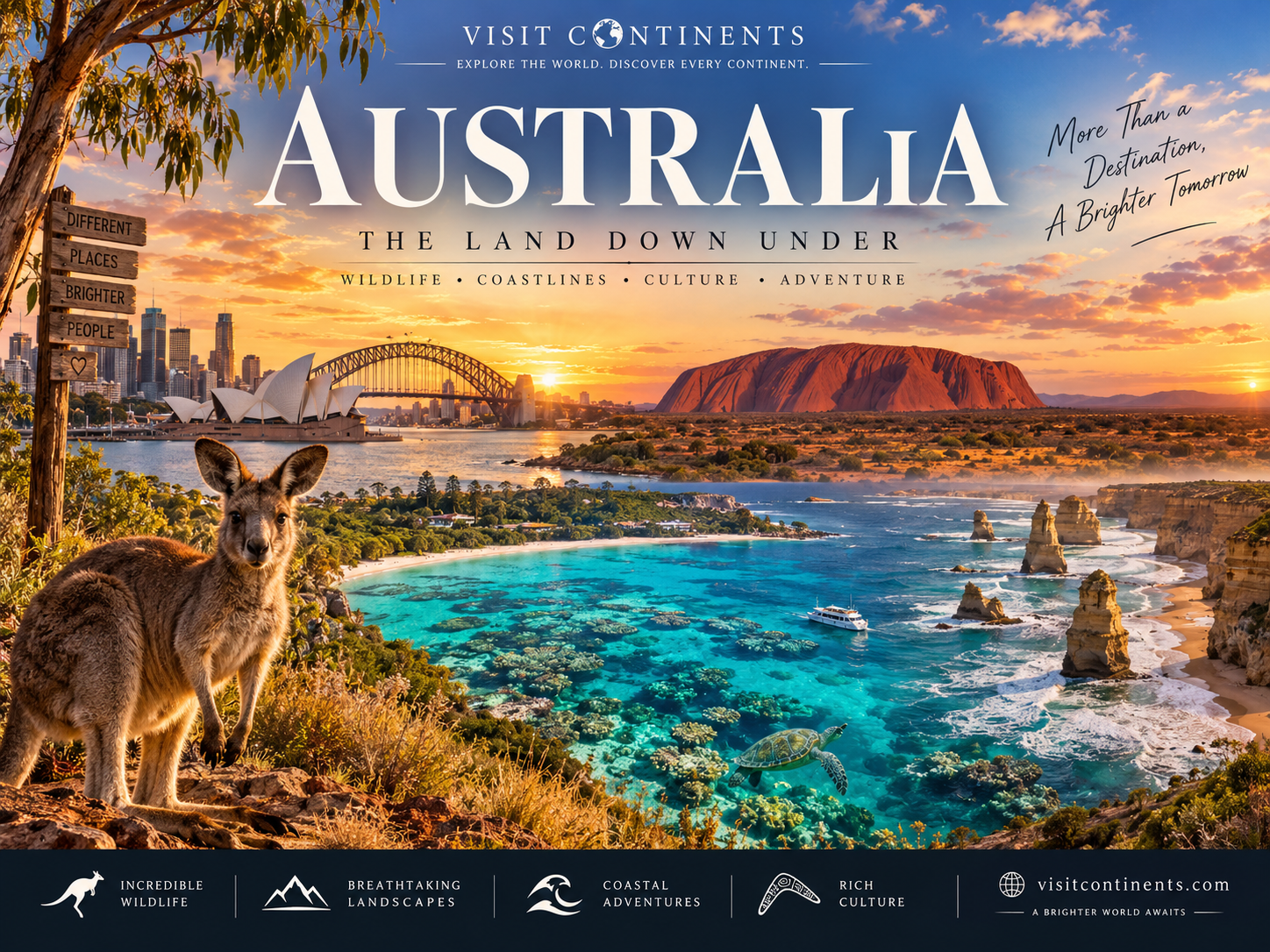
Australia is one of the world’s most extraordinary travel destinations, famous for its breathtaking landscapes, remarkable wildlife, ancient Indigenous cultures, modern cities, and spectacular coastlines.
From the iconic Sydney Opera House and the colorful underwater ecosystems of the Great Barrier Reef to the immense sandstone formation of Uluru and the rugged wilderness of Tasmania, Australia offers a remarkable variety of travel experiences.
Visitors can explore tropical rainforests, relax on pristine beaches, discover vibrant cities, encounter kangaroos and koalas, travel through the Australian Outback, and learn about the world’s oldest continuing living cultures.
Australia is also unique in its geography. It is both a sovereign country and a continent in the commonly used seven-continent model. However, the broader geographical region known as Oceania also includes New Zealand, Papua New Guinea, and numerous Pacific island nations.
For travelers planning to visit all seven continents, Australia represents an opportunity to discover a destination unlike anywhere else on Earth.
In this comprehensive Visit Continents guide, explore Australia’s geography, states and territories, capital cities, natural wonders, wildlife, cultural heritage, famous destinations, travel seasons, and everything you need to know before planning an unforgettable Australian adventure.
1. Discover Australia: A Country and a Continent


7
Australia lies in the Southern Hemisphere, between the Indian and Pacific Oceans.
It is the world’s sixth-largest country by land area, covering approximately 7.7 million square kilometers. Its geographical position gives it an extraordinary range of environments, from tropical northern coastlines and extensive interior deserts to temperate southern forests, mountain regions, and offshore islands.
Australia is commonly described as the world’s smallest continent. However, the term Oceania is often used when discussing the broader region encompassing Australia, New Zealand, Papua New Guinea, and the Pacific islands.
Australia’s national territory includes the mainland, Tasmania, and numerous smaller islands.
Although large parts of its interior are sparsely populated, the country has several major metropolitan centers, including Sydney, Melbourne, Brisbane, Perth, and Adelaide.
Australia at a glance
| Official name | Commonwealth of Australia |
| Continent | Australia |
| Broader region | Oceania |
| Capital city | Canberra |
| Largest city by population | Sydney |
| Land area | Approximately 7.7 million km² |
| Population | More than 27 million people |
| Currency | Australian dollar (AUD) |
| Primary national language | English, alongside many other languages |
| Highest mainland mountain | Mount Kosciuszko |
Australia’s immense size is an important consideration when planning a journey. Traveling between major cities or natural attractions may involve flights lasting several hours or long road journeys through sparsely populated landscapes.
A visit to Sydney, the Great Barrier Reef, Uluru, and Perth involves travel across different parts of the country, so visitors should build a realistic itinerary rather than assuming that all major attractions are located close together.
2. How Many Countries Are in Australia?

Australia is both a sovereign country and a continent. In the commonly used seven-continent model, the continent of Australia is centered on the Australian mainland and its associated islands.
However, Australia is frequently grouped with neighboring countries and territories under the broader regional name Oceania.
Oceania includes Australia, New Zealand, Papua New Guinea, and many island countries across the Pacific Ocean.
The 14 independent countries of Oceania
COUNTRIES OF OCEANIA
| 01 | Australia | Canberra |
| 02 | Fiji | Suva |
| 03 | Kiribati | South Tarawa |
| 04 | Marshall Islands | Majuro |
| 05 | Federated States of Micronesia | Palikir |
| 06 | Nauru | No official capital; government offices in Yaren District |
| 07 | New Zealand | Wellington |
| 08 | Palau | Ngerulmud |
| 09 | Papua New Guinea | Port Moresby |
| 10 | Samoa | Apia |
| 11 | Solomon Islands | Honiara |
| 12 | Tonga | Nukuʻalofa |
| 13 | Tuvalu | Funafuti |
| 14 | Vanuatu | Port Vila |
This list includes the 14 sovereign countries commonly counted within Oceania. The region also contains dependent territories, self-governing territories in free association, and other island jurisdictions.
The remainder of this article focuses on Australia itself, including its states, territories, natural attractions, cities, people, and travel experiences.
3. Australia’s Six States and Two Major Mainland Territories

Australia is a federation consisting of six states and several territories. Its two principal mainland territories are the Australian Capital Territory and the Northern Territory.
Each state and territory has a distinctive identity, landscape, population, and range of attractions.

State 1
New South Wales — Capital: Sydney
Known for Sydney Harbour, the Blue Mountains, coastal beaches, wine regions, and important cultural and historical landmarks.

State 2
Victoria — Capital: Melbourne
Features vibrant urban culture, the Great Ocean Road, alpine environments, historic towns, and renowned food and arts scenes.

State 3
Queensland — Capital: Brisbane
Famous for the Great Barrier Reef, tropical rainforests, the Gold Coast, the Whitsunday Islands, and diverse wildlife.

State 4
Western Australia — Capital: Perth
Australia’s largest state by area, with immense desert landscapes, remote coastlines, Ningaloo Reef, and the Kimberley region.

State 5
South Australia — Capital: Adelaide
Known for Kangaroo Island, the Flinders Ranges, historic architecture, agricultural regions, and coastal landscapes.

State 6
Tasmania — Capital: Hobart
An island state known for its rugged wilderness, ancient forests, mountain scenery, historic settlements, and distinctive wildlife.

Territory 1
Australian Capital Territory — Capital: Canberra
Home to Australia’s national government, major museums, national institutions, gardens, and cultural attractions.

Territory 2
Northern Territory — Capital: Darwin
Features Uluru, Kakadu National Park, tropical wetlands, ancient rock art, remote desert environments, and Indigenous cultural heritage.
Australia also has external territories, including Christmas Island, the Cocos (Keeling) Islands, Norfolk Island, and others, which have different geographical and administrative characteristics.
4. The Most Beautiful Places to Visit in Australia
Australia offers some of the world’s most remarkable natural and cultural attractions.
Its immense geographical diversity allows travelers to experience modern cities, tropical rainforests, coral reefs, desert landscapes, dramatic coastlines, and mountain environments within a single country.
Sydney: Discover Australia’s Iconic Harbour City


7
Sydney is Australia’s largest city and one of its most internationally recognized travel destinations.
Located on the southeastern coast of New South Wales, the city is famous for its spectacular natural harbour, distinctive architecture, coastal beaches, cultural institutions, and lively urban atmosphere.
The Sydney Opera House is one of the country’s most iconic landmarks, recognized for its remarkable roof design and its importance as a performing arts venue.
Nearby, the Sydney Harbour Bridge provides another defining feature of the city’s skyline.
Visitors can explore the historic Rocks district, enjoy harbour cruises, visit museums, and discover restaurants and cultural attractions throughout the city.
Sydney is also known for its beaches, including Bondi, Manly, and Coogee.
The coastal walk between Bondi and Coogee offers dramatic ocean views, rocky cliffs, public beaches, and scenic coastal landscapes.
Sydney travel highlights
Suggested duration: 3–5 days.
Recommended experiences: Sydney Opera House, Harbour Bridge, Bondi Beach, harbour cruising, museums, and coastal walks.
Travel tip: Use public transportation and ferries to explore the city, and swim only in designated areas while following beach safety instructions.
The Great Barrier Reef: Explore an Underwater Natural Wonder


7
The Great Barrier Reef is one of Australia’s most remarkable natural attractions and the world’s largest coral reef system.
Located off the coast of Queensland, it extends for approximately 2,300 kilometers and contains thousands of individual reefs and hundreds of islands.
Its marine environments support an extraordinary diversity of life, including tropical fish, sea turtles, rays, sharks, dolphins, and numerous other organisms.
Visitors can explore selected reef locations through licensed snorkeling, diving, glass-bottom boat excursions, and guided marine tours.
Cairns and Port Douglas are popular gateways for exploring the northern section of the reef, while the Whitsunday Islands provide access to spectacular beaches and island scenery farther south.
The Great Barrier Reef is environmentally sensitive and has experienced substantial pressures from marine heatwaves, coral bleaching, storms, and other threats.
Travelers should choose responsible tourism operators and avoid touching, standing on, or collecting coral.
Great Barrier Reef travel highlights
Suggested duration: 3–5 days for Cairns or Port Douglas and selected marine excursions.
Recommended experiences: Snorkeling, guided diving, glass-bottom boat trips, marine wildlife observation, and island exploration.
Travel tip: Select activities appropriate to your swimming experience and follow seasonal marine safety guidance, including instructions concerning dangerous jellyfish.
Uluru: Experience the Heart of the Australian Outback


6
Uluru is one of Australia’s most recognizable natural landmarks.
Located within Uluru-Kata Tjuta National Park in the Northern Territory, this immense sandstone formation rises dramatically above the surrounding desert landscape.
Its appearance changes throughout the day as sunlight produces different shades of red, orange, and brown.
Uluru holds deep cultural and spiritual significance for the Anangu, the Traditional Owners of the land.
Visitors can explore designated walking trails, participate in appropriate cultural experiences, and learn about the natural environment and Indigenous heritage of the region.
Climbing Uluru has been prohibited since October 26, 2019. Visitors should respect this prohibition and experience the landmark through authorized ground-level activities.
Nearby Kata Tjuta contains a collection of enormous rock domes surrounded by spectacular desert scenery.
Together, Uluru and Kata Tjuta provide opportunities to appreciate the natural beauty and cultural significance of Australia’s Red Centre.
Uluru travel highlights
Suggested duration: 3–5 days.
Recommended experiences: Sunrise and sunset viewing, cultural tours, designated walking trails, Kata Tjuta, and desert photography.
Travel tip: Carry sufficient drinking water and avoid strenuous activities during extreme heat.
The Great Ocean Road: One of the World’s Most Scenic Coastal Drives


5
The Great Ocean Road is a spectacular coastal route in Victoria, stretching for approximately 243 kilometers along Australia’s southern coastline.
The journey offers dramatic ocean views, coastal towns, forests, beaches, and remarkable geological formations.
Its most famous attraction is the Twelve Apostles, a collection of large limestone stacks rising from the Southern Ocean.
These formations were created through long-term coastal erosion, as waves gradually shaped the limestone cliffs.
Travelers can also explore scenic locations such as Loch Ard Gorge, Apollo Bay, and the rainforest environments of Great Otway National Park.
The route is particularly popular for road trips, photography, hiking, and coastal sightseeing.
Great Ocean Road travel highlights
Suggested duration: 2–4 days.
Recommended experiences: Twelve Apostles, coastal viewpoints, scenic driving, rainforest walks, and historic seaside towns.
Travel tip: Allow sufficient time for frequent scenic stops rather than attempting to complete the entire route in a single hurried journey.
Melbourne: Discover Australia’s Arts and Cultural Scene


6
Melbourne is the capital of Victoria and one of Australia’s major cultural, artistic, and culinary centers.
The city is known for its museums, galleries, live music, sporting events, architecture, restaurants, and distinctive laneways.
Visitors can explore Federation Square, the National Gallery of Victoria, the Royal Botanic Gardens, and the historic Queen Victoria Market.
Melbourne’s laneways feature street art, independent cafés, and small businesses that contribute to the city’s urban identity.
The city also serves as a starting point for excursions to the Great Ocean Road, Phillip Island, and other destinations in Victoria.
Sports enthusiasts may be interested in Melbourne’s major sporting venues and internationally recognized events, including the Australian Open tennis tournament.
Melbourne travel highlights
Suggested duration: 3–5 days.
Recommended experiences: Art galleries, historic architecture, culinary exploration, laneway walks, cultural festivals, and regional day trips.
Tasmania: Discover Australia’s Island Wilderness


8
Tasmania is Australia’s southern island state, separated from the mainland by Bass Strait.
The island is recognized for its rugged mountains, temperate forests, coastal landscapes, distinctive wildlife, and historic towns.
Cradle Mountain-Lake St Clair National Park offers spectacular alpine scenery, walking trails, lakes, and wilderness experiences.
Freycinet National Park is famous for Wineglass Bay, a beautiful coastal landscape surrounded by granite mountains.
Tasmania also contains important examples of temperate rainforest and protected wilderness.
Hobart, the state capital, offers historic architecture, markets, museums, restaurants, and a scenic waterfront.
Visitors can explore the Museum of Old and New Art, known as MONA, and learn about Tasmania’s history, artistic traditions, and contemporary cultural life.
Tasmania travel highlights
Suggested duration: 5–10 days.
Recommended experiences: Cradle Mountain, Wineglass Bay, Hobart, wilderness hiking, wildlife observation, and historic settlements.
Travel tip: Tasmania’s weather can change rapidly, particularly in mountain areas, so carry appropriate clothing throughout the year.
Kakadu National Park: Explore Ancient Culture and Tropical Wilderness


7
Kakadu National Park is located in Australia’s Northern Territory and is recognized for its exceptional natural and cultural heritage.
The park contains wetlands, rivers, waterfalls, sandstone escarpments, woodlands, and remarkable wildlife habitats.
Kakadu is also home to important Aboriginal rock art sites, reflecting the long cultural history of the region.
Visitors can explore designated viewing areas and learn about Aboriginal cultural traditions through appropriate interpretive programs and guided experiences.
The park supports numerous bird species, reptiles, mammals, and aquatic animals.
Saltwater crocodiles inhabit many waterways, so travelers must strictly follow water safety signs and never assume that a river, lagoon, or beach is safe for swimming.
Seasonal rainfall can affect access to roads, waterfalls, and visitor sites.
Kakadu travel highlights
Suggested duration: 3–5 days.
Recommended experiences: Aboriginal rock art, guided wetland excursions, wildlife observation, scenic landscapes, and cultural heritage programs.
Travel tip: Check seasonal access and crocodile safety guidance before visiting waterways or remote areas.
Western Australia: Discover the Wild West Coast


7
Western Australia covers approximately one-third of the country’s total land area, making it Australia’s largest state.
Its landscapes include remote deserts, tropical northern coastlines, dramatic gorges, coral reefs, and extensive beaches.
Perth, the state capital, is known for its coastal lifestyle, parks, restaurants, and access to nearby islands and natural attractions.
Rottnest Island is particularly famous for its quokkas, small marsupials that are native to parts of Western Australia.
Farther north, Ningaloo Reef offers opportunities for marine wildlife observation and snorkeling.
The Kimberley region contains ancient rock formations, gorges, waterfalls, and important Aboriginal cultural landscapes.
Karijini National Park is known for its dramatic red rock gorges and spectacular geological formations.
Because Western Australia is immense, travelers should plan individual regions carefully rather than attempting to explore the entire state during a short visit.
5. Australian Wildlife: Discover Animals Found Nowhere Else


4
Australia is internationally recognized for its remarkable wildlife, including many species that evolved in geographical isolation over millions of years.
The country is particularly famous for its marsupials, egg-laying mammals, colorful birds, marine life, and reptiles.
Its wildlife can be observed in national parks, protected habitats, wildlife sanctuaries, and other natural environments.
However, visitors should avoid feeding wild animals, maintain appropriate distances, and choose wildlife experiences that prioritize animal welfare and conservation.
Kangaroos

Kangaroos are among Australia’s most recognizable animals and are represented by several species found across different environments.
These marsupials are known for their powerful hind legs, long tails, and distinctive hopping movement.
Female kangaroos carry their young, called joeys, in a pouch during early development.
Travelers may encounter kangaroos in grasslands, woodlands, national parks, and some rural areas.
Wild kangaroos should not be approached or fed, and motorists should exercise additional caution when driving through areas where animals may cross roads.
Koalas

Koalas are tree-dwelling marsupials native to eastern and southeastern Australia.
They are known for their round ears, thick fur, and specialized diet consisting mainly of eucalyptus leaves.
Koalas spend much of their time resting in trees because their diet provides relatively little usable energy.
Habitat loss, disease, bushfires, and other environmental pressures threaten some koala populations.
Travelers interested in observing koalas should choose responsible wildlife-viewing experiences and avoid disturbing animals resting in their natural habitats.
Wombats

Wombats are sturdy, burrowing marsupials found in parts of southeastern Australia and Tasmania.
They have strong limbs and powerful claws that help them dig extensive underground burrow systems.
Wombats are primarily herbivorous and feed on grasses, roots, and other vegetation.
Visitors may encounter them in suitable national parks and natural environments, particularly during periods when they are active outside their burrows.
Platypuses

The platypus is one of Australia’s most unusual native animals.
It is a semi-aquatic, egg-laying mammal with a distinctive bill, webbed feet, and a dense waterproof coat.
Platypuses inhabit freshwater rivers and streams in eastern Australia and Tasmania.
They are generally elusive and are more likely to be observed during quiet periods near suitable freshwater habitats.
Visitors should avoid disturbing riverbanks, nesting areas, or the animals themselves.
Tasmanian devils

The Tasmanian devil is a carnivorous marsupial native to Tasmania, with conservation-related populations also established on the Australian mainland.
It is known for its powerful jaws, distinctive vocalizations, and scavenging behavior.
Tasmanian devils play an important ecological role by feeding on animal remains and other available food sources.
Conservation programs seek to protect the species from threats including devil facial tumor disease.
Australia’s extraordinary marine life

Australia’s surrounding oceans support remarkable marine biodiversity.
The Great Barrier Reef and other coastal ecosystems provide habitats for sea turtles, rays, sharks, dolphins, whales, colorful reef fish, and numerous invertebrate species.
Marine wildlife experiences are available through guided snorkeling, diving, boat excursions, and seasonal whale-watching tours.
Visitors should follow marine park regulations and maintain appropriate distances from animals.
6. Aboriginal and Torres Strait Islander Cultures

Australia is home to Aboriginal and Torres Strait Islander peoples, whose cultures have deep historical connections to the continent and its surrounding islands.
Aboriginal peoples have lived on the Australian continent for tens of thousands of years, maintaining diverse cultural traditions, languages, knowledge systems, and relationships with Country.
Torres Strait Islander peoples have distinctive cultural identities and histories associated with the islands between northern Queensland and Papua New Guinea.
There is no single Aboriginal or Torres Strait Islander culture. Australia contains many distinct First Nations communities, each with its own heritage, traditions, languages, and cultural practices.
Understanding Country
For many Aboriginal peoples, Country refers to relationships connecting land, waters, people, ancestors, knowledge, and cultural responsibilities.
These relationships are reflected in storytelling, artistic traditions, cultural ceremonies, and traditional environmental knowledge.
Travelers can learn about these cultural connections through experiences organized or guided by Traditional Owners and other appropriately authorized local cultural representatives.
Indigenous art and storytelling

Aboriginal and Torres Strait Islander artistic traditions include rock art, painting, sculpture, weaving, carving, music, dance, and contemporary visual arts.
Different communities have distinctive artistic styles, materials, and cultural meanings associated with their work.
Visitors can explore Indigenous art at cultural centers, museums, galleries, and community-led exhibitions throughout Australia.
When purchasing Indigenous art, travelers should seek reputable sellers who provide information about the artist and support ethical payment practices.
Cultural experiences for visitors
Australia offers opportunities to participate in guided cultural walks, storytelling experiences, art workshops, and educational programs.
Some experiences explore traditional knowledge of native plants, local environments, cultural heritage, and historical connections to particular places.
Cultural sites may have restrictions on photography, entry, or access. Travelers should follow all posted guidance and instructions from Traditional Owners and authorized guides.
7. Australia’s Major Cities and Urban Experiences


6
Although Australia is famous for its Outback, beaches, and wildlife, its major cities also provide rich travel experiences.
Australian urban centers are home to diverse communities, cultural institutions, universities, major sporting venues, restaurants, historic architecture, and contemporary arts.
| City | State or territory | Notable attractions |
|---|---|---|
| Sydney | New South Wales | Sydney Opera House, Harbour Bridge, Bondi Beach |
| Melbourne | Victoria | Federation Square, art galleries, laneways, sporting venues |
| Brisbane | Queensland | South Bank, Brisbane River, cultural institutions |
| Perth | Western Australia | Kings Park, Swan River, nearby beaches and islands |
| Adelaide | South Australia | Historic city center, cultural institutions, surrounding natural landscapes |
| Canberra | Australian Capital Territory | Parliament House, national museums, galleries, memorials |
| Hobart | Tasmania | Historic waterfront, MONA, Mount Wellington/kunanyi |
| Darwin | Northern Territory | Waterfront, cultural museums, tropical northern landscapes |
These cities also serve as gateways to different parts of Australia.
For example, Sydney provides access to the Blue Mountains, Cairns serves as a starting point for Great Barrier Reef excursions, and Darwin is a gateway to Kakadu and other Northern Territory destinations.
8. Australian Food and Cuisine


7
Australian cuisine reflects the country’s diverse communities, agricultural landscapes, coastal environments, Indigenous food traditions, and historical connections with Europe, Asia, and other regions.
Visitors can discover everything from traditional baked goods and grilled seafood to contemporary multicultural cuisine.
Australian meat pies
Meat pies are a widely recognized Australian food, commonly prepared with pastry and a savory filling.
They are available in bakeries, cafés, sporting venues, and other casual dining locations.
Barbecue
Outdoor barbecues are a familiar part of Australian social life.
Popular foods include grilled meats, seafood, vegetables, and a wide range of side dishes.
Different communities also bring distinctive culinary traditions to Australian barbecue culture.
Seafood
Australia’s extensive coastline contributes to its diverse seafood cuisine.
Depending on the region, visitors may encounter fish, prawns, oysters, scallops, and other locally available seafood.
Coastal cities often offer restaurants specializing in regional marine produce.
Pavlova and lamingtons
Pavlova is a meringue-based dessert commonly served with cream and fresh fruit. It is strongly associated with both Australia and New Zealand.
Lamingtons are traditional sponge cakes coated in chocolate and coconut, sometimes prepared with cream or jam.
These desserts are widely available at bakeries and cafés.
Indigenous Australian ingredients
Traditional Indigenous food knowledge includes the use of native plants, seeds, fruits, seafood, and other locally available resources.
Contemporary Australian restaurants and cultural experiences may introduce visitors to ingredients such as finger lime, lemon myrtle, wattleseed, and other native foods.
Responsible culinary tourism should recognize the knowledge and contributions of the communities associated with these ingredients and traditions.
9. When Is the Best Time to Visit Australia?

Australia’s immense geographical size means that weather conditions vary considerably by region.
The northern tropical areas experience distinct wet and dry seasons, while southern regions have more pronounced seasonal temperature changes.
Australia is located in the Southern Hemisphere, so its seasons are opposite to those in much of Europe and North America.
| Season | Months | General conditions |
|---|---|---|
| Summer | December–February | Warm to hot in many regions; wet season in the tropical north |
| Autumn | March–May | Often milder conditions in southern regions |
| Winter | June–August | Cooler in southern regions; generally drier conditions in much of the tropical north |
| Spring | September–November | Warming temperatures and seasonal flowering in many regions |
Visiting Sydney and Melbourne
Spring and autumn are popular periods for exploring Australia’s southeastern cities.
These seasons often provide comfortable conditions for walking, sightseeing, outdoor dining, and coastal excursions.
Summer is also popular for beaches and outdoor events, although temperatures can become high during heatwaves.
Visiting the Great Barrier Reef
The Great Barrier Reef can be visited throughout the year, but marine conditions vary.
The tropical wet season generally occurs during the Australian summer, while the drier months often provide different weather and sea conditions.
Marine wildlife activity, visibility, and the availability of particular activities also vary by season.
Visiting Uluru and the Outback
The Australian Outback can experience extremely high summer temperatures.
April through September generally offers milder conditions for visiting Uluru and other parts of the Red Centre.
Even during cooler months, travelers should prepare for strong sunlight, dry conditions, and substantial differences between daytime and nighttime temperatures.
Visiting Tasmania
Tasmania experiences a generally cooler climate than much of mainland Australia.
Summer is a popular period for hiking and outdoor exploration, while winter can bring snow to higher elevations.
Mountain weather can change rapidly at any time of year.
10. How Much Does It Cost to Visit Australia?

Australia offers accommodation, transportation, dining, and travel experiences across a wide range of price levels.
However, long-distance transportation, major city accommodation, and specialized excursions can represent significant travel expenses.
A visitor planning a short city break may require a very different budget from someone organizing a month-long road trip across several states.
Major expenses to consider
| Expense | What to include |
|---|---|
| International flights | Flights to Australia and return transportation |
| Domestic transportation | Regional flights, trains, buses, rental cars, and fuel |
| Accommodation | Hotels, hostels, apartments, camping, and holiday rentals |
| Food | Restaurants, cafés, groceries, and snacks |
| Attractions | Museums, guided tours, national parks, and cultural experiences |
| Outdoor activities | Reef excursions, wildlife tours, hiking guides, and adventure activities |
| Travel documents | Passport, visa, and applicable entry authorization |
| Insurance | Medical coverage, trip interruption, and activity-specific protection |
| Emergency reserve | Unexpected transportation, medical, and accommodation expenses |
Travelers should compare current accommodation and transportation prices before finalizing an itinerary.
For an extended journey, combining several destinations within the same geographical region can reduce unnecessary travel costs.
For example, visiting Sydney and the Blue Mountains during one trip is generally easier to organize than combining Sydney with distant destinations in Western Australia without allowing substantial additional travel time.
11. Suggested Australia Travel Itinerary

Australia’s enormous size makes route planning essential.
A traveler with one week available should focus on one city and its surrounding attractions, while visitors with several weeks can combine destinations in different states.
The following itinerary is an example of a three-week Australian journey.

Days 1–4
Sydney and the Blue Mountains
Explore Sydney Harbour, the Opera House, Bondi Beach, and the city’s cultural attractions. Include a day trip to the Blue Mountains for scenic viewpoints and nature walks.

Days 5–8
Melbourne and the Great Ocean Road
Discover Melbourne’s galleries, markets, historic streets, and restaurants. Travel along the Great Ocean Road to see dramatic coastal scenery and the Twelve Apostles.

Days 9–12
Uluru and the Red Centre
Travel to the Northern Territory to experience Uluru, Kata Tjuta, desert landscapes, and appropriately organized Indigenous cultural activities.

Days 13–17
Cairns and the Great Barrier Reef
Explore tropical northern Queensland, participate in suitable reef excursions, and discover surrounding rainforest environments.

Days 18–21
Brisbane and the Queensland Coast
Explore Brisbane’s cultural attractions, enjoy coastal scenery, and complete your journey with additional opportunities for outdoor recreation and relaxation.
This itinerary requires domestic flights or other long-distance transportation between several destinations.
Travelers should also consider the season. Conditions suitable for exploring the Red Centre may differ from the preferred travel period for tropical Queensland.
For a more relaxed journey, extending the trip to four weeks or focusing on fewer destinations can provide additional time for local experiences and unexpected travel delays.
12. Essential Travel Tips Before Visiting Australia

Traveling to Australia requires preparation, particularly for visitors planning to explore multiple states, remote environments, or outdoor destinations.
Check passport and visa requirements
Most international visitors require an appropriate visa or travel authorization before entering Australia.
Entry requirements depend on nationality, passport type, travel purpose, and intended length of stay.
Travelers should verify their requirements through official Australian immigration services before booking.
Australia also maintains strict biosecurity controls. Food, plants, animal products, and other items may need to be declared or may be prohibited from entering the country.
Prepare for long travel distances
Australia is a vast country, and major attractions are often separated by hundreds or thousands of kilometers.
Travelers should research flight schedules, road conditions, fuel availability, and accommodation options when planning their routes.
Remote Outback journeys require particular care because mobile phone coverage, emergency services, and fuel stations may be limited.
Protect yourself from the sun
Australia can experience strong ultraviolet radiation, including on relatively cool or cloudy days.
Visitors should use appropriate sun protection, wear protective clothing, stay hydrated, and avoid unnecessary exposure during periods of extreme heat.
Follow beach and marine safety guidance
When swimming at Australian beaches, follow local safety signs and swim between the red and yellow flags at patrolled beaches.
Ocean currents, strong waves, marine animals, and changing weather conditions can create hazards.
In tropical northern Australia, crocodiles and dangerous marine stingers may occur in certain waterways and coastal areas. Always follow local warnings.
Respect wildlife and protected environments
Australia’s wildlife should be observed from appropriate distances.
Do not feed wild animals, disturb nesting sites, remove plants or natural materials, or enter restricted areas.
Follow national park guidance and support tourism activities that prioritize environmental protection and animal welfare.
Respect Indigenous cultural heritage
Australia contains cultural sites of deep significance to Aboriginal and Torres Strait Islander peoples.
Visitors should respect Traditional Owners’ guidance, follow photography restrictions, and choose culturally appropriate experiences.
Learning about local heritage can provide a deeper understanding of the places being explored.
13. Frequently Asked Questions About Australia
1. Is Australia a country or a continent?
Australia is both a sovereign country and a continent in the commonly used seven-continent model. The broader region of Oceania includes Australia and numerous neighboring Pacific countries and territories.
2. What is the capital city of Australia?
Canberra is Australia’s national capital. Sydney is its largest city by population.
3. How many states are in Australia?
Australia has six states and two principal mainland territories: the Australian Capital Territory and the Northern Territory. It also has several external territories.
4. How many countries are in Oceania?
Oceania is commonly counted as having 14 sovereign countries, along with numerous territories and other island jurisdictions.
5. What is the largest state in Australia?
Western Australia is the country’s largest state by land area, covering approximately one-third of Australia.
6. What is the highest mountain in Australia?
Mount Kosciuszko, located in New South Wales, is the highest mountain on mainland Australia, reaching approximately 2,228 meters above sea level. Australia’s external territories include higher peaks, such as Mawson Peak on Heard Island.
7. What animals are Australia famous for?
Australia is particularly known for kangaroos, koalas, wombats, platypuses, echidnas, Tasmanian devils, and numerous distinctive birds, reptiles, and marine animals.
8. Can you visit the Great Barrier Reef?
Yes. Visitors can explore selected areas through licensed snorkeling, diving, boat tours, and other marine excursions. Activities are subject to environmental regulations, weather conditions, and operator requirements.
9. Can you climb Uluru?
No. Climbing Uluru has been prohibited since October 26, 2019. Visitors can experience the landmark through designated walking routes and culturally appropriate ground-level activities.
10. What is the best time to visit Australia?
The most suitable travel season depends on the destination. Spring and autumn are popular for many southern cities, while the cooler, drier months are generally more comfortable for exploring the tropical north and the Red Centre.
11. How long should you spend visiting Australia?
A one- or two-week trip can provide a meaningful introduction to selected destinations. Travelers hoping to experience several states, major cities, and remote natural attractions may prefer three to four weeks or longer.
12. Is Australia part of the seven continents?
Yes. Australia is one of the seven continents in the widely used geographical model, alongside Africa, Antarctica, Asia, Europe, North America, and South America.
Conclusion: Australia, a Continent of Extraordinary Discoveries

Australia is one of the world’s most remarkable destinations, offering an extraordinary combination of natural beauty, distinctive wildlife, ancient cultural heritage, modern cities, and unforgettable travel experiences.
From the iconic Sydney Opera House and the colorful marine ecosystems of the Great Barrier Reef to the immense sandstone formation of Uluru, the dramatic coastline of the Great Ocean Road, and the rugged wilderness of Tasmania, Australia presents opportunities for discovery across an immense and varied landscape.
Its six states and two principal mainland territories each offer distinctive attractions, cultural experiences, and natural environments.
Travelers can explore vibrant cities, enjoy coastal adventures, observe native wildlife, learn about Aboriginal and Torres Strait Islander cultures, and discover the remarkable geographical diversity of the Australian continent.
However, Australia’s vast size requires thoughtful travel planning. Long distances, varying climates, remote landscapes, and seasonal conditions should all be considered when preparing an itinerary.
Whether your dream is to snorkel above coral reefs, photograph kangaroos in the wild, walk through tropical rainforests, experience the Australian Outback, or explore the streets of Sydney and Melbourne, Australia offers experiences for many different travel interests.
For those planning to visit all seven continents, Australia represents an extraordinary opportunity to discover the natural and cultural diversity of the Southern Hemisphere.
With careful preparation, respect for local communities and environments, and a spirit of exploration, a journey through Australia can create unforgettable memories and a deeper appreciation for one of Earth’s most remarkable destinations.
VISIT CONTINENTS
Explore Australia. Discover the Land Down Under.
Experience breathtaking landscapes, remarkable wildlife, ancient cultures, vibrant cities, and unforgettable adventures across Australia and Oceania.
Explore the World. Discover Every Continent.
visitcontinents.com